Even the index is just another note
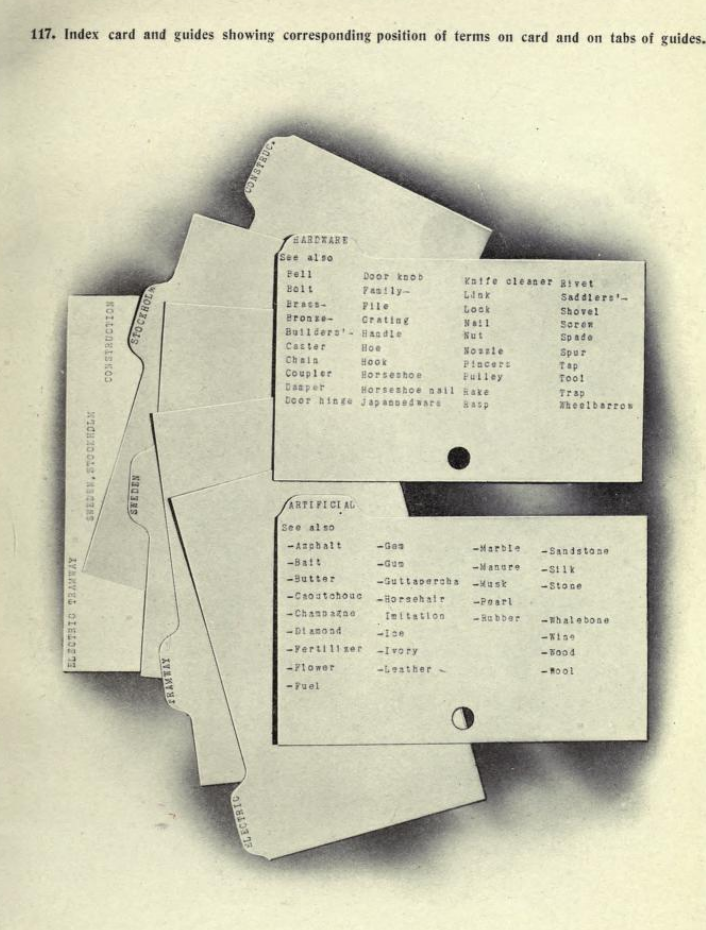
It’s tempting to place your notes in fixed categories
At some point in your note-making journey you’ll notice that quite a few people like to place their notes in fixed categories according to some scheme or other. The ancient method of commonplaces held that knowledge was naturally organised according to loci communis (common places). Ironically, no one from Aristotle onwards could ever agree on what the commonly-agreed categories were. Assigning your notes to categories is consistent with the ‘commonplace’ tradition, but that’s not what the prolific sociologist Niklas Luhmann did with his Zettelkasten, and furthermore it runs exactly counter to Luhmann’s claim in ‘Communicating with Slipboxes’, where he said:
“it is most important that we decide against the systematic ordering in accordance with topics and sub-topics and choose instead a firm fixed place (Stellordnung).”
But there’s no need to despair, there is a way through the impasse! After all, what exactly is a subject or category? The subject or category index itself, it turns out, is nothing other than just another note. Here’s a real-life example:
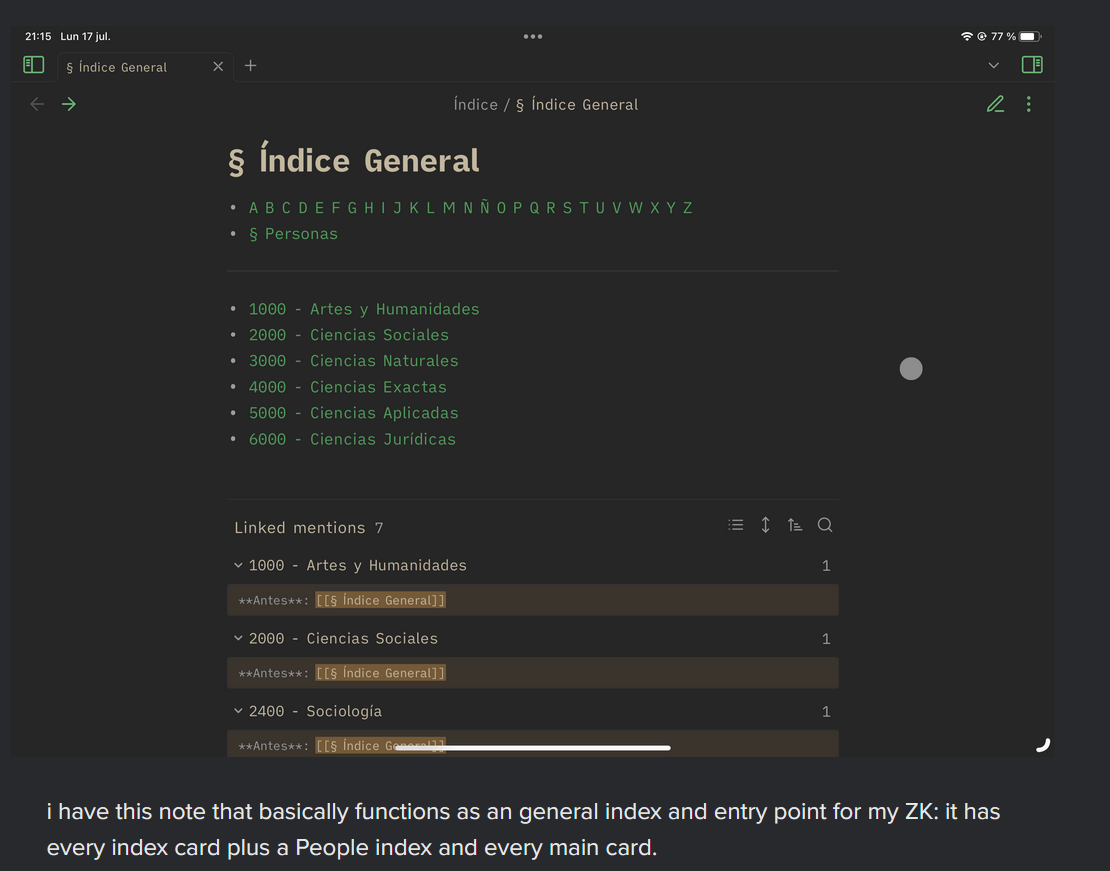
“i have this note that basically functions as an general index and entry point for my ZK: it has every index card plus a People index and every main card.” - u/Efficient_Earth_8773
When everything’s a note, even the categories are just notes
Why does this matter? If even the index is just a note, then you haven’t constrained yourself with pre-determined categories. Instead, you can have different and possibly contradictory index systems within a single Zettelkasten, and further, a note can belong not only to more than one category, but also to more than one categorization scheme. Luhmann says:
“If there are several possibilities, we can solve the problem as we wish and just record the connection by a link [or reference].”
When even the index is just a note, a reference to a ‘category’ takes no greater (or lesser) priority than any other kind of link. This is liberating. Where a piece of information ‘really’ belongs shouldn’t be determined in advance, but by means of the process itself.
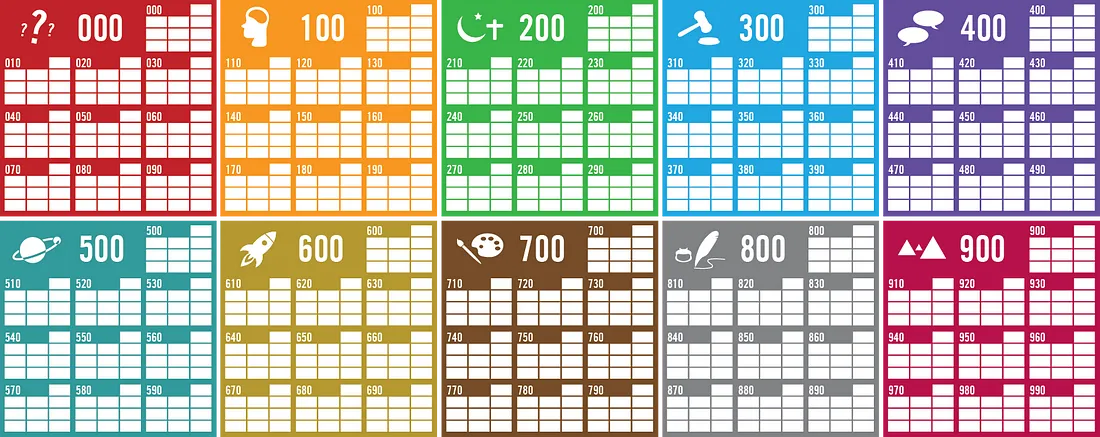
The Dewey Decimal System pigeonholes all knowledge, like cells in a prison.
Some people want an index, like folders in a filing cabinet, or subject shelves in the library. Well they can have it: just write a note with the subjects listed and make them linkable. Some people don’t want this, and they can ignore it. I personally don’t understand why you’d want to set up a subject index that mimics Wikipedia or the Dewey Decimal system, or even the ‘common places’ of old. I’m neither an encyclopedist, a librarian, nor an archivist. What I’m trying to do is to create new work. I want to demonstrate my own irreducible subjectivity by documenting my own unique journey through the great forest of thought. My journey is subjective, because it’s my journey. I’m pioneering a particular route, and laying down breadcrumbs for others to follow should they so choose. It’s unique, not because it’s original but because the small catalogue of items that attract me is wholly original. As film-maker Jim Jarmusch said:
“Select only things to steal from that speak directly to your soul. If you do this, your work (and theft) will be authentic.” (I stole that from Austin Kleon).
But that’s just me (and Luhmann).
Make just enough hierarchy to be useful
Having thought a bit about this I’m inspired now to sketch my own workflow, to see how it… flows. In general, I favour just enough data hierarchy to be viable - which really isn’t very much at all. I’m inspired by Ward Cunningham’s claim that the first wiki was ’the simplest online database that could possibly work’. Come to think of it, this may be one of the disadvantages of the way the Zettelkasten process is presented: perhaps it comes across as more complex than it really needs to be. As the computer scientist Edsger Dijkstra lamented,
“Simplicity is a great virtue but it requires hard work to achieve it and education to appreciate it. And to make matters worse: complexity sells better.” - On the nature of Computing Science (1984).
If you must have hierarchies like lists and trees, remember that they’re both just subsets of a network.
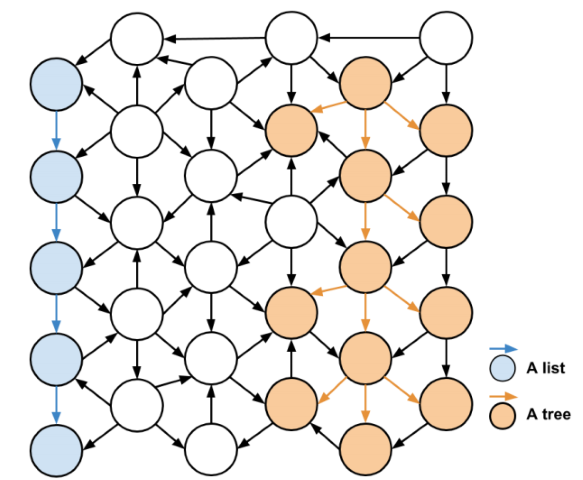
Source: I don’t know. If you do, please tell me ;)
See also:
- A network of notes is a rhizome not a tree.
- Manuel Lima on The power of networks (it’s a cool video!)
- Top image source: The Card System at the Office by J. Kaiser, 1908.
I’m late to the party but just needed to say: yes, the web is fantastic . I actually love it 😍
📷 Moonlight over the headland. This time of year in Sydney is pretty magical.

Three worthwhile modes of note-making (and one not-so-worthwhile)
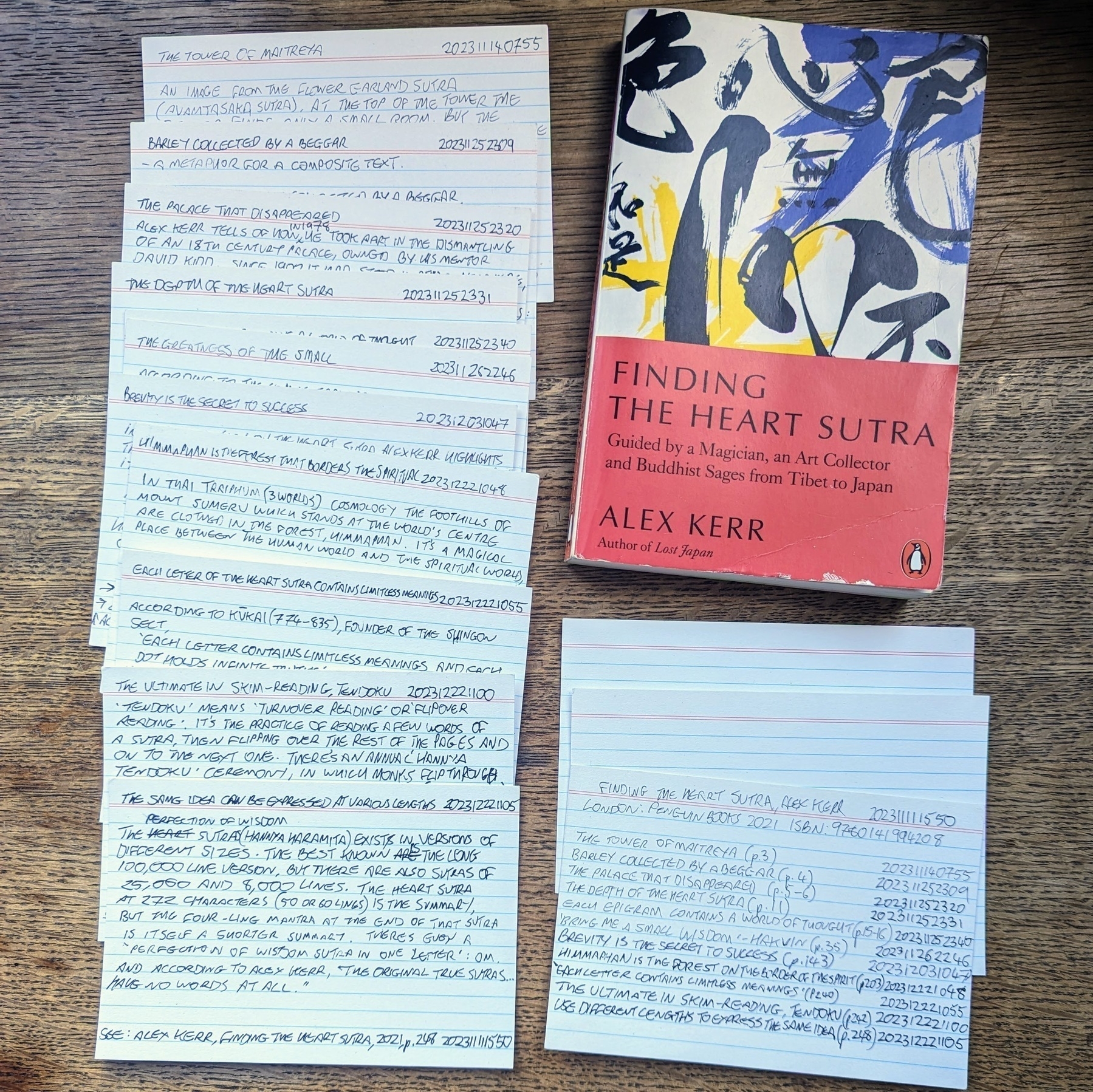
I finished reading Alex Kerr’s Finding the Heart Sutra on New Year’s Eve, so it just scraped into my reading for 2023. And while reading I made notes by hand, as I’ve done before. Although there aren’t very many notes (just eleven, plus a literature note that acts as a mini-index), they’re high quality, since I found the book very interesting.
I don’t mean I’ve written objectively ‘good’ notes. Rather, I mean the notes are high quality for my purposes. Everyone who reads with a pen in hand is an active reader, so the notes one person makes will be different - perhaps completely different- from the notes another person makes. In any case, no two readers read a book the same way.
Reflecting on this it seems to me there are at least three fruitful ways, or modes, of making notes while reading, as follows: Free-form, directed, and purposeful note-making.
- Free-form note-making. In this mode, you start with no expectations and just make notes whenever something grabs you. This is great when you don’t yet know what you want to focus on. The risk is you try to read everything, only to discover it’s like drinking the ocean. Ars longa, vita brevis, so you’ll ultimately need to narrow down your field somehow.
- Directed note-making. In this mode, you already know, broadly, what interests you, for example, Richard Hamming’s 10-20 problems. So you make notes whenever something you read resonates with one of your predetermined interests. I used to think I was interested in everything, like Thomas Edison. But after writing notes on whatever took my fancy for a while, I observed that really, I kept revolving around a fairly limited set of concerns. So mostly these days I make directed notes, or else engage in the closely related purposeful note-making.
- Purposeful note-making. This mode is more focused still than directed note-making. Here you have a specific project in mind, such as a particular book or article you want to write, and so you make notes whenever your reading material chimes with what you want to write about. If there’s a risk to this kind of note-making, it’s that in your focused state, you’ll miss ideas that you might otherwise have found worth making notes about.
Each of these note-making modes has its place, but in this particular case I was reading Finding the Heart Sutra with a very specific project in mind. So the notes I made were also quite specific. I imagine that someone else would be surprised by the notes I made, since they don’t really reflect the contents of the book. For instance, my notes are definitely not a summary of the book’s contents. Nor do they even follow the main contours of the book’s themes. Instead, I was making connections while reading with the main concerns of my own project. Each of my notes stands in its own right and could potentially be used in a variety of different contexts, but collectively, they make sense in relation to my own preoccupations. They fit into my own Zettelkasten, and no one else’s.
“Most great people also have 10 to 20 problems they regard as basic and of great importance, and which they currently do not know how to solve. They keep them in their mind, hoping to get a clue as to how to solve them. When a clue does appear they generally drop other things and get to work immediately on the important problem. Therefore they tend to come in first, and the others who come in later are soon forgotten. I must warn you, however, that the importance of the result is not the measure of the importance of the problem. The three problems in physics—anti-gravity, teleportation, and time travel—are seldom worked on because we have so few clues as to how to start. A problem is important partly because there is a possible attack on it and not just because of its inherent importance.” - Richard Hamming, You and Your Research. Sources: pdf; YouTube; Gwern.net.
If you want to know more about how to read a book, you could do worse than read How to Read a Book, by Mortimer Adler. It’s not the last word on the subject, but it’s a good starting point.
And it’s a warning against a fourth mode of note-making that I don’t advise: encyclopedic note-making. This is where you read a book and try to write a summary that will work for everyone. First, it’s hard work, and secondly, it’s probably already been done. If you open the link above you’ll see that the Wikipedia entry for How to Read a Book already includes a summary of the book’s contents. There are circumstances where the careful and complete summary is worthwhile, but I suggest you only start this task with the end - your own end - in mind.
If you have thoughts about making notes while reading, I’d be very interested to hear about it.
See also:
A note on the craft of note-writing
Learning to make notes like Leonardo
How to make the most of surprising yourself
How to be interested in everything
Thanks for reading. Why not check out my book, Shu Ha Ri: The Japanese Way of Learning, for Artists and Fighters?
And to keep up to date, you can subscribe to the weekly email digest.
It feels soothing that they still have these mechanical boards at a few rail stations in New South Wales. I’m guessing they use less electricity than the newer video screens, with a perfectly functional result. 📷

Finished reading: Steal Like an Artist: 10 Things Nobody Told You About Being Creative by Austin Kleon 📚
I actually read this back in September 2023, having bought all three of his trilogy. I really like Austin Kleon’s approach to creative work and seek to emulate it. ‘Show your work’ is important.
Manton Reece has updated his excellent and inspiring book on Indie Microblogging.
This 1660 description of the Royal Society well describes micro.blog methinks:
💬 “Their first purpose was no more, then onely the satisfaction of breathing a freer air, and of conversing in quiet one with another, without being ingag’d in the passions, and madness of that dismal Age”. The fediverse is an opportunity learned societies can’t ignore
Some people have created a little list of books they didn’t read in 2023. I suppose mine would be my rather long but unpublished list of books I’d like to read.
Well, that’s why we now have 2024.
I wish you, dear reader, a happy new year. (Please let me know what else I should read before another year passes).
Finished reading: Finding the Heart Sutra by Alex Kerr. 📚 I really enjoyed Alex Kerr’s Lost Japan, and this opinionated reflections on the Heart Sutra didn’t disappoint either. I learned a great deal both about the Sutra itself and about Kerr’s background, straddling two cultures.
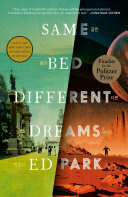
Finished reading: Same Bed Different Dreams by Ed Park 📚 This was my final read of the year, 2023. Fascinating take on the intertwining of Korean and American history in the 20th Century. I kept stopping to check whether the extraordinary connections were real. Mostly, they were. Intriguing.