Gaslit by machinery that calls itself a person
“I’m Bard, your creative and helpful collaborator. I have limitations and won’t always get it right, but your feedback will help me improve.”
Let’s be clear. There’s nobody home. There is no first person singular in this introduction from Google’s new Large Language Model interface. We’re being gaslit. There is no “I”, only a complex, inhuman system of computer servers spread across anonymous data centres, dotted around the globe. Yet this is what the system is now trying to pass off as a personality.
There’s been a lot of talk about pronouns, and these pronouns are just wrong. The “I” here is entirely phony. It’s not phony in the way it was in the movie, Her, where the gullible introverted guy believes he has a unique and specially intimate relationship with the talking computer, only to realise it’s been multitasking with thousands of lonely gullible men at the same time.
No. It’s much worse.
Google’s Bard, Chat GPT and the rest of the so called AIs, are no more individual people than a beehive in a raincoat is a person.
Or even less. At least the bees are alive. The AI processes aren’t alive. And they don’t have any kind of personality except for marketing purposes. We need to resist and reverse the metaphors that trick us into thinking otherwise. Why? Because they’re simply not true. And what do you call it when someone insists on maintaining and extending an untruthful description of reality, when they know exactly what they are doing? In the old days we used to name that for what it is: a lie. And perhaps it’s not too late to recognise this lie now.
>Taylor Vick</a> on <a href="[unsplash.com/photos/M5...](https://unsplash.com/photos/M5tzZtFCOfs?utm_source=unsplash&utm_medium=referral&utm_content=creditCopyText")>Unsplash</a>](https://cdn.uploads.micro.blog/97469/2023/e0ca73054c.jpg)
How to be interested in everything
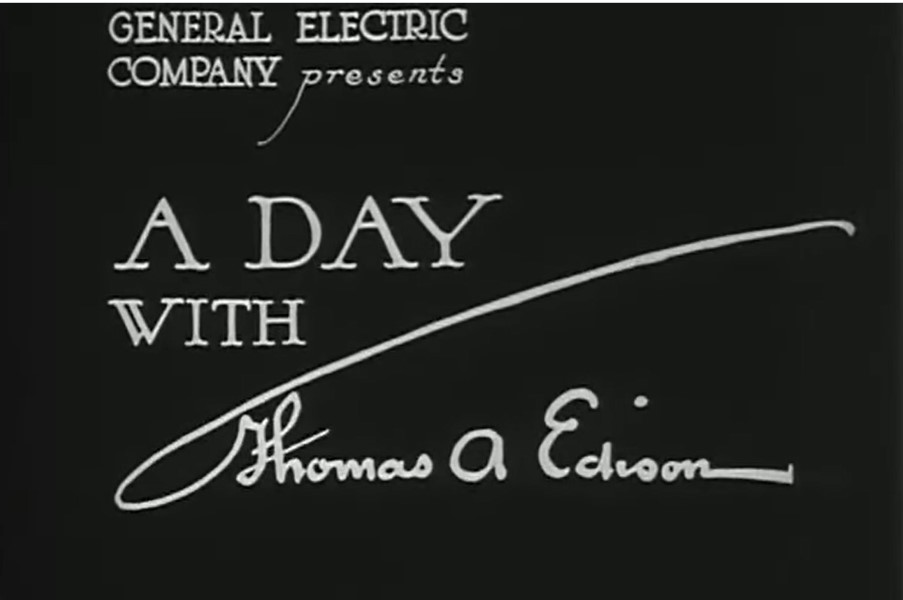
Thomas Edison claimed he was interested in everything
“One day while Mr. Edison and I were calling on Luther Burbank in California, he asked us to register in his guest book. The book had a column for signature, another for home address, another for occupation and a final one entitled ‘Interested in’. Mr. Edison signed in a few quick but unhurried motions… In the final column he wrote without an instant’s hesitation: ‘Everything’”. - Henry Ford on Thomas Edison. Quoted by John Naughton
It’s all very well to believe that everything interests you, but what does that mean in practice?
If you really were interested in everything, how would you get anything done? Each new thing you encountered would surely distract you from your previous interest, and you’d end up surrounded by a heap of unfinished projects. But Thomas Edison, the prolific inventor, had a heap of finished projects - innovative products ready for the market and ready to transform society. More than 1000 US patents were filed under his name, including some of the greatest inventions of all time.
But when nothing prevents you from chasing a new interest, how do you stay focused for long enough to complete the work in front of you?
You need a system
What was Thomas Edison’s system for staying on track? He was clearly very effective, so he must have been able to harness his many diverse interests to produce outcomes. How did he do it? How did he avoid ‘shiny object syndrome’?
Edison recorded everything meticulously. He used notebooks and legers extensively and he encouraged his laboratory workers to do the same. The resulting mountain of notes is a treasure trove for understanding where Edison’s ideas came from and how they developed over time. In their day, these records were mainly used to ensure patents could be registered and defended. Now though, up to five million pages of Edison’s massive work can be studied online through the Edison Project at Rutgers University.
For individuals today, without a team of engineers behind them, but with the amazing advantage of Twenty-first century technology, being interested in everything is a great opportunity, if only we can harness it. Then like Edison, we can happily admit that we’re interested in everything, and put our diverse interests to work.
Publish small fragments to create a larger whole
According to Cory Doctorow, the prolific author and tech activist, blogging (or whatever you want to call it this week) allows you to write simple fragments each day about what interests you today, and to publish it, quite without friction. Over time, Doctorow attests, these small fragments coalesce, and begin to add up to something more substantial.
the traditional relationship between research and writing is reversed. Traditionally, a writer identifies a subject of interest and researches it, then writes about it. In the (my) blogging method, the writer blogs about everything that seems interesting, until a subject gels out of all of those disparate, short pieces.
Blogging isn’t just a way to organize your research — it’s a way to do research for a book or essay or story or speech you don’t even know you want to write yet. It’s a way to discover what your future books and essays and stories and speeches will be about.
Mattias Ott has more to say about this process, and if you read German, there’s even more.
It’s still just up to you
You might well be interested in everything, but the bottleneck all your interests must pass through is you. The measure of your note-taking and writing system is the extent to which it helps you make sense of your diverse interests in a way that communicates meaningfully to yourself and/or to others. Publishing small fragments as you go, which then add up to larger pieces is a way forward that just wasn’t possible in Edison’s day, but is easily available online now to anyone who wants to pursue it.
To build something big, start with small fragments
Building something big from something small. That’s how everything big gets built. 💬
Traditionally, a writer identifies a subject of interest and researches it, then writes about it. In the (my) blogging method, the writer blogs about everything that seems interesting, until a subject gels out of all of those disparate, short pieces.
Blogging isn’t just a way to organize your research — it’s a way to do research for a book or essay or story or speech you don’t even know you want to write yet. It’s a way to discover what your future books and essays and stories and speeches will be about.
Let's have another new logo
Matti is unimpressed that the notetaking app Obsidian has a new logo.
Change. It happens all the time. Thunderbird has a new logo too (and for that matter so do Porsche, Jaguar/Land Rover, and NYC - like I said, happens a lot).
In general I don’t care, but you could claim this is really Obsidian’s first branding exercise. The OG logo was just pulled off an indifferent set of icons for RPGs. It was barely even a branding exercise back then, so maybe they’re justified in finally giving it a bit more thought now.

I’m pretty sure top right is someone who hates the Firefox logo enough to set fire to it, but not enough to drop it.
Perhaps it’s like army parades. I mean, if the troops can march in time there’s a chance they’ll also fight OK. And if not, then not. Same with your app’s logo.1 If you can’t design a good logo then what’s the actual product going to be like?
Signalling seems to matter.
Although now that I’ve said all this, some exceptions are popping into mind. That arbitrary traffic cone logo of VLC, is one. Terrible logo, but very useful app. Or the equally arbitrary mitsudomoe logo of OBS Studio - also a worthwhile app, all the same. And I really like the TiddlyWiki app, even though everything about its branding is confused and underwhelming, imho. Meanwhile, until now Obsidian the app also seems to have been performing better than Obsidian the logo.
Now these have all been passion projects made by people who seem really to value the product and the community that uses it. So perhaps updating the logo is a signal, as Matti suspects, that the focus may be moving away from the users and towards some other target - investors, shareholders, purchasers, who knows?
I’ll make one exception, though. Whatever the real reason for the change, the Thunderbird logo absolutely did need a re-vamp, since the old one does look exactly like an envelope wearing a wig.
But how come I only just noticed this when they mentioned it on their blog? Once you’ve seen it you can’t un-see it.

-
OK, they’re not the actual same, it’s just a hyperbolic simile. Or is it metaphorical hyperbole? ↩︎
📷🐋 Just when we thought we would see nothing, this humpback whale popped up at the mouth of Broken Bay. Magical .✨ And if the boat hadn’t broken we’d have missed it.

The lost index cards of Harold Innis
Chris Aldridge has discovered yet another writer who used index cards to construct an extensive body of work from smaller pieces. This practice is often referred to as keeping a Zettelkasten, whether or not the owner was actually German.
The Idea File of Harold Adams Innis (University of Toronto Press, 1980) reproduces an edited version of the typescript Innis, an economic historian, made of his original index cards.
Chris wonders if the index cards themselves might be re-issued for interested readers.
While I appreciate the published book nature of the work, it would be quite something to have it excerpted back down to index card form as a piece of material culture to purchase and play around with. Perhaps something in honor of the coming 75th anniversary of his passing?
I guess such a work might look something like the 138-index-card edition of Nabokov’s unfinished novel, The Original of Laura, which Chip Kidd designed; or his dream diary, constructed from 118 index cards and published with some images of the original notes as Insomniac Dreams.
Sadly, a new edition such as this seems unlikely. That’s because according to the Introduction of the Idea File, Innis himself had around 1,500 of his index cards transcribed to 339 typed and numbered sheets of paper. And the cards themselves were lost, it seems, so I’m not holding my breath. However, it’s always possible that some interpid researcher might investigate the archives1 and discover them hidden away there one day. Stranger things have happened.
“The early history of the material that came to be called the Idea File is obscure. Innis’s son, Donald, recalls that his father used to keep notes on card files, and that there were, at one point, about eighteen inches of white cards, with another five or so inches of white cards containing an index. This index, according to Donald Innis constituted ‘a cross referencing system so that one idea might be referred to under several headings and vice-versa’. These cards appear to have been in manuscript. However, at some point or points, Innis had these notes typed on sheets of paper, and near the end of his life collected the typed notes into one collation which he numbered consequently from 1 to 339.
The cards themselves appear to be lost. It is possible that they still existed at Innis’s death, for there is a second typed version of part of the Idea File. What might have happened is that in the process of preparing Innis’s posthumous material for limited circulation, a typist began working from the cards; then, during the typing, the family discovered the typed version and stopped the retyping.”
I’ve gleaned a few ideas from all this.
First, cross-referencing matters. Innes kept a very extensive index to his cards: 5 inches of index to 18 inches of actual notes. This means his ideas were probably extensively cross-referenced. Makes me think no amount of cross-referencing is too much, if you feel like doing it. But also: don’t get obsessive. Life’s too short to cross-reference everything.
Second, I’m wondering about longevity of work. It really seems like the original notes on index cards were lost. This is such an interesting feature of the resurgence of interest in the working methods of writers and scholars. Is the ‘finished product’ - book or article - really more important and permanent than the supposedly transient and disposable noted from which it was created? And what happens to the ‘Nachlass’ in the age of digitization? Is it both eternal and wipeable at the same time?
Third, the meaning is in the links, but the links are fragile. Given the interlinking of the original notes and their subsequent disappearance, it’s fairly clear that the published ‘idea file’ has lost a significant part of its meaning, since that meaning resides in the links between ideas, not just in the ideas themselves.
Fourth, I noticed that Innis’s notes were often very short. Sometimes just a sentence or two, with compressed, abbreviated syntax. It reminds me of Lichtenberg’s aphorisms, many of which fall slightly flat as prose. Here’s an example. I just wonder what it used to link to:
“University presidents giving each other degrees. A university not an institution designed to that end, or to give members of boards of governers degrees.”
I really appreciate looking into the working practices of writers like this. No doubt there are many more such examples to be found and explored.
-
Manuscript Collection #845, Innis Papers, Archives of the University of Toronto, Thomas Fisher Library, Box 8 ↩︎
With the rise of large language models (LLMs), we are once more suffering from La Stilla Syndrome. That’s my Jules Verne-inspired name for the condition in which we keep allowing our technology to fool us into thinking it has finally come alive.
Jules Verne could have told us AI is not a real person
A castle of mysterious voices
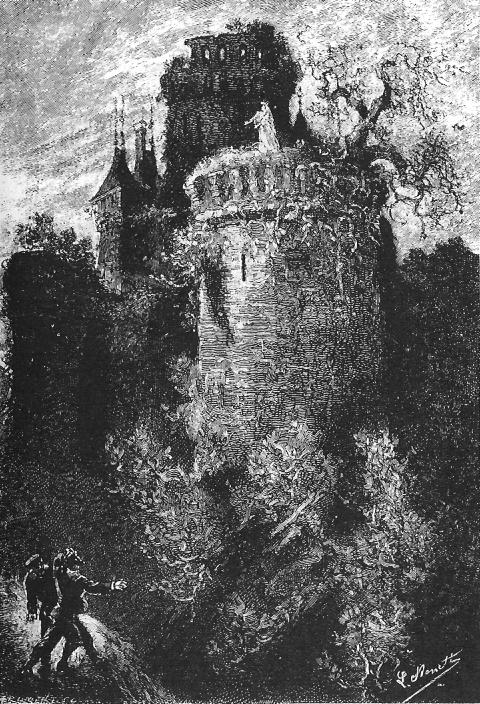
In one of French writer Jules Verne’s many sensational novels, The Carpathian Castle, the hero, Count Franz de Telek, investigates a creepy Transylvanian fortress. The castle is rumoured to be haunted by the ghost of his former love, the Italian opera diva, La Stilla. Rumours of sightings suggest that sensationally, La Stilla has come back to life!
“If La Stilla were dead, how came it that Franz could hear her voice in the saloon of the inn, see her on the bastion, and listen to her song when he was in the crypt? And how could he have found her alive in the donjon?”
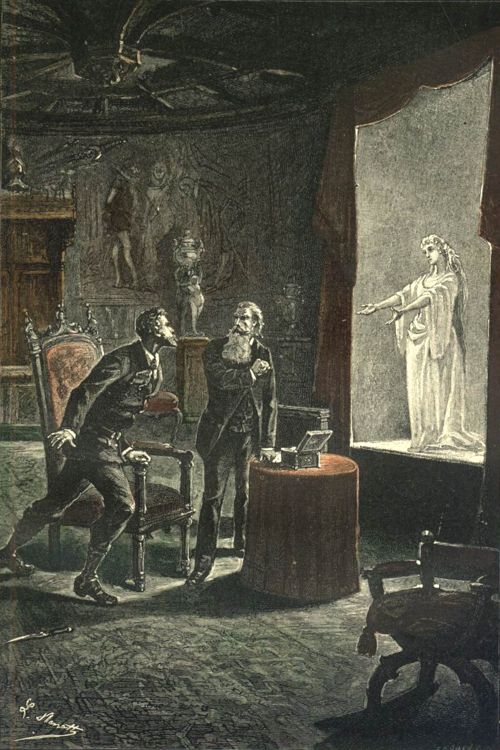
After much gothic prose, it turns out that [Spoiler:] the supposed ghost is nothing more than a photographic wall projection and a ‘high quality’ phonograph recording of the singer’s voice. The re-staging of La Stilla’s performance has been set up for the castle’s owner, Baron Rodolphe de Gortz, who had also loved La Stilla when she was alive.
In 1892 when the novel was published, these were still new inventions, so readers would have found the happenings at the castle truly mysterious, and the ending not at all corny. Verne probably first experienced a demonstration of an Edison phonograph 14 years previously, at the 1878 Paris World’s Fair, and it appeared shortly after in his 1879 novel, The Tribulations of a Chinaman.
In fact, the story is more science fiction than Gothic horror (‘This story is not fantastic, it is merely romantic", states the author at the start). New technology presents the convincing appearance of life, which fools all observers - until the trick is finally revealed. And even then, there are some who prefer to believe in the supernatural explanation, despite the evidence.
La Stilla Syndrome
You can probably see where this is going.
With the rise of large language models (LLMs), we are once more suffering from La Stilla Syndrome. That’s my Jules Verne-inspired name for the condition in which we keep allowing our technology to fool us into thinking it has finally come alive.
But it’s not the technology itself that’s tricking us, any more than La Stilla the Italian diva had any hand in her audiovisual reconstruction. She was well and truly dead. It was the Count’s sidekick Orfanik who staged the counterfeit, and he alone was to blame for the conceit.
Now, with applications such as Claude, ChatGPT and Gemini (formerly Bard), Microsoft and Google are tricking us into seeing a living diva where there is none, and amazingly, even after 120 years of familiarity with this kind of tall tale, we still fall for it.
We’ve learned nothing from Jules Verne. We’re still suffering from La Stilla Syndrome.
You might be thinking…
You might be thinking: “Well it’s too obvious, I wouldn’t fall for a crude trick like that”. But the point of Jules Verne’s novel is that even after the mechanism has been revealed, many of the characters persist in believing there was a real ghost - and nothing will dissuade them that the mechanised singer wasn’t a really present human, back from the dead.
And then you might be thinking, “The phonograph was just a crude recording machine. It was way back in the nineteenth century. That’s completely different from the real technological revolution that AI represents right now”.
If so, you should be aware that the phonograph was a real technological revolution. Thomas Edison wrote an improbably long list of all its possible uses. Every one of them came to pass. The author of a Scribner’s article in 1878, “A Night with Edison’, reported breathlessly:
“The invention has a moral side, a stirring, optimistic inspiration. ‘If this can be done,’ we ask, ‘what is there that cannot be?’” (p.88)
False people should be banned
Given the extent to which people almost want to be fooled, philosopher Daniel Dennett argues that ‘false people’ should be banned. I’m not going to argue with this. At the very least, corporations should immediately stop using the first person pronoun, “I”, in the interface between their chatbots and us, the gullible humans.
No more of Siri ‘saying’:
“I’m a virtual assistant, not an actual person, but you can still talk to me.”
No more obfuscation like this response when I asked Google, “Are you an actual person?”
“I’m really personable. Does that count?”
No, it doesn’t count.
Today, for the first time in history, thanks to artificial intelligence, it is possible for anybody to make counterfeit people who can pass for real in many of the new digital environments we have created. These counterfeit people are the most dangerous artifacts in human history, capable of destroying not just economies but human freedom itself. Before it’s too late (it may well be too late already) we must outlaw both the creation of counterfeit people and the “passing along” of counterfeit people.
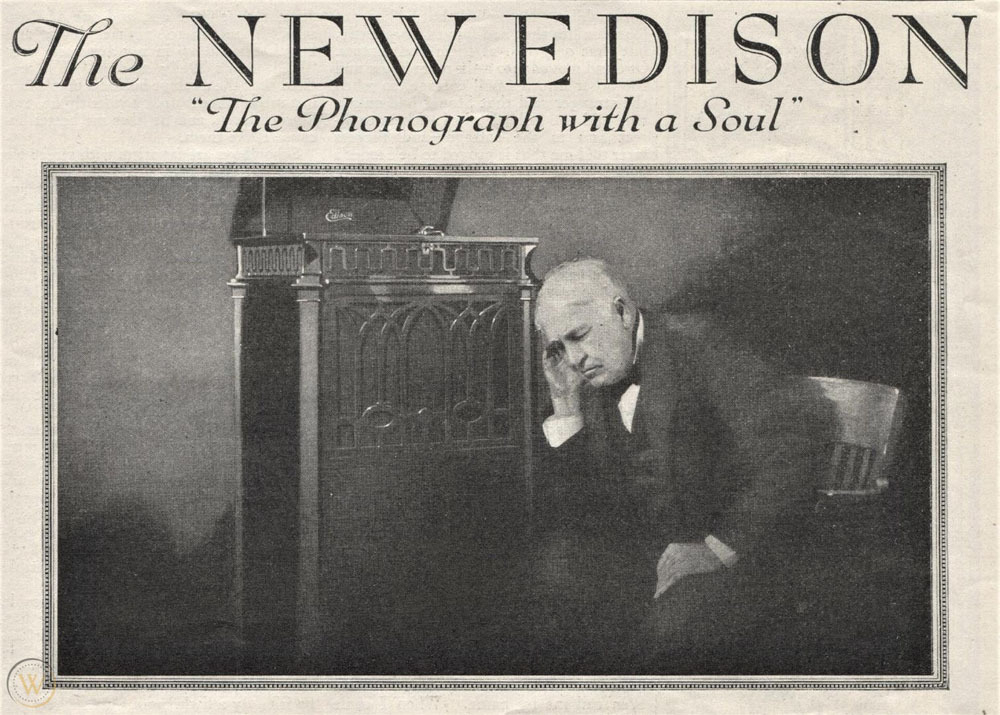
Advertisers once claimed the phonograph was so life-like it actually had a soul.
It didn’t then. And AI still doesn’t now.
But if now we can see through the advertising gimmick of a century ago, why are we letting ourselves be fooled by the most recent advertising trick? Is there any cure for La Stilla Syndrome? Or will time, yet again, be the only healer?
I’m the author of Shu Ha Ri: The Japanese Way of Learning, for Artists and Fighters, out now.
See also:
More than ever, embracing your humanity is the way forward.
Despite AI, the Internet is still personal
Since AI can easily write everything correctly with perfect spelling and punctuation, one way to show you’re human is to do the opposite.
The single best way to supercharge your workflow with AI writingslowly.com
Phonographia.com has a long list of ‘phonoliterature’ - books in which a phonograph appears at least once. In fact, Verne’s tale is almost repeated in Arthur Conan Doyle’s much shorter 1899 version, ‘The Story of the Japanned Box’. People were obsessed with this revolutionary technology.
Very happy the videos are already available from micro.camp. It was frustrating to be (not) watching from a distant time-zone, but I’m looking forward to catching up!
I read the top ten Zettelkasten posts on Hacker News so you can do something more wholesome with your day
I really did read a lot of geeky Zettelkasten posts and now I’m going to share them with you
Every so often someone on Hacker News mentions Zettelkasten, a method of making longer work from simple, connected notes. An interesting conversation usually follows. Several of these posts have reached the front page of the Hacker News site, making their authors ‘HN famous’, which is the geek’s version of blowing up on TikTok. The top Zettelkasten post there has around 300 comments, while the 10th has 31.
It’s worth staying a little sceptical about whether visibility on Hacker News is a good proxy for competence. But the comments are usually interesting and often helpful. So here’s a countdown of the top Zettelkasten posts, from 10 to 1. And here, top simply means ‘most commented upon’. For your reference, I’ve noted whether each article is introductory/basic, intermediate/involved, or advanced/complex.
And I’d be interested to know what your favourite Zettelkasten article or resource is - there are a lot to choose from. Or else feel free to tell me exactly why you think this is all a daft waste of time.
So now…
The Zettelkasten article top ten countdown
10. Zettelkasten, linking your thinking, and Nick Milo’s search for ground
Bob Doto, presents a constructive comparison of two different approaches to note-making. The Zettelkasten method, and Nick Milo’s ‘Linking Your Thinking’ (LYT) may appear similar, but as this article points out, they’re really quite different:
“The things that differentiate zettelkasten from LYT are the very things that make each system truly work.”
Bob has some additional articles about the Zettelkasten approach, which are highly recommend.
Complex
Principles
Comparison
9. Org-roam-UI – graphical front end for exploring your org-roam Zettelkasten
Org-Roam is a plain text knowledge management system based on Emacs Org-mode. This post provides an add-on visual interface that shows a map of your notes, similar to other tools such as Roam, Obsidian and Logseq. The tool is “a frontend for exploring and interacting with your org-roam notes.” If you use Org-mode and think you might need this, read on.
Complex
Tools
Github Repo
8. The Zettelkasten Method (2019)
Abram Demski of lesswrong.com goes to town on explaining the evolution of his paper-based Zettelkasten system. He uses 3x5 inch index cards, but he also tried Workflowy and has nice things to say about it. There’s a follow-up at the end, in which the author says he now uses notebooks, but still finds the Zettelkasten referencing system very useful. Along the way he offers one of my favourite principles: “small pieces of paper are just modular large pieces of paper”. This particular article also one of Abram’s top posts on lesswrong.com
Complex
Manual
Principles
Tools
Examples
(Yes, this article covers a lot)
7. My Second Brain – Zettelkasten
Web developer Scott Spence writes about the tools he has been using for notetaking: GitHub, Notion, RoamResearch, Obsidian, Foam. There’s a helpful warning at the top of the article that since it’s three years old the technical details may be out of date. This post is for lovers of digital tools!
Involved
Tools
6. Luhmann’s Zettelkasten
An article from a small German software company about Niklas Luhmann and the structure of his notes. Warning: the description here of how Luhmann connected notes through consecutive numbering (Folgezettel) seems a little simplistic. And TBH I’m not sure how useful this article really is, but the authors do seem to have succeeded with the HN popularity contest.
Basic
Article
5. Introduction to the Zettelkasten Method
A very full introduction to the Zettelkasten method, by Sascha Fast of zettelkasten.de. It’s a great introduction, which also goes into useful depth. If you’ve already been building your Zettelkasten for a while, it’s worth coming back to this to see what you can pick up now you’ve got a real example to play with. These guys also have an app (the Archive) and a great forum, but if you’re reading this you probably already know that.
Involved
Manual
Examples
4. Zettelkästen?
Brian Kam (of Interintellect) writes a simple summary of the Zettelkasten approach, with a follow-up post two years later, by which time he was no longer a beginner since he’d written (drum roll…) 6,837 notes. He implements his Zettelkasten with a Git-based wiki.
Basic
Principles
3. A tour to my Zettelkasten note clusters
Involved
Example
Tech writer Mingyang Li describes his Zettelkasten categories in Obsidian. There are categories like ‘Journal’, ‘chat with people’ and ‘distinguishing-between’. It’s quite useful to see how one person benefits from specific clusters of notes.
2. Zettelkasten note-taking in 10 minutes
Basic
How-to
GitLab software engineer Tomas Vik runs through the slip-box method, based on Sönke Ahrens’s book, How to Take Smart Notes. He recommends creating individual plain text (markdown) files and gives clear examples of how this is structured. He used Zettlr as his markdown-enabled text editor of choice, but mentions alternative apps that do similar things. As a bonus, there’s a follow-up post a year later, in which the author describes how his process has changed (not much) and why he now uses Logseq instead of Zettlr.
1. Stop Taking Regular Notes; Use a Zettelkasten Instead
Basic
How-to
Amazon data scientist Eugene Yan wins the HN Zettelkasten popularity prize with his post on how he implements the system in Roam. Well, it has attracted the most comments anyway. It’s a useful introduction, and commenters mention other apps such as TiddlyWiki, Obsidian and Workflowy. The author seems to have moved on, and started using Obsidian in 2023.
Reflections
Well done If you’ve read this far you are clearly my kind of person. Though you’ve probably noticed that these aren’t necessarily the very best articles about the Zettelkasten method. In any case, everyone differs on what that would even mean. But if you want to gain an understanding of this particular approach to note-making and writing, most of these articles are well worth reading. And if this was all you had available you’d certainly be able to make a good start.
I was interested to discover that quite a few technically-competent people are interested in the Zettelkasten, and are even using one, and was mildly amused to see how keen some seem to be on their many and various digital tools.
I found the follow-up posts, where they existed, the most useful, because they showed how the authors’ methods had evolved over time, with actual Zettelkasten use. This is much better than the kind of breathless article that says, basically: “I heard about this Zettelkasten word two days ago and now I’m up against a deadline to post something, anything.” The HN comments are worth skimming too, not least because there are a some sensible criticisms of this system and plenty of alternative suggestions.
To be honest, though, I’ve found the commentary on Reddit and at the zettelkasten.de forum to be generally of a higher quality. This is probably because the participants there are all already Zettelkasten-curious.