article
-
OK, they’re not the actual same, it’s just a hyperbolic simile. Or is it metaphorical hyperbole? ↩︎
-
Manuscript Collection #845, Innis Papers, Archives of the University of Toronto, Thomas Fisher Library, Box 8 ↩︎
Let's have another new logo
Matti is unimpressed that the notetaking app Obsidian has a new logo.
Change. It happens all the time. Thunderbird has a new logo too (and for that matter so do Porsche, Jaguar/Land Rover, and NYC - like I said, happens a lot).
In general I don’t care, but you could claim this is really Obsidian’s first branding exercise. The OG logo was just pulled off an indifferent set of icons for RPGs. It was barely even a branding exercise back then, so maybe they’re justified in finally giving it a bit more thought now.

I’m pretty sure top right is someone who hates the Firefox logo enough to set fire to it, but not enough to drop it.
Perhaps it’s like army parades. I mean, if the troops can march in time there’s a chance they’ll also fight OK. And if not, then not. Same with your app’s logo.1 If you can’t design a good logo then what’s the actual product going to be like?
Signalling seems to matter.
Although now that I’ve said all this, some exceptions are popping into mind. That arbitrary traffic cone logo of VLC, is one. Terrible logo, but very useful app. Or the equally arbitrary mitsudomoe logo of OBS Studio - also a worthwhile app, all the same. And I really like the TiddlyWiki app, even though everything about its branding is confused and underwhelming, imho. Meanwhile, until now Obsidian the app also seems to have been performing better than Obsidian the logo.
Now these have all been passion projects made by people who seem really to value the product and the community that uses it. So perhaps updating the logo is a signal, as Matti suspects, that the focus may be moving away from the users and towards some other target - investors, shareholders, purchasers, who knows?
I’ll make one exception, though. Whatever the real reason for the change, the Thunderbird logo absolutely did need a re-vamp, since the old one does look exactly like an envelope wearing a wig.
But how come I only just noticed this when they mentioned it on their blog? Once you’ve seen it you can’t un-see it.

The lost index cards of Harold Innis
Chris Aldridge has discovered yet another writer who used index cards to construct an extensive body of work from smaller pieces. This practice is often referred to as keeping a Zettelkasten, whether or not the owner was actually German.
The Idea File of Harold Adams Innis (University of Toronto Press, 1980) reproduces an edited version of the typescript Innis, an economic historian, made of his original index cards.
Chris wonders if the index cards themselves might be re-issued for interested readers.
While I appreciate the published book nature of the work, it would be quite something to have it excerpted back down to index card form as a piece of material culture to purchase and play around with. Perhaps something in honor of the coming 75th anniversary of his passing?
I guess such a work might look something like the 138-index-card edition of Nabokov’s unfinished novel, The Original of Laura, which Chip Kidd designed; or his dream diary, constructed from 118 index cards and published with some images of the original notes as Insomniac Dreams.
Sadly, a new edition such as this seems unlikely. That’s because according to the Introduction of the Idea File, Innis himself had around 1,500 of his index cards transcribed to 339 typed and numbered sheets of paper. And the cards themselves were lost, it seems, so I’m not holding my breath. However, it’s always possible that some interpid researcher might investigate the archives1 and discover them hidden away there one day. Stranger things have happened.
“The early history of the material that came to be called the Idea File is obscure. Innis’s son, Donald, recalls that his father used to keep notes on card files, and that there were, at one point, about eighteen inches of white cards, with another five or so inches of white cards containing an index. This index, according to Donald Innis constituted ‘a cross referencing system so that one idea might be referred to under several headings and vice-versa’. These cards appear to have been in manuscript. However, at some point or points, Innis had these notes typed on sheets of paper, and near the end of his life collected the typed notes into one collation which he numbered consequently from 1 to 339.
The cards themselves appear to be lost. It is possible that they still existed at Innis’s death, for there is a second typed version of part of the Idea File. What might have happened is that in the process of preparing Innis’s posthumous material for limited circulation, a typist began working from the cards; then, during the typing, the family discovered the typed version and stopped the retyping.”
I’ve gleaned a few ideas from all this.
First, cross-referencing matters. Innes kept a very extensive index to his cards: 5 inches of index to 18 inches of actual notes. This means his ideas were probably extensively cross-referenced. Makes me think no amount of cross-referencing is too much, if you feel like doing it. But also: don’t get obsessive. Life’s too short to cross-reference everything.
Second, I’m wondering about longevity of work. It really seems like the original notes on index cards were lost. This is such an interesting feature of the resurgence of interest in the working methods of writers and scholars. Is the ‘finished product’ - book or article - really more important and permanent than the supposedly transient and disposable noted from which it was created? And what happens to the ‘Nachlass’ in the age of digitization? Is it both eternal and wipeable at the same time?
Third, the meaning is in the links, but the links are fragile. Given the interlinking of the original notes and their subsequent disappearance, it’s fairly clear that the published ‘idea file’ has lost a significant part of its meaning, since that meaning resides in the links between ideas, not just in the ideas themselves.
Fourth, I noticed that Innis’s notes were often very short. Sometimes just a sentence or two, with compressed, abbreviated syntax. It reminds me of Lichtenberg’s aphorisms, many of which fall slightly flat as prose. Here’s an example. I just wonder what it used to link to:
“University presidents giving each other degrees. A university not an institution designed to that end, or to give members of boards of governers degrees.”
I really appreciate looking into the working practices of writers like this. No doubt there are many more such examples to be found and explored.
Jules Verne could have told us AI is not a real person
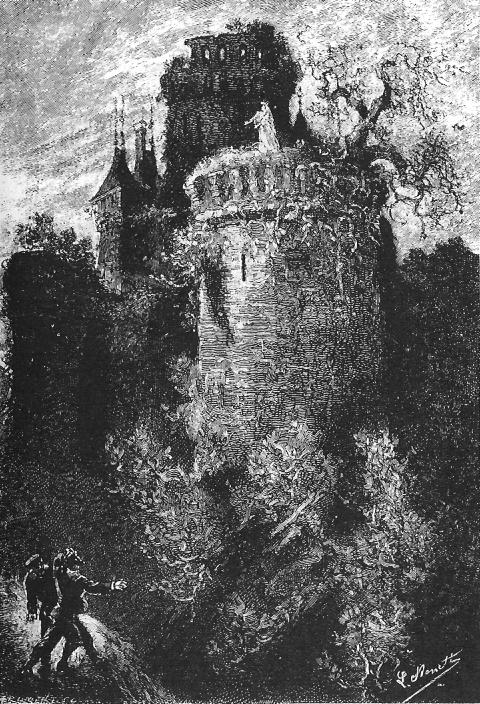
A castle of mysterious voices
In one of French writer Jules Verne’s many sensational novels, The Carpathian Castle, the hero, Count Franz de Telek, investigates a creepy Transylvanian fortress. The castle is rumoured to be haunted by the ghost of his former love, the Italian opera diva, La Stilla. Rumours of sightings suggest that sensationally, La Stilla has come back to life!
“If La Stilla were dead, how came it that Franz could hear her voice in the saloon of the inn, see her on the bastion, and listen to her song when he was in the crypt? And how could he have found her alive in the donjon?”
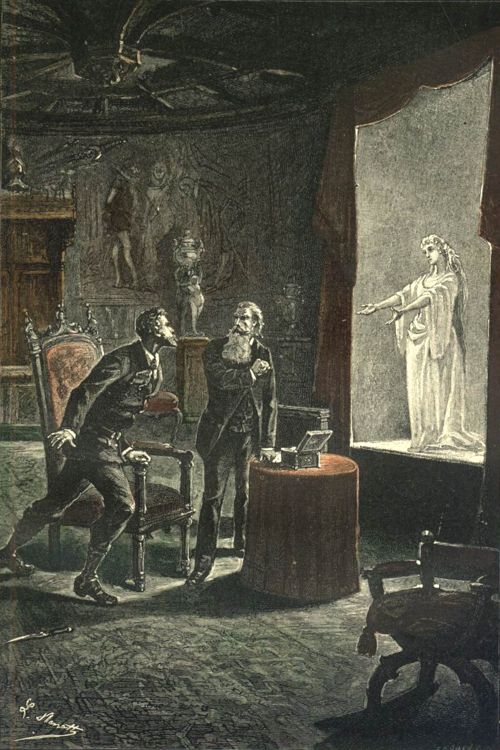
After much gothic prose, it turns out that [Spoiler:] the supposed ghost is nothing more than a photographic wall projection and a ‘high quality’ phonograph recording of the singer’s voice. The re-staging of La Stilla’s performance has been set up for the castle’s owner, Baron Rodolphe de Gortz, who had also loved La Stilla when she was alive.
In 1892 when the novel was published, these were still new inventions, so readers would have found the happenings at the castle truly mysterious, and the ending not at all corny. Verne probably first experienced a demonstration of an Edison phonograph 14 years previously, at the 1878 Paris World’s Fair, and it appeared shortly after in his 1879 novel, The Tribulations of a Chinaman.
In fact, the story is more science fiction than Gothic horror (‘This story is not fantastic, it is merely romantic", states the author at the start). New technology presents the convincing appearance of life, which fools all observers - until the trick is finally revealed. And even then, there are some who prefer to believe in the supernatural explanation, despite the evidence.
La Stilla Syndrome
You can probably see where this is going.
With the rise of large language models (LLMs), we are once more suffering from La Stilla Syndrome. That’s my Jules Verne-inspired name for the condition in which we keep allowing our technology to fool us into thinking it has finally come alive.
But it’s not the technology itself that’s tricking us, any more than La Stilla the Italian diva had any hand in her audiovisual reconstruction. She was well and truly dead. It was the Count’s sidekick Orfanik who staged the counterfeit, and he alone was to blame for the conceit.
Now, with applications such as Claude, ChatGPT and Gemini (formerly Bard), Microsoft and Google are tricking us into seeing a living diva where there is none, and amazingly, even after 120 years of familiarity with this kind of tall tale, we still fall for it.
We’ve learned nothing from Jules Verne. We’re still suffering from La Stilla Syndrome.
You might be thinking…
You might be thinking: “Well it’s too obvious, I wouldn’t fall for a crude trick like that”. But the point of Jules Verne’s novel is that even after the mechanism has been revealed, many of the characters persist in believing there was a real ghost - and nothing will dissuade them that the mechanised singer wasn’t a really present human, back from the dead.
And then you might be thinking, “The phonograph was just a crude recording machine. It was way back in the nineteenth century. That’s completely different from the real technological revolution that AI represents right now”.
If so, you should be aware that the phonograph was a real technological revolution. Thomas Edison wrote an improbably long list of all its possible uses. Every one of them came to pass. The author of a Scribner’s article in 1878, “A Night with Edison’, reported breathlessly:
“The invention has a moral side, a stirring, optimistic inspiration. ‘If this can be done,’ we ask, ‘what is there that cannot be?’” (p.88)
False people should be banned
Given the extent to which people almost want to be fooled, philosopher Daniel Dennett argues that ‘false people’ should be banned. I’m not going to argue with this. At the very least, corporations should immediately stop using the first person pronoun, “I”, in the interface between their chatbots and us, the gullible humans.
No more of Siri ‘saying’:
“I’m a virtual assistant, not an actual person, but you can still talk to me.”
No more obfuscation like this response when I asked Google, “Are you an actual person?”
“I’m really personable. Does that count?”
No, it doesn’t count.
Today, for the first time in history, thanks to artificial intelligence, it is possible for anybody to make counterfeit people who can pass for real in many of the new digital environments we have created. These counterfeit people are the most dangerous artifacts in human history, capable of destroying not just economies but human freedom itself. Before it’s too late (it may well be too late already) we must outlaw both the creation of counterfeit people and the “passing along” of counterfeit people.
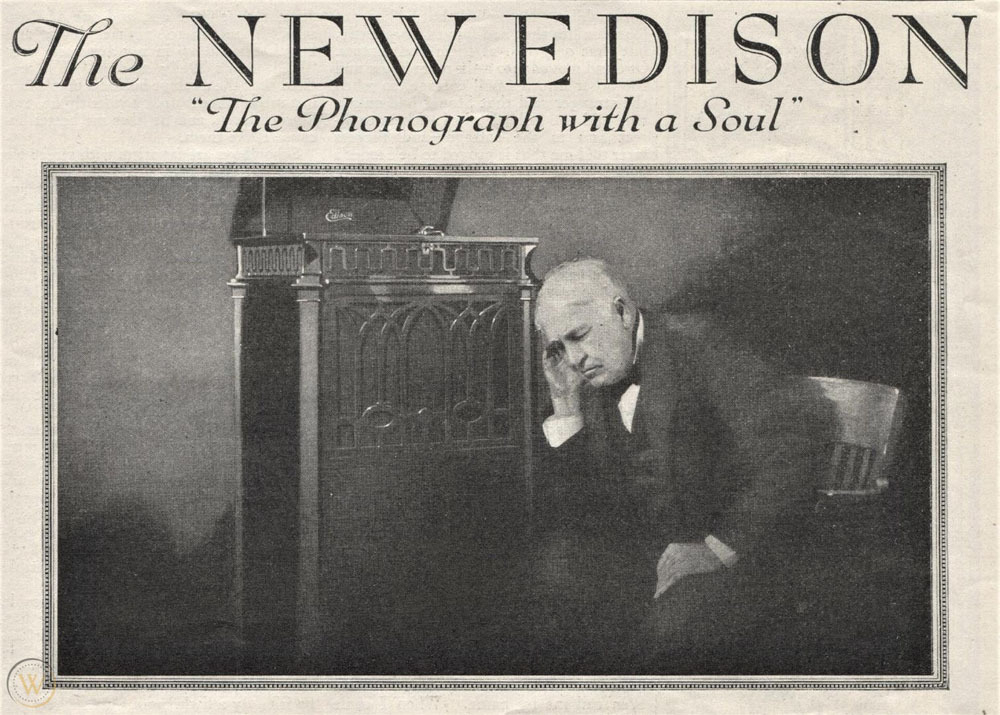
Advertisers once claimed the phonograph was so life-like it actually had a soul.
It didn’t then. And AI still doesn’t now.
But if now we can see through the advertising gimmick of a century ago, why are we letting ourselves be fooled by the most recent advertising trick? Is there any cure for La Stilla Syndrome? Or will time, yet again, be the only healer?
I’m the author of Shu Ha Ri: The Japanese Way of Learning, for Artists and Fighters, out now.
See also:
More than ever, embracing your humanity is the way forward.
Despite AI, the Internet is still personal
Since AI can easily write everything correctly with perfect spelling and punctuation, one way to show you’re human is to do the opposite.
The single best way to supercharge your workflow with AI writingslowly.com
Phonographia.com has a long list of ‘phonoliterature’ - books in which a phonograph appears at least once. In fact, Verne’s tale is almost repeated in Arthur Conan Doyle’s much shorter 1899 version, ‘The Story of the Japanned Box’. People were obsessed with this revolutionary technology.
I read the top ten Zettelkasten posts on Hacker News so you can do something more wholesome with your day
I really did read a lot of geeky Zettelkasten posts and now I’m going to share them with you
Every so often someone on Hacker News mentions Zettelkasten, a method of making longer work from simple, connected notes. An interesting conversation usually follows. Several of these posts have reached the front page of the Hacker News site, making their authors ‘HN famous’, which is the geek’s version of blowing up on TikTok. The top Zettelkasten post there has around 300 comments, while the 10th has 31.
It’s worth staying a little sceptical about whether visibility on Hacker News is a good proxy for competence. But the comments are usually interesting and often helpful. So here’s a countdown of the top Zettelkasten posts, from 10 to 1. And here, top simply means ‘most commented upon’. For your reference, I’ve noted whether each article is introductory/basic, intermediate/involved, or advanced/complex.
And I’d be interested to know what your favourite Zettelkasten article or resource is - there are a lot to choose from. Or else feel free to tell me exactly why you think this is all a daft waste of time.
So now…
The Zettelkasten article top ten countdown
10. Zettelkasten, linking your thinking, and Nick Milo’s search for ground
Bob Doto, presents a constructive comparison of two different approaches to note-making. The Zettelkasten method, and Nick Milo’s ‘Linking Your Thinking’ (LYT) may appear similar, but as this article points out, they’re really quite different:
“The things that differentiate zettelkasten from LYT are the very things that make each system truly work.”
Bob has some additional articles about the Zettelkasten approach, which are highly recommend.
Complex
Principles
Comparison
9. Org-roam-UI – graphical front end for exploring your org-roam Zettelkasten
Org-Roam is a plain text knowledge management system based on Emacs Org-mode. This post provides an add-on visual interface that shows a map of your notes, similar to other tools such as Roam, Obsidian and Logseq. The tool is “a frontend for exploring and interacting with your org-roam notes.” If you use Org-mode and think you might need this, read on.
Complex
Tools
Github Repo
8. The Zettelkasten Method (2019)
Abram Demski of lesswrong.com goes to town on explaining the evolution of his paper-based Zettelkasten system. He uses 3x5 inch index cards, but he also tried Workflowy and has nice things to say about it. There’s a follow-up at the end, in which the author says he now uses notebooks, but still finds the Zettelkasten referencing system very useful. Along the way he offers one of my favourite principles: “small pieces of paper are just modular large pieces of paper”. This particular article also one of Abram’s top posts on lesswrong.com
Complex
Manual
Principles
Tools
Examples
(Yes, this article covers a lot)
7. My Second Brain – Zettelkasten
Web developer Scott Spence writes about the tools he has been using for notetaking: GitHub, Notion, RoamResearch, Obsidian, Foam. There’s a helpful warning at the top of the article that since it’s three years old the technical details may be out of date. This post is for lovers of digital tools!
Involved
Tools
6. Luhmann’s Zettelkasten
An article from a small German software company about Niklas Luhmann and the structure of his notes. Warning: the description here of how Luhmann connected notes through consecutive numbering (Folgezettel) seems a little simplistic. And TBH I’m not sure how useful this article really is, but the authors do seem to have succeeded with the HN popularity contest.
Basic
Article
5. Introduction to the Zettelkasten Method
A very full introduction to the Zettelkasten method, by Sascha Fast of zettelkasten.de. It’s a great introduction, which also goes into useful depth. If you’ve already been building your Zettelkasten for a while, it’s worth coming back to this to see what you can pick up now you’ve got a real example to play with. These guys also have an app (the Archive) and a great forum, but if you’re reading this you probably already know that.
Involved
Manual
Examples
4. Zettelkästen?
Brian Kam (of Interintellect) writes a simple summary of the Zettelkasten approach, with a follow-up post two years later, by which time he was no longer a beginner since he’d written (drum roll…) 6,837 notes. He implements his Zettelkasten with a Git-based wiki.
Basic
Principles
3. A tour to my Zettelkasten note clusters
Involved
Example
Tech writer Mingyang Li describes his Zettelkasten categories in Obsidian. There are categories like ‘Journal’, ‘chat with people’ and ‘distinguishing-between’. It’s quite useful to see how one person benefits from specific clusters of notes.
2. Zettelkasten note-taking in 10 minutes
Basic
How-to
GitLab software engineer Tomas Vik runs through the slip-box method, based on Sönke Ahrens’s book, How to Take Smart Notes. He recommends creating individual plain text (markdown) files and gives clear examples of how this is structured. He used Zettlr as his markdown-enabled text editor of choice, but mentions alternative apps that do similar things. As a bonus, there’s a follow-up post a year later, in which the author describes how his process has changed (not much) and why he now uses Logseq instead of Zettlr.
1. Stop Taking Regular Notes; Use a Zettelkasten Instead
Basic
How-to
Amazon data scientist Eugene Yan wins the HN Zettelkasten popularity prize with his post on how he implements the system in Roam. Well, it has attracted the most comments anyway. It’s a useful introduction, and commenters mention other apps such as TiddlyWiki, Obsidian and Workflowy. The author seems to have moved on, and started using Obsidian in 2023.
Reflections
Well done If you’ve read this far you are clearly my kind of person. Though you’ve probably noticed that these aren’t necessarily the very best articles about the Zettelkasten method. In any case, everyone differs on what that would even mean. But if you want to gain an understanding of this particular approach to note-making and writing, most of these articles are well worth reading. And if this was all you had available you’d certainly be able to make a good start.
I was interested to discover that quite a few technically-competent people are interested in the Zettelkasten, and are even using one, and was mildly amused to see how keen some seem to be on their many and various digital tools.
I found the follow-up posts, where they existed, the most useful, because they showed how the authors’ methods had evolved over time, with actual Zettelkasten use. This is much better than the kind of breathless article that says, basically: “I heard about this Zettelkasten word two days ago and now I’m up against a deadline to post something, anything.” The HN comments are worth skimming too, not least because there are a some sensible criticisms of this system and plenty of alternative suggestions.
To be honest, though, I’ve found the commentary on Reddit and at the zettelkasten.de forum to be generally of a higher quality. This is probably because the participants there are all already Zettelkasten-curious.
Aby Warburg's Zettelkasten and the search for interconnection
Aby Warburg and the compulsion to interconnect
Aby Warburg was a German art historian obsessed with the connections he saw across European and Mediterranean culture in the afterlife of Antiquity. He even coined a phrase: Verknüpfungszwang - the compulsion to find connections.
“Coining a word that is as fitting as it is symptomatic of the urge it describes, [Aby] Warburg spoke of his Verknüpfungszwang. This ‘compulsion to interconnect’ lies not only at the root of his research and working methods. It is also manifested in regular references within his work to events in his private life, his family and collaborators.” - The Warburg Institute
Three projects in particular display Warburg’s extraordinary scholarly methods.
“The library, panels and boxes formed the ensemble of supports on which Aby Warburg’s spiritual work and intellectual creativity were based.” - Benjamin Steiner, Aby Warburgs Zettelkasten Nr. 2 “Geschichtsauffassung”, In: Heike Gfrereis / Ellen Strittmatter (Hrsg.): Zettelkästen. Maschinen der Phantasie (Marbacher Kataloge, 66). Marbach 2013, S. 154-161.
Taken together, these three amount to a technology for exploring Warburg’s obsession with interconnection.
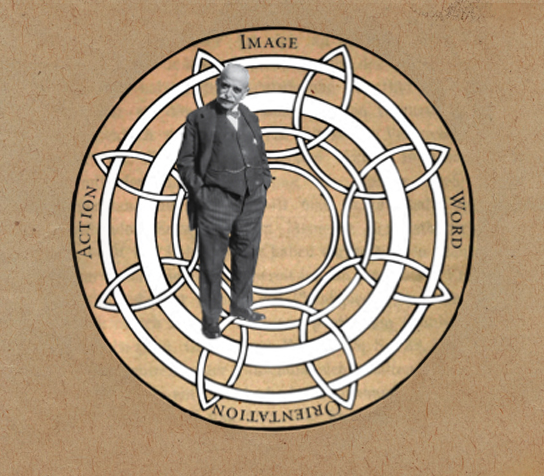
Image source: Helix Center Warburg Symposium
The Zettelkasten as a thread through the labyrinth of thought
The first technology of note is Warburg’s Zettelkasten, his collection of index boxes, containing notes on many subjects.
“Aby Warburg’s collection of index cards (III.2.1.ZK), containing notes, bibliographical references, printed material and letters, was compiled throughout the scholar’s life. Ninety-six boxes survive, each containing between 200 and 800 individually numbered index cards. Cardboard dividers and envelopes group these index cards into thematic sections. The online catalogue reproduces the structure of the dividers and sub-dividers with their original titles in German and consists of about 3,200 items.” - Warburg Institute Archive
“…Warburg apparently worked constantly with these boxes, and, as his first biographer Carl Georg Heise has reported, he often stood with a strained facial expression bent over the mass of papers and arranged and shifted the individual cards in a long-lasting and never-ending process of order. “Those who follow Warburg’s note box follow his train of thought; from the banking system in Florence, the medieval trading company, the development of individuality, the restless professional work of the Calvinists and the Reformed form of asceticism, to Warburg’s own origin from the old Jewish banking family. The slip box is Warburg’s Ariadne’s thread through his labyrinthine library like his labyrinthine thinking: from the werewolf to the historical concept. A thought, an idea or a new concept does not emerge in a linear progression, but in a process of reciprocating units of ideas and cross-references, which continues until new intersections and nodes have formed.” - Benjamin Steiner, Aby Warburgs Zettelkasten Nr. 2 “Geschichtsauffassung”, In: Heike Gfrereis / Ellen Strittmatter (Hrsg.): Zettelkästen. Maschinen der Phantasie (Marbacher Kataloge, 66). Marbach 2013, S. 154-161.
According to Fritz Saxl, Warburg’s assistant and collaborator, “this vast card-index had a special quality… they had become part of his system and scholarly existence”.
“Often one saw Warburg standing tired and distressed bent over his boxes with a packet of index cards, trying to find for each one the best place within the system; it looked like a waste of energy. […] It took some time to realise that his aim was not bibliographical. This was his method of defining the limits and contents of his scholarly world and the experience gained here became decisive in selecting books for the Library.” - Fritz Saxl, The History of Warburg’s Library (1943-44, p. 329), quoted in Mnemonics, Mneme And Mnemosyne. Aby Warburg’s Theory Of Memory, Claudia Wedepohl (p.389).
A library of good neighbours
Second of note, and much larger than the card-index, is Warburg’s library. As the oldest son, Aby Warburg was in line to inherit his family’s seriously wealthy banking business. But his lack of interest in finance led him to offer the business to his younger brother Max, on the condition he could purchase any books he needed for his research into his true interest, art history. It may have seemed like a modest request, but Warburg’s book collection grew ever larger and eventually expanded into a significant research library. This library was organised like no other. The shelves, and eventually whole rooms were arranged to enable serendipitous connections across and between categories.
“the book you need might not necessarily be the one you were looking for. It might, in fact, be the one next to it. The books are shelved around the law of the good neighbour, meaning that the library’s collection is organised thematically instead of by author, title, or publication date. Gertrud Bing, an architect of the classification system and director of the Institute when it moved to London, said that ‘the manner of shelving the books is meant to impact certain suggestions to the reader who, looking on the shelves for one book, is attracted by the kindred ones next to it, glances at the sections above and below, and finds himself involved in a new trend of thought which may lend additional interest to the one he was pursuing’. Although the Warburg’s serendipitous system may initially seem unconventional and somewhat esoteric, the structuring of the library’s collection around the law of the good neighbour means that it is much easier for readers to discover and find texts they didn’t even know they needed within the interconnected, interdisciplinary classmarks. For Warburg, every book was useful in the context of the whole collection.”
…“the arrangement of the books at the Kulturwissenschaftliche Bibliothek Warburg, the first Warburg library in Hamburg, was intended to encourage rather than obstruct discoveries. Whenever Warburg, an avid book collector, took receipt of one of his many deliveries of new acquisitions, he would rearrange the shelves to accommodate each new book into the collection. In this way, his theories on the interrelation of various images, literary motifs and disciplines found physical form in the arrangement of the books on the shelves. Bing remarked that ‘Warburg had chosen and arranged the books like stones from a mosaic of which he had the pattern in his mind’. They were collected for research into specific areas, under a general theme of the afterlife of antiquity.” Source: The Warburg Institute
An Atlas of Images
The third technology for making connections was Warburg’s visual Memosyne Atlas, intended to demonstrate in a series of large panels the lines of connection between artistic motifs in varying periods and locations.
“Warburg believed that these symbolic images, when juxtaposed and then placed in sequence, could foster immediate, synoptic insights into the afterlife of pathos-charged images depicting what he dubbed “bewegtes Leben” (life in motion or animated life).” - ZKM Center for Art and Media
Warburg’s institutional legacy
These three enterprises, card index, library and atlas, are today combined into the Warburg Institute, which began life in Hamburg and since 1944 has been in London.
Above the front door of the Institute is inscribed the Greek word MEMOSYNE. Warburg saw this not straightforwardly as the name of the goddess of memory, but as a sphynx presenting a great riddle. The Institute revolves around memory as a problem. What is memory? How does it persist in culture and individuals, and especially through art?
“In the first public occurrence of the word “Mnemosyne” I am aware of in his writings, found in the annual report on the Library for the year 1925, Warburg identifies Mnemosyne not as the goddess of Memory and mother of the Muses but rather as “the great Sphynx,” out of whom he hopes “to unlock, if not her secret, at least the formulation of her riddle [der grossen Sphynx Mnemosyne, wenn auch nicht ihr Geheimnis, so doch die Formulierung ihrer Rätselfrage zu entlocken]”” – Davide Stimilli, «Aby Warburg’s Impresa», Images Re-vues (En ligne), Hors-série 4, 2013.
Arguably, Warburg’s self-diagnosed Verknüpfungszwang, his ‘compulsion to interconnect’ hindered the completion and publication of his work. Perhaps his constant sorting and re-sorting represented a kind of perfectionism, or even a form of obsessive-compulsive behaviour. Indeed, he spent several years battling significant mental health problems and the end published comparatively little.
However, in another sense, through his Zettelkasten, his library and his atlas of images, the compulsion to interconnect became Warburg’s life’s work. It is telling that though Warburg left relatively few completed texts, his institutional legacy, especially through London’s Warburg Institute and Hamburg’s Warburg-Haus, has proved extremely influential and highly intellectually fertile over many decades - and continues strongly into the Twenty-first Century.
In his novel The White Castle (1998), Orhan Pamuk’s narrator says: “I suppose that to see everything as connected with everything else is the addiction of our time.” The life and legacy of Aby Warburg, shows that this doesn’t have to be a pointless pursuit of arbitrary links but can generate lasting knowledge and meaning with wide implications.
Further reading and viewing:
Chernow, Ron (1993). The Warburgs: The Twentieth Century Odyssey of a Remarkable Jewish Family. New York: Random House. ISBN 978-0525431831.
The Warburg Institute Library: A Brief Description
Introduction to the Warburg Institute Library and Collections - description of Warburg’s Zettelkasten at 8:36
Aby Warburg: Metamorphosis and Memory - and Chris Aldridge’s online notes on this documentary (which is how I discovered it).
I’m the author of Shu Ha Ri. The Japanese Way of Learning, for Artists and Fighters, available now in paperback and ebook.
The Writer’s Journey began as a memo.
Working at Disney during the 1980s, Christopher Vogler saw senior executives using memos effectively. He wrote one to summarise The Hero with a Thousand Faces, as he was sure Joseph Campbell’s book had inspired George Lucas’s Star Wars. He wrote a 7-page memo that became so popular he expanded it into a book. This became the ‘Bible’ for beginning scriptwriters. He called it a ‘practical guide’, since besides summarising Campbell’s ideas on narrative, he showed how they could be used to write film scripts.
Question: what else could start with just a memo?
Personal publishing is still the future
The online writing gurus say it’s pointless starting your own blog, because no one will read it. Best to go where the readers are and write directly on Twitter, LinkedIn, Reddit, Quora, Instagram. Anywhere that enables so-called organic discovery.
Social media and new-style forum sites are where it’s at, they say. That’s where you can gain a few readers and gauge the relative popularity of your writing. Then double down on what seems to be working and… lift off! you have an online writing presence with a responsive audience. Next you entice this emerging audience to sign up to your email list, so they become no longer the social media giant’s audience but your audience, to whom you can now go direct.
So really, the advice of those who claim to know is that it’s fine to start your own blog so long as you distribute it by email, advertise it on social media and above all, don’t call it a blog. It’s a newsletter, OK?
Whatever.
I started with the Internet in the late 1980s, several years before the Web even existed. I used FTP, Gopher, and Usenet, and it’s delightful to see that the venerable email still endures, even though it’s an unwieldy beast, forced to perform tasks it was never meant for.
The Web revolution, I can state with some confidence having lived through it, was and still is a revolution in personal publishing. A person of modest means can publish on the web and anyone in the world can read it. Simple but amazing.
Of course findability is an issue. Of course attention is finite. Of course you have to have something you want to say, or show. But the basic tools are there to make anyone a publisher of their own work, if they want it. The corporations do everything in their power to try to put that particular genie back in its lamp, but they can’t.
In the early 1990s UK, the only way to get on the Internet (outside universities) was through Compuserve. Compuserve ran its own forums and pretended the Web didn’t exist. It was a walled garden and they did everything possible not to inform people of what they were missing. It was ridiculous, but effective while it lasted. For eighteen months or more there really was no alternative. Of course this scam didn’t last forever and as soon as people found the real Web, the game was up.
Nowadays Compuserve is a zombified hollow shell of its former self. In the US America Online tried the same scam. And AOL too is a shadow of its former glory. But the walled-garden game plan was closely copied by Facebook. For years in the 2010s it seemed like you could explore the wider Web, but why bother when all your friends were right there on Facebook? In the Third World, meanwhile, Zuckerberg tried to provide ‘internet services’ that only included his own brands - just as Compuserve had done years before.
But the game is up for Facebook too. As Meta slowly trickles down the drain and Twitter eats itself, the wider Internet remains. As someone wise said: the Network is the social network now- and it always has been.
The Web itself is the publishing platform and anyone can still publish there.
For years, I published an obscure Wordpress blog - but it had thousands of views. More recently I’ve been publishing a static blog hosted on Github, simply as a little experiment in whether I can manage the technology. Really, it’s not very difficult. Most recently, I’ve set up a little home here on my new website, which is connected to micro.blog. Gaining readers is entirely another matter. But I’m mainly doing this for my own amusement, so that’s not the main point of the exercise.
Call it a newsletter, (don’t) call it a blog, call it what you like. Personal publishing is still the future.
See also:
You don't build art, you grow it
Finished reading: Dancing with the Gods by Kent Nerburn 📚
This book is advice on the artistic life from an experienced sculptor and writer. I found one section particularly striking. It contrasted two approaches to making art: that of the architect and that of the gardener.
“The architect designs and builds; he [sic] knows the desired outcome before he begins. The gardener plants and cultivates, trusting the sun and weather and the vagaries of change to bring forth a bloom. As artists we must learn to be gardeners, not architects. We must seek to cultivate our art, not construct it, giving up our preconceptions and presuppositions to embrace accident and mystery. Let moments of darkness become the seedbed of growth, not occasions of fear.”
I remembered these words while visiting the new exhibition spaces at the Art Gallery of New South Wales in Sydney. It’s hard to imagine an artwork that could have more clearly illustrated the cultivation approach to art that Nerburn wrote of.
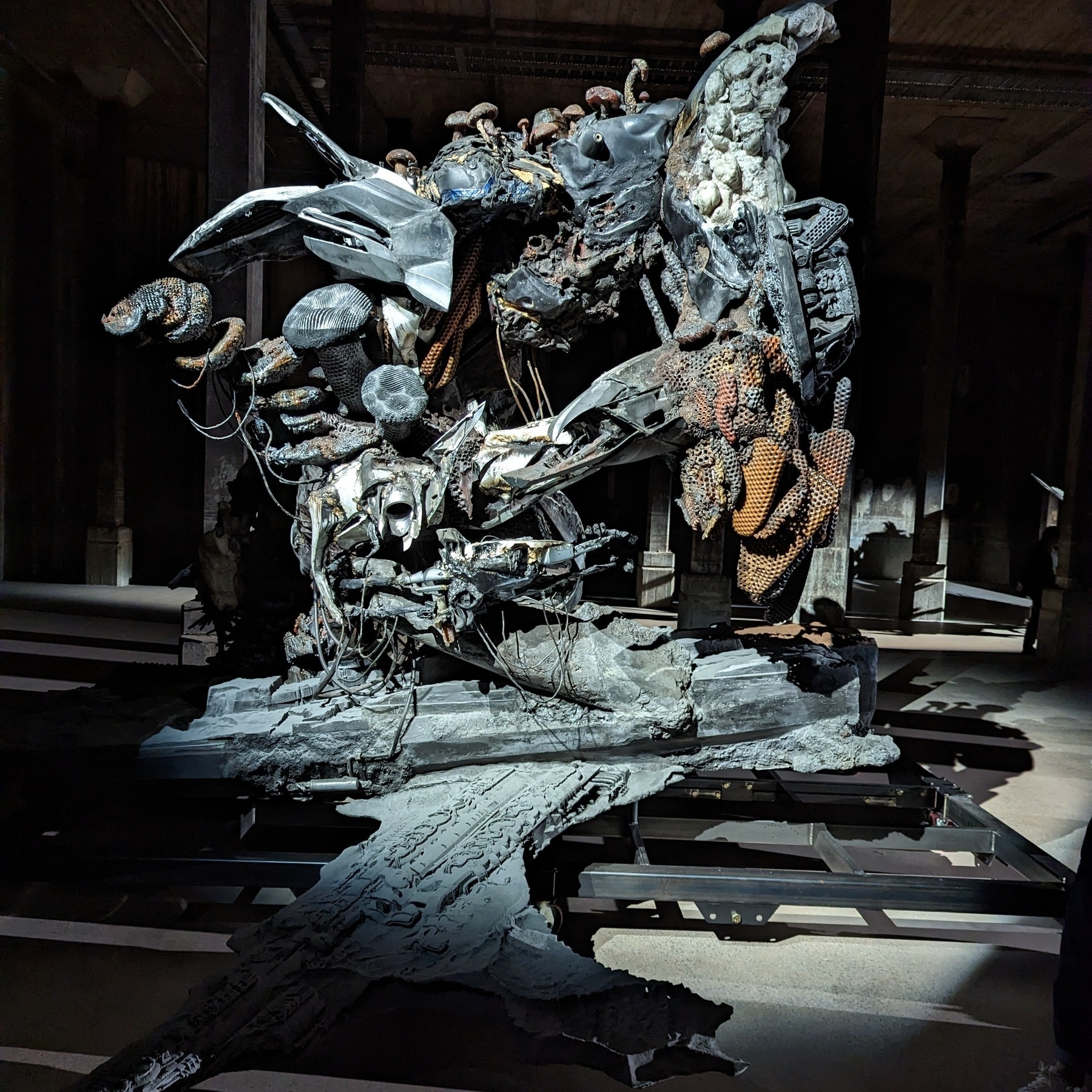
In a huge, mysterious, and very dark underground space called The Tank, Argentinian sculptor Adrián Villar Rojas was exhibiting a series of extraordinary sculptures entitled The End of Imagination. These pieces, apparently four years in the making, seemed really ancient, but of the deep future, organic, not constructed, more biological than artificial, and they appeared to be growing there in the darkness.
Rojas undertook an exhaustive computer simulation of deep-time environmental processes in imagined extraterrestrial contexts, to shape and weather each piece, prior to creating their physical representation. So the outcome was not so much sculpted as weathered and sedimented into existence - yet not by any kind of earthly processes.
Earlier thoughts on Dancing with the Gods.
Can AI give me ham off a knee?
Last night I lay awake thinking about how AI-automated writing is about to change our entire language.
Since AI can easily write everything correctly with perfect spelling and punctuation, one way to show you’re human is to do the opposite. At the time of Shakespeare, spelling was wildly idiosyncratic and people just made it up as they went along. I think this free-for-all might return soon, since it’s a neat way of showing you’re not made of silicon.
But there’s another way we might change our speech and writing to subvert our digital overlords. Ladies and gentlemen, I give you: ham off a knee! It’s something chatbots can’t provide, but that we humans can understand quite easily.
I lay awake last night thinking about cryptic crossword clues (I never do crosswords, but still, that’s rumination for you!). Here’s a clue I thought up. Not a very good clue, since I don’t know what I’m doing:
“For Joyce, recovery leads to pain, we hear (15).”
The answer? “Fine again so ache”.
Doesn’t make sense to you? Well, Finnegans Wake was James Joyce’s fourth and last major work of fiction. I was thinking of it because it’s packed full of homophony (ham off a knee - get it?).
So what’s homophony? Glad you asked. Homophony is simply when you use a word that sounds like another word. But Joyce used homophones in a complex way. His sentences read one way on the page, but when spoken out loud they often mean something else, subverting the original meaning. That’s why he was a genius and I’m not.
But it also struck me that we could start doing this and AI wouldn’t be able to keep up. Admittedly it took Joyce years to finish Finnegans Wake. It’s certainly complicated to come up with whole paragraphs of homophonic writing or speech. But I suspect young people, who are always the instigators of new slang, will be quite up to the challenge.
Alternatively, it’s the new AI frontier. Imagine if you could command something like: “ChatGPT: give me a written account of a 16th Century tourist visit to Venice, which warns of impending alien attack when read out loud.”
Now that would impress me.
Despite AI, the Internet is still personal
Blogging is great and it will never die. That’s why I keep coming back to it and you do too.
Dave Winer, the blogfather, once said:
“A blog is the unedited voice of a person.”
That’s a concept worth reconsidering in this age of AI ventriloquism. If I went in for tattoos, I’d have it inked in cursive writing on the back of my neck1.
Because online, in spite of everything, despite all the cynicism and exploitation, advertising and automation, I’m still looking for genuine communication. I’m seeking some kind of connection, some marker that says:
“I was here, and so were you.”
It’s the voice of a person connecting to another person. Not a machine, not an algorithm, but a person. A person with a body, not a corpus, not a pretence but a real presence.
But why keep doing it?
Here I present two good reasons that will cover many use-cases.
Publish to find your people
First, I keep coming back to it because blogging is a long-winded search query to find your tribe. It’s a calling card, many words long. The tldr; version of the message is:
Hardly anyone likes what I like, but that’s OK because now there’s two of us.
Austin Kleon drew my attention to this, so it must be true.
There might be a bit more to this, though. By publishing, you make something that never existed before. It’s not impossible that through it people might find themselves. I’m not saying every post is going to be a revelation. But in my experience the right word at the right time can work wonders. There are a few writers I feel like that about. Perhaps you know of some too.
Publish or be damned
Secondly, it’s a miracle that you can publish your unedited voice so easily. You’re a one person media company - and that’s amazing. When I think of all the functionality crammed into a blogging system like micro.blog, or Wordpress, or Substack, or even Blot or WriteAs, and how previous generations could hardly even dream of such publishing power, I almost feel a duty to make use of it. Imagine a time traveller recently arrived here from the past2 looking at us and saying, incredulously:
“So you can do all this at the press of a button, and what? Right now you can’t be bothered?”
That’s right. Sometimes I can’t be bothered.
And then the feeling passes.