article
- I need a simpler system for online writing. It’s been clear for some time that Wordpress was holding me back. I know: “poor workers blame their tools”, and obviously there’s something wrong with me if I can’t just log in to Wordpress and write a line or two from time to time. But really, it felt as though the user interface was presenting a psychological barrier. Every time I logged in it seemed the WordPress UX had got more complex. Anyway, that’s my excuse. I’m hoping that a switch entirely to micro.blog hosting will help the writing to flow a bit better.
- I like the IndieWeb. Although I had some Indieweb plug-ins set up on my Wordpress site, it didn’t feel as though they were getting much use. The Musky shenanigans at Twitter have made it even clearer that independence on the web is essential and that the true social network is the web itself. Switching to micro.blog will hopefully connect me better, and if I ever change my mind, there’s no lock-in.
- Updating the app feels like a chore. When I checked my hosting dashboard it was clear that there were several insecurities caused by a lack of updating. I just hadn’t gotten around to it for ages. But really, I don’t have much interest in which version of PHP I’m supposed to be using, or what version the plug-ins are - so I’d rather not think about this side of things. If micro.blog can do this for me, I’m not complaining.
- I also quite like Mastodon. Micro.blog has a certain amount of compatability with Mastodon, through the activitypub protocol. So I plan to try that out.
- Writing in Markdown syntax has become more and more intuitive to me, despite its limitations, and I like the relative simplicity of static sites. Micro.blog uses Hugo as its site generator, so now I’m now using Markdown to create static pages.
- for motivation, and
- to leave a record, sharing what I know and
- to encourage you, dear reader, to stop scrolling and go read a good book.
Aby Warburg's Zettelkasten and the search for interconnection
Aby Warburg and the compulsion to interconnect
Aby Warburg was a German art historian obsessed with the connections he saw across European and Mediterranean culture in the afterlife of Antiquity. He even coined a phrase: Verknüpfungszwang - the compulsion to find connections.
“Coining a word that is as fitting as it is symptomatic of the urge it describes, [Aby] Warburg spoke of his Verknüpfungszwang. This ‘compulsion to interconnect’ lies not only at the root of his research and working methods. It is also manifested in regular references within his work to events in his private life, his family and collaborators.” - The Warburg Institute
Three projects in particular display Warburg’s extraordinary scholarly methods.
“The library, panels and boxes formed the ensemble of supports on which Aby Warburg’s spiritual work and intellectual creativity were based.” - Benjamin Steiner, Aby Warburgs Zettelkasten Nr. 2 “Geschichtsauffassung”, In: Heike Gfrereis / Ellen Strittmatter (Hrsg.): Zettelkästen. Maschinen der Phantasie (Marbacher Kataloge, 66). Marbach 2013, S. 154-161.
Taken together, these three amount to a technology for exploring Warburg’s obsession with interconnection.
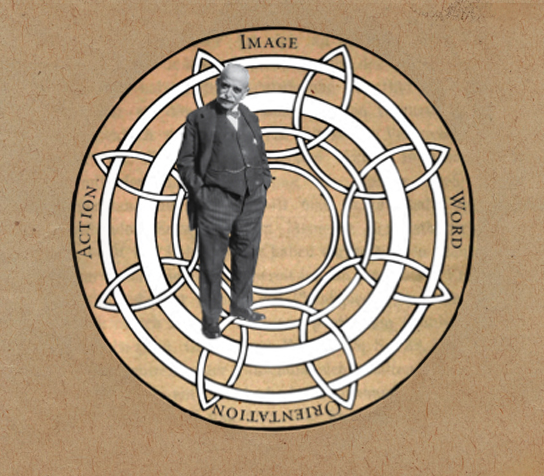
Image source: Helix Center Warburg Symposium
The Zettelkasten as a thread through the labyrinth of thought
The first technology of note is Warburg’s Zettelkasten, his collection of index boxes, containing notes on many subjects.
“Aby Warburg’s collection of index cards (III.2.1.ZK), containing notes, bibliographical references, printed material and letters, was compiled throughout the scholar’s life. Ninety-six boxes survive, each containing between 200 and 800 individually numbered index cards. Cardboard dividers and envelopes group these index cards into thematic sections. The online catalogue reproduces the structure of the dividers and sub-dividers with their original titles in German and consists of about 3,200 items.” - Warburg Institute Archive
“…Warburg apparently worked constantly with these boxes, and, as his first biographer Carl Georg Heise has reported, he often stood with a strained facial expression bent over the mass of papers and arranged and shifted the individual cards in a long-lasting and never-ending process of order. “Those who follow Warburg’s note box follow his train of thought; from the banking system in Florence, the medieval trading company, the development of individuality, the restless professional work of the Calvinists and the Reformed form of asceticism, to Warburg’s own origin from the old Jewish banking family. The slip box is Warburg’s Ariadne’s thread through his labyrinthine library like his labyrinthine thinking: from the werewolf to the historical concept. A thought, an idea or a new concept does not emerge in a linear progression, but in a process of reciprocating units of ideas and cross-references, which continues until new intersections and nodes have formed.” - Benjamin Steiner, Aby Warburgs Zettelkasten Nr. 2 “Geschichtsauffassung”, In: Heike Gfrereis / Ellen Strittmatter (Hrsg.): Zettelkästen. Maschinen der Phantasie (Marbacher Kataloge, 66). Marbach 2013, S. 154-161.
According to Fritz Saxl, Warburg’s assistant and collaborator, “this vast card-index had a special quality… they had become part of his system and scholarly existence”.
“Often one saw Warburg standing tired and distressed bent over his boxes with a packet of index cards, trying to find for each one the best place within the system; it looked like a waste of energy. […] It took some time to realise that his aim was not bibliographical. This was his method of defining the limits and contents of his scholarly world and the experience gained here became decisive in selecting books for the Library.” - Fritz Saxl, The History of Warburg’s Library (1943-44, p. 329), quoted in Mnemonics, Mneme And Mnemosyne. Aby Warburg’s Theory Of Memory, Claudia Wedepohl (p.389).
A library of good neighbours
Second of note, and much larger than the card-index, is Warburg’s library. As the oldest son, Aby Warburg was in line to inherit his family’s seriously wealthy banking business. But his lack of interest in finance led him to offer the business to his younger brother Max, on the condition he could purchase any books he needed for his research into his true interest, art history. It may have seemed like a modest request, but Warburg’s book collection grew ever larger and eventually expanded into a significant research library. This library was organised like no other. The shelves, and eventually whole rooms were arranged to enable serendipitous connections across and between categories.
“the book you need might not necessarily be the one you were looking for. It might, in fact, be the one next to it. The books are shelved around the law of the good neighbour, meaning that the library’s collection is organised thematically instead of by author, title, or publication date. Gertrud Bing, an architect of the classification system and director of the Institute when it moved to London, said that ‘the manner of shelving the books is meant to impact certain suggestions to the reader who, looking on the shelves for one book, is attracted by the kindred ones next to it, glances at the sections above and below, and finds himself involved in a new trend of thought which may lend additional interest to the one he was pursuing’. Although the Warburg’s serendipitous system may initially seem unconventional and somewhat esoteric, the structuring of the library’s collection around the law of the good neighbour means that it is much easier for readers to discover and find texts they didn’t even know they needed within the interconnected, interdisciplinary classmarks. For Warburg, every book was useful in the context of the whole collection.”
…“the arrangement of the books at the Kulturwissenschaftliche Bibliothek Warburg, the first Warburg library in Hamburg, was intended to encourage rather than obstruct discoveries. Whenever Warburg, an avid book collector, took receipt of one of his many deliveries of new acquisitions, he would rearrange the shelves to accommodate each new book into the collection. In this way, his theories on the interrelation of various images, literary motifs and disciplines found physical form in the arrangement of the books on the shelves. Bing remarked that ‘Warburg had chosen and arranged the books like stones from a mosaic of which he had the pattern in his mind’. They were collected for research into specific areas, under a general theme of the afterlife of antiquity.” Source: The Warburg Institute
An Atlas of Images
The third technology for making connections was Warburg’s visual Memosyne Atlas, intended to demonstrate in a series of large panels the lines of connection between artistic motifs in varying periods and locations.
“Warburg believed that these symbolic images, when juxtaposed and then placed in sequence, could foster immediate, synoptic insights into the afterlife of pathos-charged images depicting what he dubbed “bewegtes Leben” (life in motion or animated life).” - ZKM Center for Art and Media
Warburg’s institutional legacy
These three enterprises, card index, library and atlas, are today combined into the Warburg Institute, which began life in Hamburg and since 1944 has been in London.
Above the front door of the Institute is inscribed the Greek word MEMOSYNE. Warburg saw this not straightforwardly as the name of the goddess of memory, but as a sphynx presenting a great riddle. The Institute revolves around memory as a problem. What is memory? How does it persist in culture and individuals, and especially through art?
“In the first public occurrence of the word “Mnemosyne” I am aware of in his writings, found in the annual report on the Library for the year 1925, Warburg identifies Mnemosyne not as the goddess of Memory and mother of the Muses but rather as “the great Sphynx,” out of whom he hopes “to unlock, if not her secret, at least the formulation of her riddle [der grossen Sphynx Mnemosyne, wenn auch nicht ihr Geheimnis, so doch die Formulierung ihrer Rätselfrage zu entlocken]”” – Davide Stimilli, «Aby Warburg’s Impresa», Images Re-vues (En ligne), Hors-série 4, 2013.
Arguably, Warburg’s self-diagnosed Verknüpfungszwang, his ‘compulsion to interconnect’ hindered the completion and publication of his work. Perhaps his constant sorting and re-sorting represented a kind of perfectionism, or even a form of obsessive-compulsive behaviour. Indeed, he spent several years battling significant mental health problems and the end published comparatively little.
However, in another sense, through his Zettelkasten, his library and his atlas of images, the compulsion to interconnect became Warburg’s life’s work. It is telling that though Warburg left relatively few completed texts, his institutional legacy, especially through London’s Warburg Institute and Hamburg’s Warburg-Haus, has proved extremely influential and highly intellectually fertile over many decades - and continues strongly into the Twenty-first Century.
In his novel The White Castle (1998), Orhan Pamuk’s narrator says: “I suppose that to see everything as connected with everything else is the addiction of our time.” The life and legacy of Aby Warburg, shows that this doesn’t have to be a pointless pursuit of arbitrary links but can generate lasting knowledge and meaning with wide implications.
Further reading and viewing:
Chernow, Ron (1993). The Warburgs: The Twentieth Century Odyssey of a Remarkable Jewish Family. New York: Random House. ISBN 978-0525431831.
The Warburg Institute Library: A Brief Description
Introduction to the Warburg Institute Library and Collections - description of Warburg’s Zettelkasten at 8:36
Aby Warburg: Metamorphosis and Memory - and Chris Aldridge’s online notes on this documentary (which is how I discovered it).
I’m the author of Shu Ha Ri. The Japanese Way of Learning, for Artists and Fighters, available now in paperback and ebook.
The Writer’s Journey began as a memo.
Working at Disney during the 1980s, Christopher Vogler saw senior executives using memos effectively. He wrote one to summarise The Hero with a Thousand Faces, as he was sure Joseph Campbell’s book had inspired George Lucas’s Star Wars. He wrote a 7-page memo that became so popular he expanded it into a book. This became the ‘Bible’ for beginning scriptwriters. He called it a ‘practical guide’, since besides summarising Campbell’s ideas on narrative, he showed how they could be used to write film scripts.
Question: what else could start with just a memo?
Personal publishing is still the future
The online writing gurus say it’s pointless starting your own blog, because no one will read it. Best to go where the readers are and write directly on Twitter, LinkedIn, Reddit, Quora, Instagram. Anywhere that enables so-called organic discovery.
Social media and new-style forum sites are where it’s at, they say. That’s where you can gain a few readers and gauge the relative popularity of your writing. Then double down on what seems to be working and… lift off! you have an online writing presence with a responsive audience. Next you entice this emerging audience to sign up to your email list, so they become no longer the social media giant’s audience but your audience, to whom you can now go direct.
So really, the advice of those who claim to know is that it’s fine to start your own blog so long as you distribute it by email, advertise it on social media and above all, don’t call it a blog. It’s a newsletter, OK?
Whatever.
I started with the Internet in the late 1980s, several years before the Web even existed. I used FTP, Gopher, and Usenet, and it’s delightful to see that the venerable email still endures, even though it’s an unwieldy beast, forced to perform tasks it was never meant for.
The Web revolution, I can state with some confidence having lived through it, was and still is a revolution in personal publishing. A person of modest means can publish on the web and anyone in the world can read it. Simple but amazing.
Of course findability is an issue. Of course attention is finite. Of course you have to have something you want to say, or show. But the basic tools are there to make anyone a publisher of their own work, if they want it. The corporations do everything in their power to try to put that particular genie back in its lamp, but they can’t.
In the early 1990s UK, the only way to get on the Internet (outside universities) was through Compuserve. Compuserve ran its own forums and pretended the Web didn’t exist. It was a walled garden and they did everything possible not to inform people of what they were missing. It was ridiculous, but effective while it lasted. For eighteen months or more there really was no alternative. Of course this scam didn’t last forever and as soon as people found the real Web, the game was up.
Nowadays Compuserve is a zombified hollow shell of its former self. In the US America Online tried the same scam. And AOL too is a shadow of its former glory. But the walled-garden game plan was closely copied by Facebook. For years in the 2010s it seemed like you could explore the wider Web, but why bother when all your friends were right there on Facebook? In the Third World, meanwhile, Zuckerberg tried to provide ‘internet services’ that only included his own brands - just as Compuserve had done years before.
But the game is up for Facebook too. As Meta slowly trickles down the drain and Twitter eats itself, the wider Internet remains. As someone wise said: the Network is the social network now- and it always has been.
The Web itself is the publishing platform and anyone can still publish there.
For years, I published an obscure Wordpress blog - but it had thousands of views. More recently I’ve been publishing a static blog hosted on Github, simply as a little experiment in whether I can manage the technology. Really, it’s not very difficult. Most recently, I’ve set up a little home here on my new website, which is connected to micro.blog. Gaining readers is entirely another matter. But I’m mainly doing this for my own amusement, so that’s not the main point of the exercise.
Call it a newsletter, (don’t) call it a blog, call it what you like. Personal publishing is still the future.
See also:
You don't build art, you grow it
Finished reading: Dancing with the Gods by Kent Nerburn 📚
This book is advice on the artistic life from an experienced sculptor and writer. I found one section particularly striking. It contrasted two approaches to making art: that of the architect and that of the gardener.
“The architect designs and builds; he [sic] knows the desired outcome before he begins. The gardener plants and cultivates, trusting the sun and weather and the vagaries of change to bring forth a bloom. As artists we must learn to be gardeners, not architects. We must seek to cultivate our art, not construct it, giving up our preconceptions and presuppositions to embrace accident and mystery. Let moments of darkness become the seedbed of growth, not occasions of fear.”
I remembered these words while visiting the new exhibition spaces at the Art Gallery of New South Wales in Sydney. It’s hard to imagine an artwork that could have more clearly illustrated the cultivation approach to art that Nerburn wrote of.
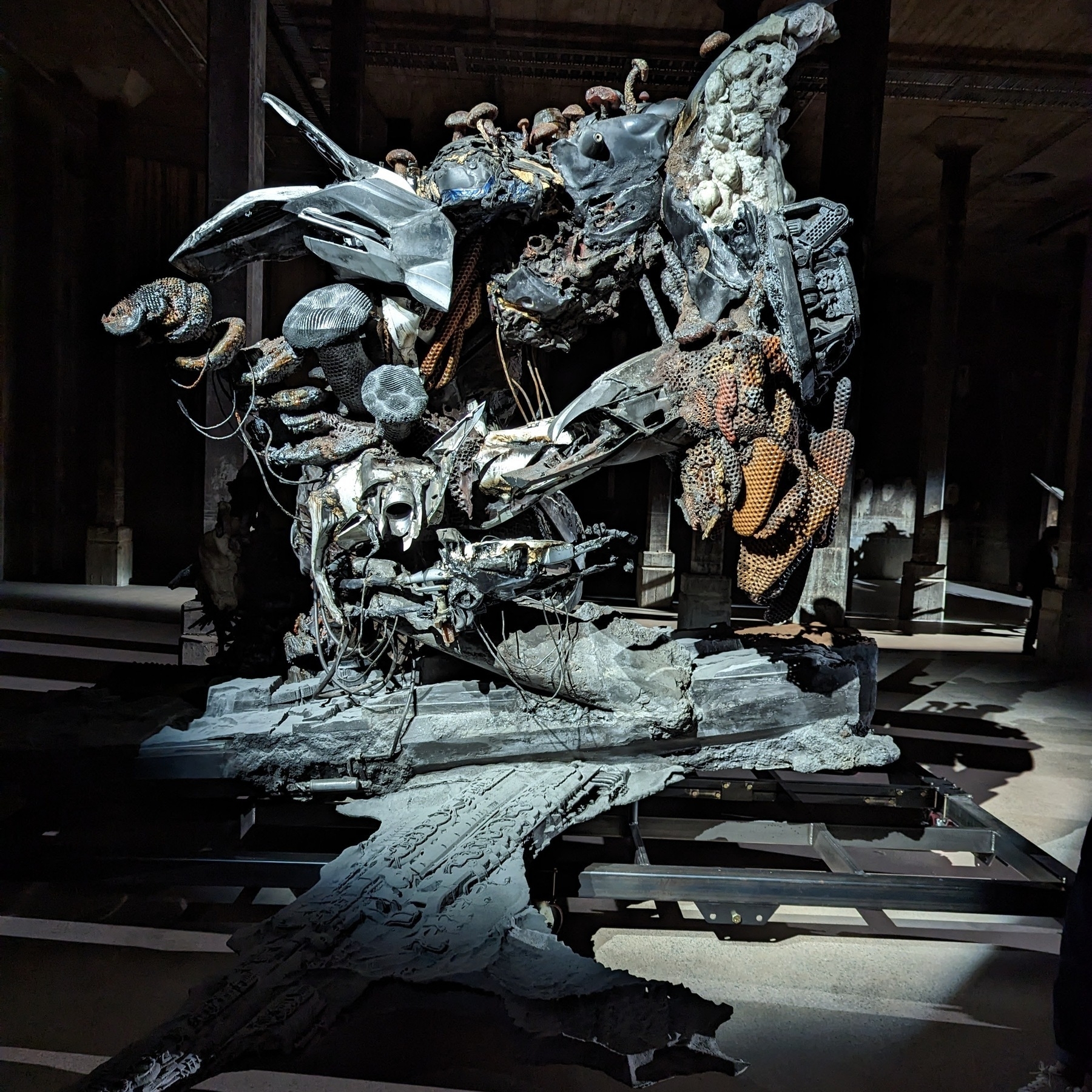
In a huge, mysterious, and very dark underground space called The Tank, Argentinian sculptor Adrián Villar Rojas was exhibiting a series of extraordinary sculptures entitled The End of Imagination. These pieces, apparently four years in the making, seemed really ancient, but of the deep future, organic, not constructed, more biological than artificial, and they appeared to be growing there in the darkness.
Rojas undertook an exhaustive computer simulation of deep-time environmental processes in imagined extraterrestrial contexts, to shape and weather each piece, prior to creating their physical representation. So the outcome was not so much sculpted as weathered and sedimented into existence - yet not by any kind of earthly processes.
Earlier thoughts on Dancing with the Gods.
Can AI give me ham off a knee?
Last night I lay awake thinking about how AI-automated writing is about to change our entire language.
Since AI can easily write everything correctly with perfect spelling and punctuation, one way to show you’re human is to do the opposite. At the time of Shakespeare, spelling was wildly idiosyncratic and people just made it up as they went along. I think this free-for-all might return soon, since it’s a neat way of showing you’re not made of silicon.
But there’s another way we might change our speech and writing to subvert our digital overlords. Ladies and gentlemen, I give you: ham off a knee! It’s something chatbots can’t provide, but that we humans can understand quite easily.
I lay awake last night thinking about cryptic crossword clues (I never do crosswords, but still, that’s rumination for you!). Here’s a clue I thought up. Not a very good clue, since I don’t know what I’m doing:
“For Joyce, recovery leads to pain, we hear (15).”
The answer? “Fine again so ache”.
Doesn’t make sense to you? Well, Finnegans Wake was James Joyce’s fourth and last major work of fiction. I was thinking of it because it’s packed full of homophony (ham off a knee - get it?).
So what’s homophony? Glad you asked. Homophony is simply when you use a word that sounds like another word. But Joyce used homophones in a complex way. His sentences read one way on the page, but when spoken out loud they often mean something else, subverting the original meaning. That’s why he was a genius and I’m not.
But it also struck me that we could start doing this and AI wouldn’t be able to keep up. Admittedly it took Joyce years to finish Finnegans Wake. It’s certainly complicated to come up with whole paragraphs of homophonic writing or speech. But I suspect young people, who are always the instigators of new slang, will be quite up to the challenge.
Alternatively, it’s the new AI frontier. Imagine if you could command something like: “ChatGPT: give me a written account of a 16th Century tourist visit to Venice, which warns of impending alien attack when read out loud.”
Now that would impress me.
Despite AI, the Internet is still personal
Blogging is great and it will never die. That’s why I keep coming back to it and you do too.
Dave Winer, the blogfather, once said:
“A blog is the unedited voice of a person.”
That’s a concept worth reconsidering in this age of AI ventriloquism. If I went in for tattoos, I’d have it inked in cursive writing on the back of my neck1.
Because online, in spite of everything, despite all the cynicism and exploitation, advertising and automation, I’m still looking for genuine communication. I’m seeking some kind of connection, some marker that says:
“I was here, and so were you.”
It’s the voice of a person connecting to another person. Not a machine, not an algorithm, but a person. A person with a body, not a corpus, not a pretence but a real presence.
But why keep doing it?
Here I present two good reasons that will cover many use-cases.
Publish to find your people
First, I keep coming back to it because blogging is a long-winded search query to find your tribe. It’s a calling card, many words long. The tldr; version of the message is:
Hardly anyone likes what I like, but that’s OK because now there’s two of us.
Austin Kleon drew my attention to this, so it must be true.
There might be a bit more to this, though. By publishing, you make something that never existed before. It’s not impossible that through it people might find themselves. I’m not saying every post is going to be a revelation. But in my experience the right word at the right time can work wonders. There are a few writers I feel like that about. Perhaps you know of some too.
Publish or be damned
Secondly, it’s a miracle that you can publish your unedited voice so easily. You’re a one person media company - and that’s amazing. When I think of all the functionality crammed into a blogging system like micro.blog, or Wordpress, or Substack, or even Blot or WriteAs, and how previous generations could hardly even dream of such publishing power, I almost feel a duty to make use of it. Imagine a time traveller recently arrived here from the past2 looking at us and saying, incredulously:
“So you can do all this at the press of a button, and what? Right now you can’t be bothered?”
That’s right. Sometimes I can’t be bothered.
And then the feeling passes.
Footnotes
Why I'm writing slowly
There’s an emerging movement in favour of ‘slow productivity’.
And writing is one of the best examples of the many benefits of hurrying slowly.
Successful writing doesn’t result from Herculean efforts to tally up mammoth word-counts, often at the last minute (although, if that’s your chosen path, good luck). The best and most sustainable writing takes place slowly and methodically. This is so despite the many voices telling you how you can ‘write a book in a month’, ‘write a book in a week’, or even ‘write a book in a day’. You can only do this if you write a lot, but without haste.
What works is to write slowly and consistently, so that the writing accumulates over time into larger and ever more meaningful pieces.
The English author of the Victorian age, Anthony Trollope, epitomised a slow but steady approach to writing. He produced a very significant output, including 47 novels, and is best known for a long series of novels centred upon the fictional county of Barsetshire. Yet he claimed never to write for more than three hours a day. In fact, while becoming one of the period’s most popular novelists, he maintained a full-time job with the Post Office. Because he had a workable method, he didn’t need more time.
And without developing a writing method that works, no amount of extra time will ever be enough.
☞ You can get a lot done by writing slowly
If you don’t have time to keep up with all the posts on this site, why not subscribe to the weekly email digest?
The thing about advice is that people do what they want with it

Currently reading: Dancing with the Gods by Kent Nerburn 📚
I know nothing at all about Kent Nerburn, so it’s interesting to read this book of reflections on creative work.
I did notice, though, that the US version of this book has been re-named to: The Artist’s Journey: On Making Art and Being an Artist. This alternative title reminds me of the format of Rilke’s Letters to a Young Poet, in the sense that both authors offer reflections on their creative experience, having been prompted by a letter from a younger person, wondering about setting out on a career as an artist. The difference is that Rilke was rather young to be dishing out such ‘wisdom’, whereas Nerburn has lived a bit.
To be fair to Rilke, though, he didn’t seek out Franz Xaver Kappus, the nineteen year old military cadet who first wrote for advice when Rilke was only twenty seven. Nor did Rilke publish his letters of advice. They were only collected and published after his death, by Kappus. Nor finally was Rilke’s advice in any way arrogant. He said:
“Nobody can advise you and help you. Nobody. There is only one way—Go into yourself.”
Rilke’s advice didn’t make Kappus a poet. It didn’t make him abandon his military career. He was an officer for 15 years and fought in WW1. But Rilke surely helped make him a writer. Kappus wrote novels and screenplays and was a newspaper editor for many years.
That’s the thing about advice. People receive it and then they do what they want with it. Oscar Wilde said:
“I always pass on good advice. It is the only thing to do with it. It is never of any use to oneself.”
Though given his legal difficulties, perhaps he should have listened, just once.
More:
I finished Dancing with the Gods.
Can Rilke change your life?
Big changes at writingslowly.com
New year, new website (backend)
It’s a new year, so it must be time for new web connections! Well, I finally decided to shift from a hosted Wordpress site to go all in on micro.blog.
It was fairly easy to migrate, just following the instructions. Things already feel easier and less complicated.
Why did I decide to make this change?
Look, I’m not really complaining about WordPress. I like it, and Automattic isn’t Apple/Facebook/Google/Twitter/Amazon, so there’s that. If I had to choose a dictator to rule the world, Matt Mullenweg would be on my shortlist. It’s not Wordpress, it’s me. I’m ready for a change.
Writing about reading
Also, I’m making a commitment to writing about my reading in 2023.
I love reading. Each year I read about 30-40 books and this year I’ll be writing about it here. There’ll soon be a ‘reading’ category at the top of the webpage. Why am I doing this?
Micro.blog has a series of companion apps, one of which is Epilogue. You can set an annual reading goal and every time you blog about a title you’ve finished, your goal moves one step closer to completion.
Micro.blog also has some other great book-related features, including a handly bookshelf, and this is one of the things that made me want to switch.
I keep a private TiddlyWiki Zettelkasten in which I already reflect on my reading, so the only real change is in making it public.
Don’t panic
So that’s what’s new. But don’t worry, whatever happens I’ll still be writing slowly.