Shu Ha Ri and the philosophy of interior design
The late interior designer Professor Shigeru Uchida discusses the importance of Shu Ha Ri for design:
💬 “The current education system lacks “Shu.” There’s a total absence of the attitude to observe, study, and learn from others. The term “breaking the mold” is common, but without having learned anything from others, one cannot depart from or break away from anything.”
I’m the author of Shu Ha Ri. The Japanese Way of Learning, for Artists and Fighters, available now in paperback and ebook.
Trying to write slowly in 2025
Before I really got going with the Zettelkasten approach to making notes (and with micro.blog) I was publishing only a handful of posts here each year.
But then my productivity exploded.
In 2023 I published 202 posts here, and this post equals that count for 2025, even though the year isn’t done yet.
In 2025 I also edited a collection of essays and published my own book.
So I’m quite happy with the year’s output. And thank you for reading along with me, I really appreciate it.
But don’t worry, in 2026 I’ll still be trying to write slowly.
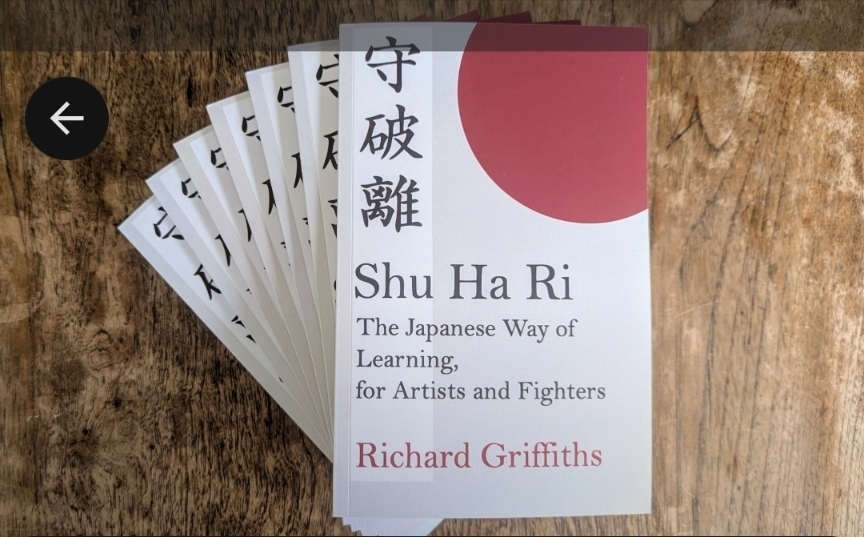
This little book would make a great present for the artist, fighter, learner, teacher, or straight-up Japan-lover in your life. Just saying.
Towards sunset, beneath Fushimi Inari Taisha, the city of Kyoto is laid out like a silver plate.

I’m the author of Shu Ha Ri: The Japanese Way of Learning, for Artists and Fighters, available now.
#Kyoto #FushimiInariTaisha #Japan #SunsetView #JapanTravel #JapanPhotography #VisitJapan #ShuHaRi #JapaneseCulture
Imitating the greats?
Imitation can be a very effective form of learning, but it’s worth considering who to imitate, and how.
Writers often seek to imitate the greats, but it interesting how far the star of some supposedly timeless writers can fade. Here’s William Zinsser, the well-read author of ‘Writing to learn’, on how he did it.
“Writing is learned by imitation. I learned to write mainly by reading writers who were doing the kind of writing I wanted to do and by trying to figure out how they did it. S. J. Perelman told me that when he was starting out he could have been arrested for imitating Ring Lardner. Woody Allen could have been arrested for imitating S. J. Perelman. And who hasn’t tried to imitate Woody Allen? Students often feel guilty about modeling their writing on someone else’s writing. They think it’s unethical—which is commendable. Or they’re afraid they’ll lose their own identity. The point, however, is that we eventually move beyond our models; we take what we need and then we shed those skins and become who we are supposed to become.”
So who are these people I’ve never heard of, I wondered, who could all have been arrested for imitating one another? I mean, they couldn’t, could they? It’s not actually illegal, is it? Or did Zinsser mean plagiarism?
It turns out that Ring Lardner was an American sports journalist and satirist whose work was greatly admired by many of the major authors who were his contemporaries. In his high school newspaper Ernest Hemingway used the pen name, ‘Ring Lardner Jr’. Lardner became a friend of F. Scott Fitzgerald and he inspired the writing of John O’Hara (another great writer whose name is seldom heard these days). In The Catcher in the Rye, J.D. Salinger gave Lardner a backhanded compliment by having his protagonist, Holden Caulfield, name Lardner as his second favourite author. So for Hemingway at least the juvenile imitation seems to have extended to impersonation.
Clearly I need to read some Ring Lardner.
S.J.Perelman was a humourist, writing especially for the New Yorker. He was admired by T.S. Eliot, Somerset Maugham, Garrison Keillor, Frank Muir, and Woody Allen. Another writer I’ve never heard of, who seems to have been inspirational. But then…
“Who hasn’t tried to imitate Woody Allen?” Is a question I’ll leave hanging in the wind.
Author and academic Adam Roberts has an interesting post about Jonathan Buckley’s novel, One Boat (2025), which appears to use Laurence Durrell’s adjectives as a model for how one of his own characters might over-write their diary. Durrell is an author whose star has certainly faded, even though he was nominated several times for the Nobel Prize for Literature. And his style is certainly not admired these days. As Roberts says,
“giving his narrator these Durrellisms: the point of this adjectival affectation, or addiction, is to characterize her as someone groping, somewhat desperately, for expression, or the impossibility thereof”
Well, whether this is a deliberate imitation in order to show a diarist whose purple prose, like Durrell’s gallops away from them, or whether, as Adam’s seems to suspect, it isn’t, whether Buckley was doing something very clever and ‘meta’ with his character’s imitation, or whether he was just getting away with it, all the same, the novel was long listed for the Booker Prize.
I’m the author of Shu Ha Ri. The Japanese Way of Learning, for Artists and Fighters, available now.
💬 "When they email or text me about a post it feels like applause from a dark corner of a large, empty theater where I rehearse."
https://daniel.industries/2025/11/22/why-write-online/
/cc @writingslowly
Daniel kindly replied to my meandering questions about writing online, which circled the theme of ‘what’s the point?’
His blog is a commonplace book, written first for himself. He says blogs got hit hard by social media. I called it the Rapture. There’s only us left!
But not quite. You’re here too.
💬 “You cannot transcend a craft you have not yet learned.”
#shuhari #LifelongLearning
🎬 Paper Films! In the 1930s, Japanese films were made on fragile paper rolls. Nearly lost forever, researchers have digitized and preserved this unique history! Learn more: Japanese Paper Films.
#PaperFilm #FilmHistory #JapaneseFilm #LostMedia #JapaneseFilmFestival #JapaneseHistory
Japanese paper films
Japanese paper films! What?
Yes, in the 1930s the Japanese made a whole bunch of short movies using rolls of paper instead of celluloid.
With the aid of a bright light and some clever mirrors this actually worked. But the technology never really took off and these paper movie reels, originally made for showing at home, were basically forgotten. Worse, the paper was fragile and highly susceptible to disintegration.
Game over for paper films?
Not quite.
Researchers eventually realised what a treasure trove this is, if only it could be rescued. They worked out a way of restoring, or rather preserving, and digitising the remaining movies and now, amazingly, it’s possible to view them in all their preserved (not restored) quirkiness.
I was lucky enough to be able to experience these paper films in a presentation to a packed house at the Art Gallery of New South Wales. There was live music too, which was exquisite, and really complemented the films that didn’t have an original ‘78 record soundtrack, which was the majority.
The presenter was Professor Eric Faden, who has devoted an impressive amount of time and effort to ensure these unique cultural artifacts weren’t lost to decay. They’re now a showpiece of the 2025 Japanese Film Festival and a valuable element of Japanese and international film history.

Now, through the magic of the Internet, you can see many of the recovered paper films for yourself, on the project’s Bluesky account.
And here’s a news story from Japanese TV (English language).
I’m the author of Shu Ha Ri. The Japanese Way of Learning, for Artists and Fighters, available now.
“Each person possesses a mind with powers that are… always unique. — César Aira.
In an age of ‘thinking’ machines, what is the feat that only you could have carried out?
#WritingCommunity #UniqueVoice #AIandWriting #Blogging