Why your note-making tools don’t quite work the way you want them to - and what to do about it
Every so often I stumble upon a really clear articulation of a concept that makes sense of something I’ve been feeling but didn’t previously have a word for. I knew there was something there but I didn’t have the language to express it.
One of the most interesting articles I’ve come across recently is Artificial memory and orienting infinity by Kei Kreutler.
In this particular case the concept illuminated is the subtle, niggling tension between what I want to use my digital writing tools for and what they actually do. My writing tools, and possibly yours too, nearly do what I want, but not quite. What’s that about? Well, on reading this article, the tension became a whole lot clearer.
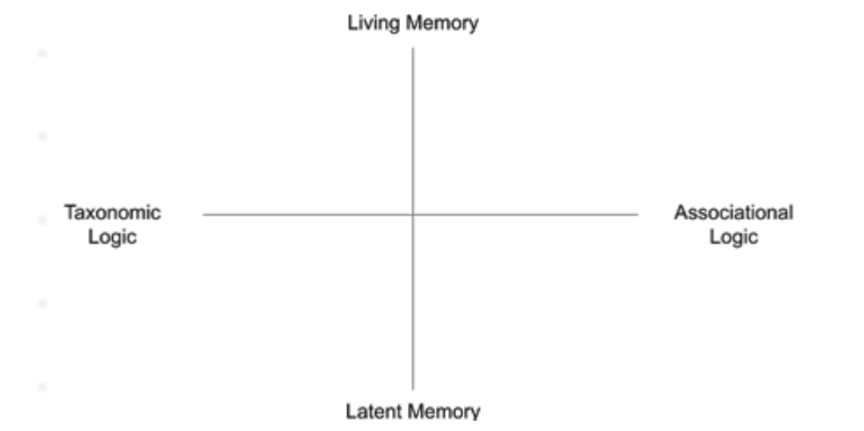
Kei’s article attempts to makes sense of memory in pair of dimensional scales: latent-living and taxonomic-associational.
-
Latent Memory
Refers to knowledge stored but not actively used.
Exists in archives, databases, or written records.
It is inactive until accessed or brought into practice. -
Living Memory
Knowledge that is actively transmitted and practised.
Maintained through oral traditions, rituals, and cultural engagement.
Keeps information dynamic and relevant in everyday life. -
Taxonomic Memory
Organises knowledge into structured, hierarchical categories.
Examples: Encyclopaedias, scientific classifications.
Emphasises order and standardisation for clarity and retrieval. -
Associational Memory
Links ideas through relationships, stories, or spatial metaphors.
Examples: Songlines, memory boards, or thematic connections.
Encourages flexible navigation and creative associations.
These four modes describe the different ways societies and individuals store, organise, and activate knowledge, ranging from static archives to dynamic cultural practices and from rigid hierarchies to fluid networks.
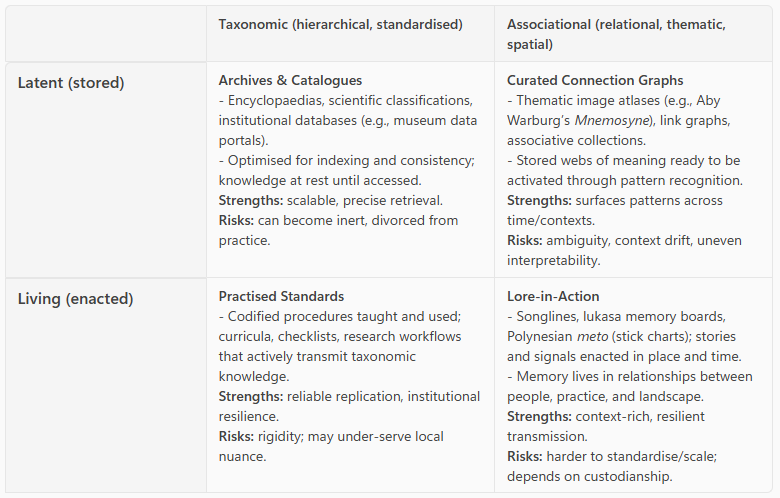
A summary of the framework described in Kei Kreutler’s article.
I’ve found this framework really illuminating. In particular the taxonomy highlights for me the point that our tools and methods lead to different outcomes. We shouldn’t expect latent, taxonomic memory devices (archives and catalogues) to perform the same functions and achieve the same outcomes as living, associational memory devices (lore-in-action).
It’s well worth reading the whole article. This four-fold framework clarifies the tension I often feel between my note-making intentions and my note-making tools. Whereas the standard tools tend towards latent, taxonomic memory, I’m far more interested in living, associational memory. And until now I didn’t quite have the right words to express this.
Well, this theory is all very well but how does it play out in the real world? Here’s a very practical example of what living, associational memory might look like in practice. The philosopher David O’Hara uses his bookshelves as a teaching device. As he discusses philosophy with his students he pulls the relevant books from his shelves, to create a pile of a dozen or more texts that he calls a ‘shelfie’.
Stored in the bookcase these books are latent memory, but this memory is activated by the discussion; it comes alive. Left on the shelves the books are ordered in some form of standard order (by subject or alphabetically, or whatever), but as they get pulled off the shelves to illustrate the discussion they become ordered by association. Then the hour is up and the little pile is re-shelved.
Every so often, my partner insists on reorganising our bookshelves in our living room. Apparently we have too many books, which is obviously not possible. Anyway this shuffling of the stacks drives me unreasonably crazy, makes me feel like I’ve undergone a lobotomy - and now, finally, I understand why: my extended mind has been messed up. My living, associational memory is undone, I’m being assailed by entropy.
So what’s the practical relevance of all this? Open up your note-making tool, whether that’s Obsidian, Notion, Apple Notes, a text editor, a collection of notecards, or a physical notebook, and ask yourself: is this designed for latent/taxonomic memory or living/associational memory?
I bet no one’s ever suggested that to you before, so how can you tell? You can look at how it wants you to organise things. Does it push you toward folders and tags, and hierarchies? Does it emphasise search and retrieval? That’s taxonomic thinking. Or does it encourage links, and serendipitous discovery, and bringing ideas into conversation with each other? That’s associational.
Then look at what it encourages you to do with your notes. Is it easy to transmit your precious knowledge (I’m guessing it’s precious), to share it, to get it out of your note-system to interact with the world? That’s heading in the direction of living memory. Or does it encourage you to store your knowledge away, to archive it rather than pass it round or create something with it. That’s oriented towards latent memory.
None of these dimensions are wrong in themselves, but knowing which type of memory your tool is optimised for helps explain that nagging tension I was feeling. You might be trying to use a filing cabinet like a conversation partner, or vice versa.
The question isn’t “which tool is best?” but “does this tool match what I’m actually trying to do?”
—–
Some further reading:
Notemaking helps you remember - and helps you forget
In this post I explore the dual nature of memory and forgetting through note-making and discuss how my notes become “conversation partners” with my future self - because I’ve forgotten what my past self thought. But I also consider that selective forgetting may have some advantages.
Don’t throw away your old notes
Though I didn’t know it at the time, this post is directly relevant to living vs. latent memory, because it’s about the Zettelkasten as a “conversation partner between my old self and my current self” and it considers how to create the right conditions for serendipity and associational connections.
My favourite tool is this notebook I made
This is about how I modified TiddlyWiki to suit me better. I wanted a rhizomatic tool for writing, and since I couldn’t find one I really liked, I adapted one for my own purposes. You might not need to invent your own tools, I said, but each of us gathers uniquely the unique contents of our own toolbox. And yes, when I grow up I want to be an aphorist.
How to write a better note without melting your brain
This is a practical guide to writing a note that might actually reach its potential. I also discuss Tim Ingold’s contrast between “textilic” (weaving) vs. “architectonic” (architecture) modes of creation, which I’m pretty sure is relevant to associational vs. taxonomic thinking.
What to do when you’ve made some notes: Write something
This post is all about the latent/living dimension, because here I’m suggesting that the point of making notes is to make something else with them, probably for others to read. Yes, it turns out I am quite opinionated about what I want to achieve with my tools. And if you click this link you’ll see a picture of me hard at work in my study overlooking the Sydney Opera House. That has to be worthwhile.
—–
I’m the author of Shu Ha Ri: The Japanese Way of Learning, for Artists and Fighters, available now.
And if you found this article interesting you might like to sign up to the Writing Slowly weekly email digest. You’ll receive all the week’s posts in that handy email format you know and love.