The swamp and the swamp monster: On seeing like a data structure
As human knowledge fragments into trillions of data-points hidden in unreadable databases, there’s a sense of something — legibility, coherence, correlation — dissolving or liquefying. In a very interesting article, Fear of oozification, the consultant Venkatesh Rao, clarifies this process by naming it, and he charts a path to help us learn “how to stop worrying, and learn to love the ooze”.
Oozification? What are you talking about? Well, here’s Venkatash’s working definition:
“Oozification is the process of recursively replacing systems based on numerous larger building blocks, governed by many rules, with ones based on fewer, smaller building blocks, governed by fewer rules, thereby increasing the number of evolutionary possibilities and lowering the number of evolutionary certainties.”
Oozification is an evocative but perhaps clumsy term. If you don’t like it, you can look at it another way: the triumph of data abstraction and indirection. The authors of another worthwhile article, ‘Seeing like a data structure’, offer a clear, practical illustration of the process:
“When the pandemic started and delivery orders skyrocketed, technologists saw an opportunity: ghost kitchens. No longer did the restaurant a customer was ordering from actually have to exist. All that mattered was that the online menu catered to customer desires. Once ordered, the food had to somehow get sourced, cooked, and packaged, sight unseen, and be delivered to the customer’s doorstep.”
This is as clear an example of ‘oozification’ as I’ve seen: the ‘restaurant’, previously assumed to be inherently physical — solid, three-dimensional, and made out of bricks and concrete — has turned to ooze, leaving behind only the essential data structure that now represents it.
Once you start thinking about this process you notice it also seems to work the other way around. Notoriously, the search engine query, ‘restaurant near me’, became the name of an actual restaurant, many times over. And why not? The data structure is now the primary reality. The data bout the real thing has become more real than the real thing, and has in fact supplanted it. That’s why I said it seems to work the other way round. In fact this is all one and the same process. The ghost kitchen exists to implement the data structure, and so does the ‘restaurant near me’. However solid these entities in the physical world may appear, their solidity is now secondary to their primary existence as oozing pools of data.

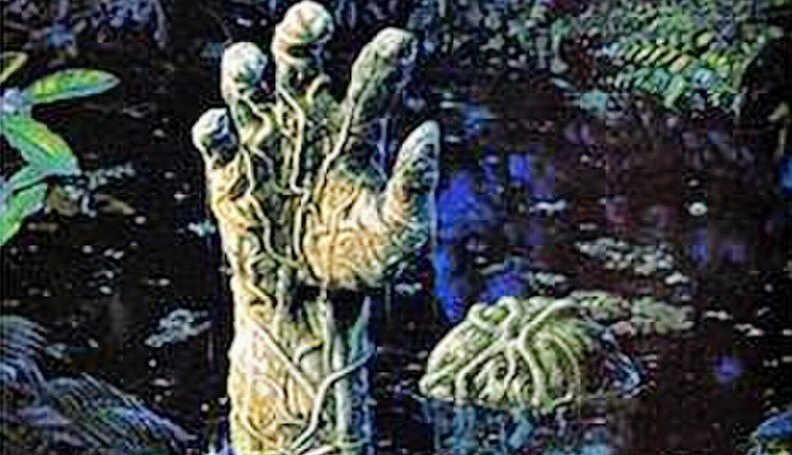
Wherever there’s a swamp it’s hard not to imagine the swamp monster that lurks there. And as Venkatash points out, there’s a kind of cosmic horror to this vision of physical reality being eaten away from the inside by data. He’s at pains to emphasise that oozification signals the end of progressification. But since we’re already waist-deep in the ooze, maybe there’s something positive to be made of our situation. For me this relates to the thinking and writing process of the prolific German sociologist Niklas Luhmann, because avant la lettre he too was interested in something a little like the oozification of established categories, to enable the creation of new forms of social theory. By breaking down the old categories, by denying their dominance, he gave space for the new.
“a clever and persistent scaffolding that serves as a kind of trellis for further evolution, where the oozification is harnessed and encouraged, and guided away from stagnation by structures that allow it to express itself and evolve to greater complexity… An approach that leans into the illegibility of the future, while seeking to discover new kinds of agency within it. Agency that will require the letting-go of old identities to exercise.” — Fear of oozification
By modularizing his knowledge-production process into the 90,000 small slips of paper in his Zettelkasten, he gave rise to a massive output of innovative new texts. He referred to his Zettelkasten, his collection of notes, as a kind of ‘septic tank’. I’m suggesting that Luhmann’s Zettelkasten workflow was a way of abstracting concepts from their categorical context, in order to reconfigure them into new shapes. And this was more than just a pragmatic working method, because it underpinned his whole intellectual project. In fact, Venkatash’s claim that ‘progressification is doomed’ could almost have been the motto for Luhmann’s intellectual outlook. It wasn’t evolutionary or quasi-evolutionary change that attracted Luhmann’s scepticism; it was high modernism’s blind trust in ’the march of progress’. Writing from a system theory perspective, he viewed society not as a unified collective actor that progresses deliberately toward a better state, but as a complex web of autonomous, increasingly functionally differentiated subsystems such as the economy, law, science, and politics.
One of the many interesting ideas in Venkatash’s article is that a mark of oozification is that “units of measure start resembling fundamental physics measures.”
This can be seen quite clearly in Luhmann’s writing process (and by extension mine), where once the process is established the productive output can now be measured in ’notes written per day’. Further, note-writing is measured in time more than in length: it’s the shortest writing session that could possibly be useful.
It just makes sense now to view knowledge and creation, and knowledge creation, like this. A few basic ‘rules’, just enough structure to be useful, these enable an outpouring of new ideas.
Making notes is always more than just making notes. I’m organising my thoughts, thinking by means of writing, sure, but at the same time, I’m playing my small part in reorganising the world. I’ve long imagined the card index, the Zettelkasten, not so much as a technical method for achieving some worthy but limited aim such as writing a book, but more as a symptom of a much wider epistemic cultural moment, in which it just makes sense to view knowledge and creation — and knowledge creation — like this.
“Like what, exactly?” I hear you ask.
Like the systematic dissolving of established categories and structures of knowledge (analysis) in order to reconfigure them (synthesis) to create something new and different (genesis).1
Nearly a century ago the cultural theorist Walter Benjamin described this process with wry humour when he observed:
“the book is already an obsolete mediation between two different card file systems. For everything essential is found in the index box of the researcher who wrote it, and the scholar who studies it assimilates it in his own card file.”
Here then is how the Zettelkasten method of making notes is a lot more than only making notes. It reflects the wider values of the culture that created it.
It doesn’t seem like an accident that Luhmann’s massive collection of notes, his Zettelkasten, has received the most public attention, when he was just one of very many academics who used card file systems for their research, and when his card system was in fact one of the very last to function before the onset of the digital era we now live in. With hindsight it’s clear that Luhmann’s soon-to-be-obsolete textual practices arrived at a major cultural inflection point. In Luhmann’s intellectual project, high modernist grand theory opened out and mutated, towards a radical decentering of the human via (quasi)biological concepts such as autopoiesis.[^2]
Meanwhile, Luhmann’s material working process, especially his paper-slip machine for thinking, the Bielefeld Zettelkasten, represents the zenith of pre-digital personal knowledge management, on the very cusp of a digital and algorithmic tidal wave, which swept away many established practices, yet also uncovered others and rewrote their history. In Luhmann’s interconnected network of notes can be seen an independent precursor to the now ubiquitous hypertext revolution.
I’m not really one to go in for a kind of Auguste Compte-endorsed socio-cultural evolutionary periodisation (Wikipedia), but if I was, I’d be interested in this version:
“The ceaseless process of unbundling and rebundling that is technological creative destruction seems to generally trend towards fewer, smaller building blocks, more possibilities, and fewer constants.” — David Chapman, Meaningness.
There’s a lot more to be said about the importance of data structures in the AI era. I’ve written about how The destiny of your notes depends on their data model.
If you just let the swamp do its thing (ooze, that is) all kinds of new and intriguing swamp monsters will emerge. From the perspective of the previous certainties the outlook is horrific. Some of them will be distinctly unfriendly.
So I can’t end without observing that quite a lot of the supposed fluidity of data structures is over-stated. The data itself might appear to ooze and flow but the infrastructure required to perform this miracle lands very heavily in the real world. Data centres guzzle up space, water and energy in huge amounts. Far from abolishing the physical world, new data structures instead displace it. While the data structure might be the primary reality for some, for others, the primary reality is the data centre infrastructure newly built just next door.
Meanwhile you can see a clear example of just how much data structures matter by reading about the discussion in the Wordpress community on the need to refactor the entire underlying data model that core Wordpress relies on. The author of that article calls WordPress “a schema-less design wearing a relational database as a costume”. (Joost de Valk | WordPress needs to refactor, not redecorate)
Further reading:
-
I rarely publish my words in bold typeface these days because AI does it so often. So, as with my em-dashes, you’ll just have to trust me on this one: I did it myself. ↩︎