Remembering what you read
One of the chief uses of note-making is to help you to remember what you read.
But it’s not as simple as imagining your notes are just an ‘aide memoire’.
When you make notes you forget your reading and replace it with the future opportunity to read again not the original book but your own notes on it. So making notes is inevitably a process of interpretation, which involves the occlusion of the original work, albeit in the name of preserving it.
Psychologists, including Ciara Greene and Gillian Murphy, authors of Memory Lane: The perfectly imperfect ways we remember (Princeton UP, 2025) believe “we construct and reconstruct our memories every time we attempt to recall them”.
So when we re-read our notes, does that mean we’re reconstructing our memories of the book, or just the memories of our notes?
These elements in time are all intertwined: the content of the book itself, the environment in which we read it in the first place, the environment of the place where the notes were made, the notes themselves, and the circumstances in which, later, perhaps much later, we recollect all these factors by re-reading the notes in a new context.
And you do actually remember at least some of what you’ve read. Your reading, or a part of it anyway, sticks in your memory in ineffable ways. Without thinking about it, you have been engaging in what literary scholar Andrew Elfenbein calls ’the differential allocation of attentional resources.’ But how?
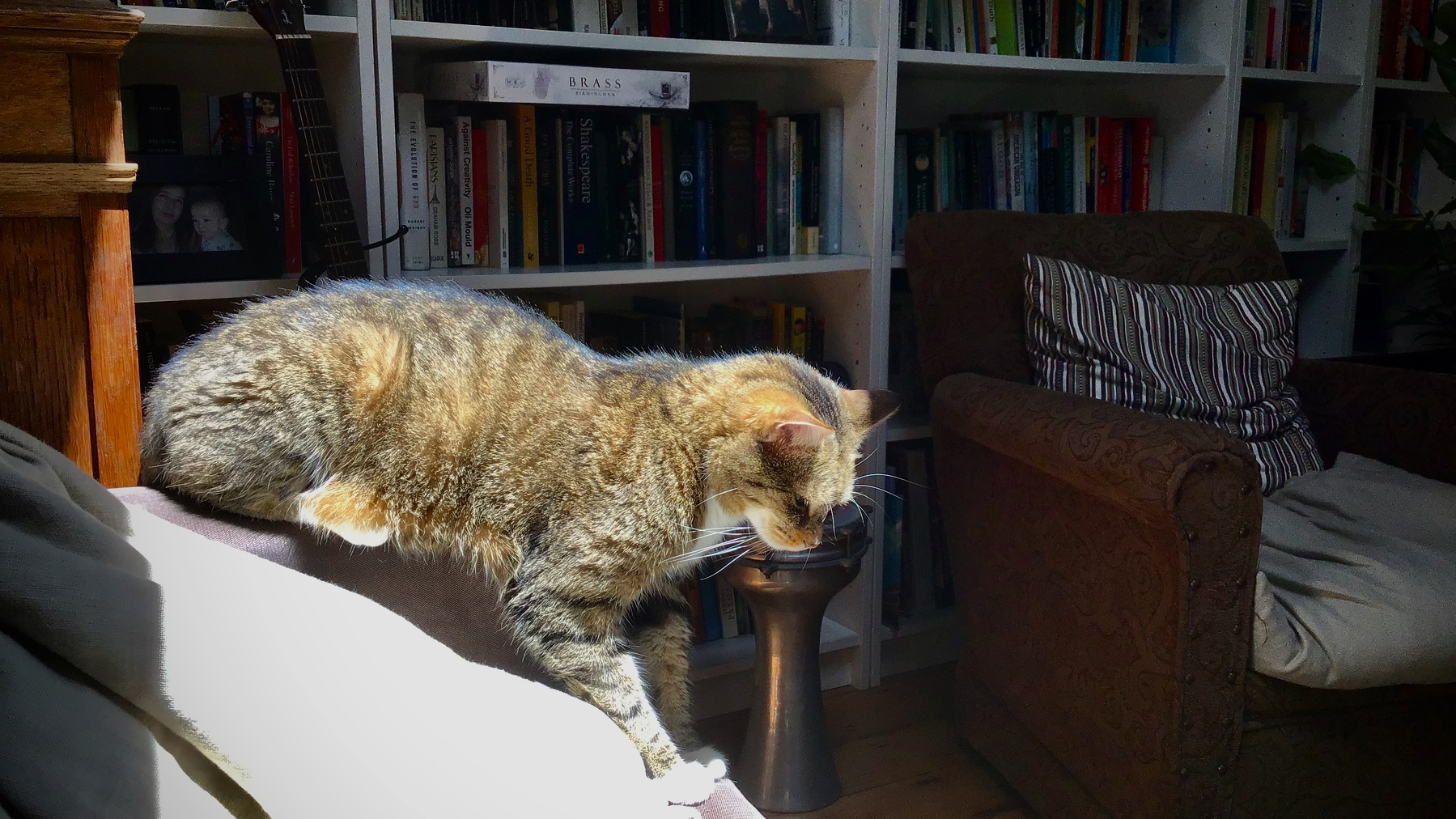
This cat has allocated his attentional resources, differentially.
Yesterday I spent a little while looking over the bookshelves in our house, reminding myself of some the books I’ve read and noticing what I haven’t read yet. It was an odd experience because what I remembered of each book varied widely.
I remembered many of the titles, and seeing their spines was a prompt to remember their contents. A surprising number of books I’d forgotten I had ever read, but seeing them again enabled my memories of their contents to come flooding back. A few books I had no memory of having read, even though I’m pretty sure I must have done. And a few more books I was convinced I had never actually owned and vaguely remember thinking I ought to buy a copy.
I suspect the memory-aiding features of the bookshelf itself are qualitatively different from those of a plain list of the books in that bookshelf. The book shelves are a kind of ‘memory palace’ for the books themselves. In fact this realisation is quite important to me. It might explain why I get frustrated when someone reorganises these books: they’re literally reorganising my memory.
Now I’m minded to take photos of these shelves, so that as I dispose of my books (it’s a working library after all) I can at least look back on how they used to be.
All this got me wondering: what does it mean to be ‘well-read’ when you can only partially remember what you’ve read?
Perhaps being well-read is really only something that can emerge in your writing, not as something you carry around with you in your memory. Or is it about the way you weave your reading into your conversation? These days it seems as though being well-read might just be a mark of someone washed up from a previous era, before there were mobile phones and AI summaries of everything.
Scan your own shelves today. Is there a book staring back at you that you have no memory of reading? Or one where the spine alone brings the whole story back? I’d love to hear about the books that have stayed with you, or about the ones that vanished entirely.
If our notes eventually replace the books themselves, we are essentially building a library of our own interpretations. Does this feel like a loss of the original work to you, or a necessary step in making the ideas your own? How do you decide what is worth ‘preserving’ in your notes, and what do you allow yourself to forget?
In an age of instant AI summaries, the slow act of reading and note-making feels almost counter-cultural. Do you find that digital tools change how you remember what you read? Or do you still find that the physical presence of a book, its size and colour, its place on a shelf, is what makes the memory stick? I’d like to know about your own ‘memory-aiding’ systems in the comments.
Meanwhile, here’s a podcast about what we remember, having first read:
What we remember after reading, with Andrew Elfenbein | How To Read Podcast
And here’s a podcast about the fallibility of memory, and why that might actually be a good thing:
Memory Lane | Princeton UP Ideas Podcast
I’ve written a lot on making notes, including:
-
Three worthwhile modes of note-making (and one not-so-worthwhile).
-
Making notes will aid your short-term memory, even when you haven’t got one.
Thanks for reading! If you like this kind of thing, why not subscribe to the weekly email digest?
And you can also buy my book, Shu Ha Ri: The Japanese Way of Learning, for Artists and Fighters.