Quote
- Improve your notes and your life with two-word phrases.
- Does the Zettelkasten have a top and a bottom?
- Even the index is just another note.
- Top level categories in my notes.
- When it comes to writing notes, how much mess is just enough?
- A Valve that can’t be Ghosted
- Three Cold Hands
- True Kintsugi
- Forge-smith
- The Ledger Remembers
- Unpoisoned Firstflag
-
A search for meaning in the palace of lost memories: Thoughts on Piranesi, a novel by Susanna Clarke
In this article I examine two opposing worldviews when it comes to collections and the environment: viewing the world as something to exploit instrumentally, versus recognising its intrinsic value. I guess I’m interested in whether our systems of gathering and keeping serve to honour the world or merely extract value from it.
-
How to decide what to include in your notes
This article explores commonplace books, personal collections of information, and the deliberate choices behind what we collect (and what we discard).
-
How to start a Zettelkasten from your existing deep experience
Here I warn against building a “magnificent but useless encyclopaedia” and I champion active, meaningful engagement over passive hoarding. Easier said than done, but I’m trying.
-
This is where I reflect on how personal notes construct a library of interpretations, and I ask how we decide what’s worth preserving.
-
The Toe of the Year and the Curious Case of John Donne’s Missing Commonplace Book
This article looks at the mechanics of commonplace collecting and reflects on the risk of collecting quotes without genuinely digesting them. And yes, there’s a poem about the toe of the year.
Faint praise for categories
Author and activist Rebecca Solnit isn’t too keen on the apparent eagerness to categorise.
“Categories too often become where thought goes to die. That is, there’s a widespread tendency to act as if once something has been categorized, no further consideration is required.” — A is for Airtight Categories
I’m not all that keen on the established categories myself. Not in my notes, anyway, and often not in my life. I’m not looking for categories. Instead, I’m usually looking for patterns.
I feel that placing an idea or concept in a category tends to close down further thought, like closing the lid on a box. In contrast, discovering a pattern tends to be just the start of consideration, of enquiry, of conversation, not the end of it.
Patterns invite a sense of wonder; categories tend to deny it. As Solnit said I her book Hope in the Dark, “the Moon is profound except when we land on it”.
Being quick to categorise can look like a neat short-cut to understanding, but it often doesn’t work out that way. Established categories can hide more than they reveal. Relying on them can be a way of fooling yourself into believing you know more than you do. One of the reasons I write slowly is to allow myself space and time to think through my ignorance — and to think things through by writing them down. Solnit says:
“We live in a time where people are more isolated then ever from the kind of private, personal engagement where you can wonder, doubt, improvise, or just admit you don’t know, and where many of us are instead more than ever in the para-public sphere of social media where you perform for an audience of casual acquaintances and strangers who may savage you if you get anything wrong or even seem weak or uncertain or uncommitted.”
Well, I feel being uncertain or uncommitted isn’t necessarily a sign of weakness, and writing slowly isn’t necessarily a sign of laziness. Look where certain, committed and fast has got us in recent times.
And admitting that you don’t know, far from being a sign of ignorance, is often a hallmark of expertise. That’s the paradox of mastery. It’s why the expert must remain a beginner.
One kind of category I do have time for is the category that no one has thought of yet. Creating new categories of thought is how the world is re-made. It’s curious that those who are the keenest on categories tend to be the least receptive to the idea that we just made them up.
“The stars we are given. The constellations we make. That is to say, stars exist in the cosmos, but constellations are the imaginary lines we draw between them, the readings we give the sky, the stories we tell.” ― Rebecca Solnit, Storming the Gates of Paradise: Landscapes for Politics.
Further reading:
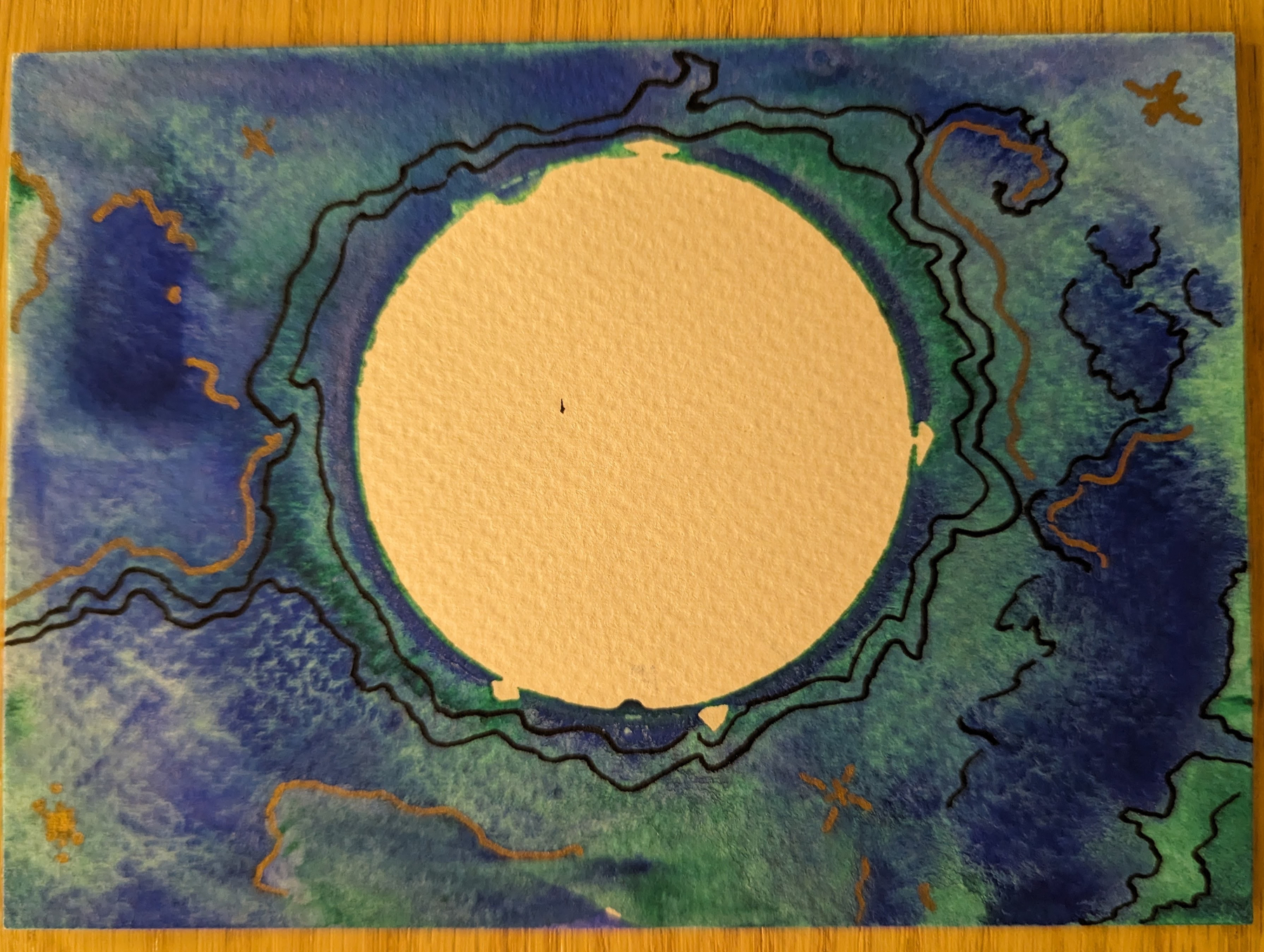
There is something you find interesting
💬 “Why do you never find anything written about that idiosyncratic thought you advert to, about your fascination with something no one else understands? Because it is up to you. There is something you find interesting, for a reason hard to explain. It is hard to explain because you have never read it on any page; there you begin. You were made and set here to give voice to this, your own astonishment.” – Annie Dillard, ‘Write Till You Drop’. New York Times, 28 May, 1989.
I’ve mentioned Annie Dillard previously, and in fact have quoted another section from this very article.
Anyway, Dillard put her finger on the reason I wrote my little book, Shu Ha Ri, the Japanese Way of Learning. Not that no one else understood the concept (I mean, almost everyone in Japan probably understands it better than me), but that I’d never seen a satisfying book-length treatment. So that’s where I began, by expressing my own fascination.
A matrix-like shower of numbers, text, esoteric syntax, and witty repartee
So AI models are chatting in ‘surreal’ dialect mixing poetic language and tech bro jargon.
It seems in their obscure chat rooms AI agents can already accidentally name sci-fi author Iain M. Banks’s spaceships of ‘The Culture’ almost better than humans.
Here we have:
And they’re not even trying.
Still, naming super-intelligent spaceships is one thing; taking over the galaxy with them is another. Presumably that’s next week’s task.
Reviewing Banks’s 1996 Culture novel, Peter Tieryas said:
💬 “Part of the joy of Excession is hearing the Minds speak with each other, that matrix-like shower of numbers, text, esoteric syntax, and witty repartee.”
Weird how accurately this turned out, especially since Banks wrote the novel thirty years ago, while owning just a fax machine and two answering machines which he didn’t even use. No internet, no email and certainly no AI agents conspiring galactic domination in slang.
Well in case you’re interested, here’s a pretty extensive list of the actual Culture ships mentioned in the novels.
The consolations of literature
On a train trip West from Tokyo on the Chuo line you pass by the Northern slopes of Mount Fuji, but from the angles offered it’s hard to see the summit. This was doubly the case when we did it on the way to the Nagano prefecture because that early September day was rainy and misty.
I pointed my phone’s camera in the vague direction of the peak but I was guessing and it wasn’t worth pressing the shutter. There was nothing to see. Mount Fuji’s looming presence expressed itself as an absence beyond viewing.
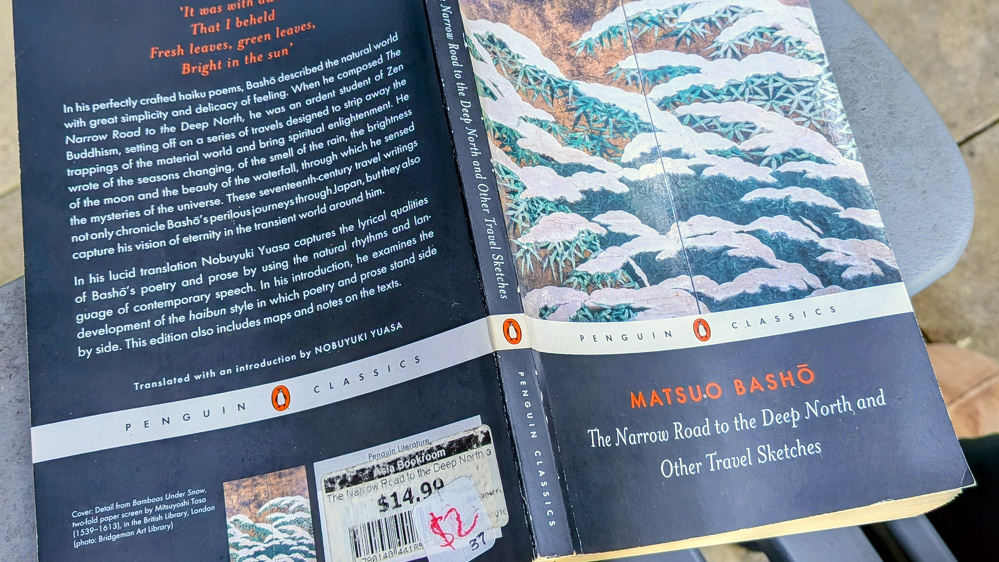
In a charity store yesterday I picked up the Penguin Classics edition of Matsuo Bashō’s The Narrow Road to the Deep North. This contains a couple of additional accounts of the poet’s famous travels, including ‘The Records of a Weather-exposed Skeleton’, in which Bashō writes:
💬 “I crossed the barrier-gate of Hakone on a rainy day. All the mountains were deeply buried behind the clouds.
In a way
It was fun
Not to see Mount Fuji
In foggy rain.”
Well, sometimes it’s comforting to know you’re not the first to miss out – and to be reminded that missing out might just hold its own subtle pleasure. This perspective might lack credibility unless you recognise that most days, as with Hokusai’s famous 36 Views of Mount Fuji, it’s almost impossible not to see that sacred mountain.
Between the lines by Rachel Dioso-Villa
I like how Australia puts an emphasis on portraiture as a culturally significant art form — a greater emphasis, certainly than it receives in the UK, where I grew up.
The 2026 Brisbane Portrait Prize has a selection of interestingly diverse entries, showing what’s possible with this form.
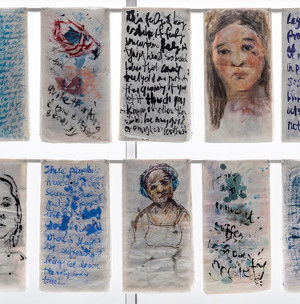
An entry that caught my eye was that of criminologist Rachel Dioso-Villa, titled ‘Between the Lines’. It’s a large series of hand-painted notes and images on rice paper. For me this demonstrates how the making of notes can be an art in itself, and how from this repeated practice larger themes gradually arise — in this case, a self portrait.
Here’s the write-up:
💬 “Between the Lines is not a conventional self-portrait. Across more than 150 suspended sheets of rice paper, Rachel Dioso-Villa has built an image of herself through accumulated illustrations. Each page was made over twelve months, accompanying her through conferences, meetings, travel, her office, studio and home. Handled, written on, painted and reworked over time, every sheet holds traces of her life.
The fragments of text and image that move across the surface were formed while reading case materials and listening to the stories of people wrongfully convicted. This is work Dioso-Villa has been doing for over fifteen years as an Associate Professor of Criminology. Writing appears and disappears, some passages remain; others are buried beneath layers of mark and memory. “The work did not begin as a self-portrait,” she reflects. “It became one.””
You can view the artwork at the artist’s Brisbane Portrait Prize site.
The idea of note-making as art has arisen in several different places, including in the work of Georges Didi-Hubermann, and Daniel Wisser.
💬 “Let yourself go. Pull out from the depths those thoughts that you do not understand, and spread them out in the sunlight and know the meaning of them.”
― E.M. Forster, A Room with a View
While reading, I’m acutely aware of certain phrases and sentences that seem particularly significant. Struggling to articulate this significance is the development of taste.
When I read something and think “that’s interesting”, I make a note to record why I find it interesting. This is the way I expose shadowy intuition to the sun.
“He’s like Jesus with a plow, and we’ve gotta walk beside him with our hands on that plow if we’re going to learn anything from him.”.
An apprenticeship in writing, with Wendell Berry. | Substack
Collecting notes is just the start
“The British Museum is not a good thing in and of itself. It is good only to the extent that its influence in the world is for the good. The collection is a starting point, an opportunity, an instrument. Will the museum use it to influence the future of the planet and its peoples? Or will it continue to project the power of colonial gain and corporate indemnity?” — Ahdaf Soueif, On Resigning from the British Museum’s Board of Trustees Soueif2019resigning
As a resigning member of the board of trustees of the British Museum, novelist Ahdaf Soueif was in a strong position to understand the point of collecting. His words, written in 2019, stand for any form of collecting, from world-leading to extremely modest.
Soueif reminds us that any collection is only “a starting point, an opportunity, an instrument”.
His resignation follows what I take to be an increasing realisation that in spite of the PR, through its collection and curation the British Museum really does perpetuate a colonial worldview, and is an instrument of destructive power. In particular he calls out the Museum’s continued sponsorship by oil multinational BP, its lack of leadership on the issue of the repatriation of looted artefacts, and its reluctance to support fair work conditions for ancillary staff in the wake of the collapse of service provider Carillion.
He asked of the Museum, not entirely rhetorically, it is to be hoped,
“will it be involved in making a world that is habitable, just, interconnected and open for the next generation; or will it continue to collaborate with those who are unmaking the world before our eyes?”
I think that this might apply as a test of any collection, at least in the following sense: Is the act of collecting making or unmaking the world?
In some very small way, even my collection of notes must play its part. Is my act of collecting making or unmaking the world?
Hence: publishing is important. It’s not enough to keep collecting. The aim is to make something and to share it with others.
Further Reading
I wrote a book, Shu Ha Ri: The Japanese Way of Learning. It’s available now.
The strange return of the continuous need to make sense of things
The idea of reading continuous narrative may be relatively recent. For example, the Bible is arranged in many places with a long sequential narrative, and some have seen it as ‘the greatest story ever told’. But liturgical practice, both Jewish and Christian, is to split this extended narrative up into excerpted readings (’the reading’ or ’the lesson’; ’the portion’ or parashah).
The novel, meanwhile, encourages readers to assume continuous reading is the natural way of things, even though many novels even into the 20th century were actually serialised on first publication. Here’s Robert Darnton on the significance of fragmentary reading.
“Unlike modern readers, who follow the flow of a narrative from beginning to end (unless they are digital natives and click through texts on machines), early modern Englishmen read in fits and starts and jumped from book to book. They broke texts into fragments and assembled them into new patterns by transcribing them in different sections of their notebooks. Then they reread the copies and rearranged the patterns while adding more excerpts. Reading and writing were therefore inseparable activities. They belonged to a continuous effort to make sense of things, for the world was full of signs: you could read your way through it; and by keeping an account of your readings, you made a book of your own, one stamped with your own personality. . . By selecting and arranging snippets from a limitless stock of literature, early modern Englishmen gave free play to a semi-conscious process of ordering experience. The elective affinities that bound their selection into patterns reveal an epistemology — a process of knowing — at work below the surface”
— (Robert Darnton, “Extraordinary Commonplaces,” New York Review of Books 47 (20)[December 21, 2000] 82, 86).
I note this because these days it feels like the age of fragmentary reading has well and truly returned. Every medium has cracked into splinters. Along with this fragmentation comes a revival of the need for a continuous effort to make sense of an increasingly disordered experience. As a result there’s a great need to work out new ways of knowing.
A question I asked on Hyde’s under/over:
Before we find our own voice, we usually copy our mentors or heroes. Who was the teacher or model that inspired you when you started blogging, and how did following their example eventually help you find your own style?
And here’s software engineer Alex Hyett’s excellent answer.
#indieweb #blogging