
Atomic Notes
-
If you’re not sure what website feeds are, see IndieWeb: feed reader and how to use RSS feeds. ↩︎
-
Does the index box distort the facts?
-
Can you create coherent writing just from a pile of notes?
-
Perhaps you should keep your notes private
-
Make it flow
-
To create coherent writing, make coherent notes
-
Begin with fragments
-
From smaller parts build a greater whole
-
Join your work together
-
Do it seamlessly well
- If you’ve enjoyed it so far, you can just keep doing what you’ve been doing, collecting all the things. Why not?
- But if you like, you could start doing it more deliberately. For example, at the start of a new year, you could say to yourself: In 2023 I seem to have been interested in a,b, and c. Now in 2024 I want to explore more about b, drop a, and learn about d and e.
- How to be interested in everything
- Don’t you need to start with categories?
- It’s tempting to place your notes in fixed categories
- To build something big start with small fragments
- Thoughts are nest-eggs: Thoreau on writing
- This article is adapted from a comment on Reddit
-
There are exceptions. A few people have tried to video their whole lives. And at least one person, Lion Kimbro, has tried to write down all their thoughts. But its not sustainable. ↩︎
- A network of notes is a rhizome not a tree.
- Manuel Lima on The power of networks (it’s a cool video!)
- Top image source: The Card System at the Office by J. Kaiser, 1908.
💬“At what point does something become part of your mind, instead of just a convenient note taking device?”
A question discussed with philosopher David Chalmers, on the Philosophy Bites podcast.
🎙️Technophilosophy and the extended mind
So much of this depends on what ‘the mind’ means. Meanwhile, we do seamlessly interact with our note-making tools, to achieve more than we could without them.
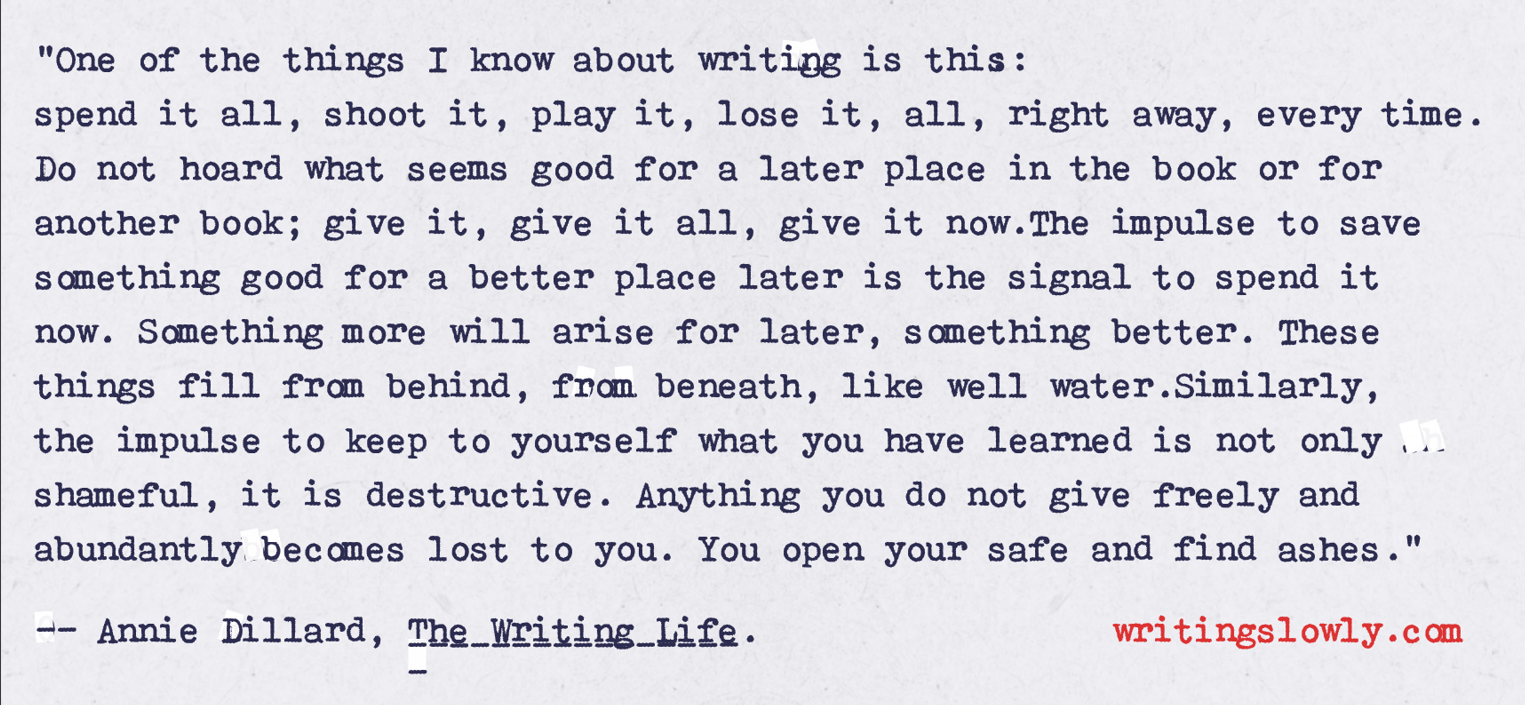
Give it, give it all, give it now
Mark Luetke shows how he uses a Zettelkasten for creative work (‘zines!)
“The goal here is to create an apophenic mindset - one where the mind becomes open to the random connections between objects and ideas. Those connections are the spark we’re after. That spark is inspiration.”
Atomic notes - all in one place
From today there’s a new category in the navigation bar of Writing Slowly.
‘Atomic Notes’ now shows all posts about making notes.
How to make effective notes is a long-standing obsession of mine, but this new category was inspired by Bob Doto, who has his own fantastic resource page: All things Zettelkasten.
The Atomic Notes category is now highlighted on the site navigation bar.
And if you’d like to follow along with your favourite feed reader,there’s also a dedicated RSS feed (in addition to the more general whole-site feed).1
But if there’s a particular key-word you’re looking for here at Writing Slowly, you can use the built-in search.
And if you prefer completely random discovery, the site’s lucky dip feature has you covered.
Connect with me on micro.blog or on Mastodon. And on Reddit, I’m - you guessed it - @atomicnotes.
See also:
Assigning posts to a new category with micro.blog
How to overcome Fetzenwissen: the illusion of integrated thought
It’s too easy to produce fragmentary knowledge.
One potential problem associated with making notes according to the Zettelkasten approach is Verknüpfungszwang: the compulsion to find connections. It may be true philosophically that everything’s connected, but in the end what matters is useful or meaningful connections. With your notes, then, you need to make worthwhile, not indiscriminate links.
Another potential problem is Fetzenwissen: fragmentary knowledge, along with the illusion that disjointed fragments can produce integrated thought.
Almost by definition, notes are brief, and I’m an enthusiast of making short, modular, atomic notes. Yes, this results in knowledge presented in fragments. And in their raw form these fragmentary notes are quite different from the kind of coherent prose and well-developed arguments readers usually expect. You can’t just jam together a set of notes and expect them to make an instant essay. So is this fragmentary knowledge really a problem for note-making? If so, how can determined note-makers overcome it?
From fragments you can build a greater whole
Everything large and significant began as small and insignificant
This is my working philosophy of creativity and I’m trying to follow it through as best I can. Starting with simple parts is how you go about constructing complex systems.
“A complex system that works is invariably found to have evolved from a simple system that worked. A complex system designed from scratch never works and cannot be patched up to make it work. You have to start over, beginning with a working simple system”. — John Gall (1975) Systemantics: How Systems Really Work and How They Fail, p. 71.
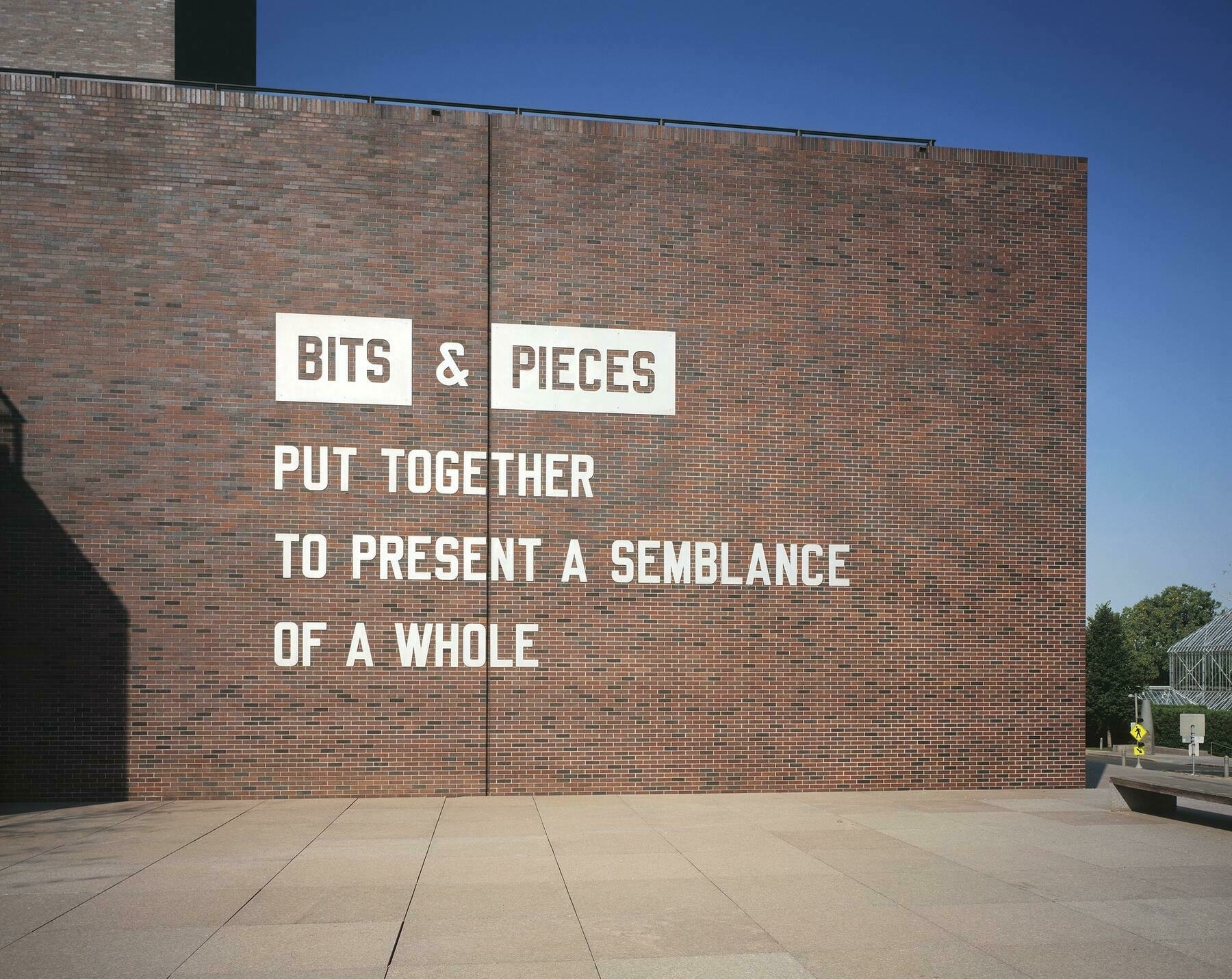
Bits and pieces put together to create a semblance of a whole, by Lawrence Weiner
How to decide what to include in your notes
Before the days of computers, people used to collect all sorts of useful information in a commonplace book.
The ancient idea of commonplaces was that you’d have a set of subjects you were interested in. These were the loci - the places - where you’d put your findings. They were called loci communis - common places, in Latin, because it was assumed everyone knew what the right list of subjects was.
But in practice, everyone had their own set of categories and no one really agreed. It was personal.
Since the digital revolution, things have become trickier still. There’s no real storage limit so you could in principle make notes about everything you encounter. But no matter what software you use, your time on this earth is limited, so you need to narrow the field down somehow1.
But how, exactly?
You might consider just letting rip and collecting everything that interests you, as though you’re literally collecting everything.
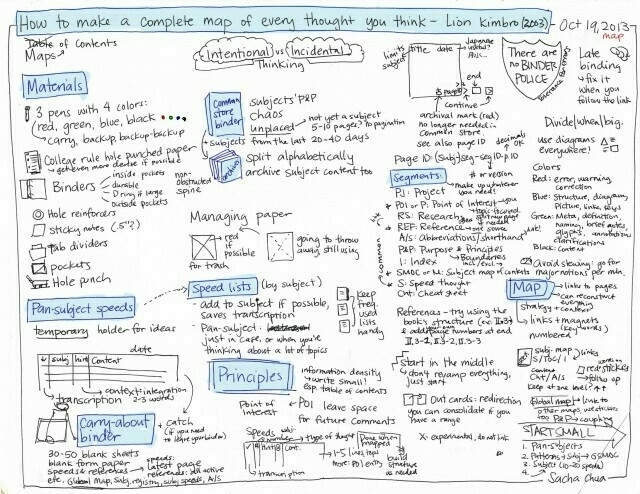
Lion Kimbro tried to make a map of every thought he had.
As time passes, you’ll notice that you haven’t actually collected everything because that’s completely impossible. Even Thomas Edison, the prolific inventor, wasn’t interested in absolutely everything, although he tried hard to be. If you do a bit of a stock-take of your own notes, you’ll see that, really, you gravitate towards only a few subjects.
These are your very own ‘commonplaces’.
From then on you have two choices.
You could create an index, with a set of keywords, and add page number references to show what subject each entry is about, and how they relate. Or not. Of course, it’s your collection of notes and you can do whatever pleases you. That’s the point.

Bower birds collect everything, but with one crucial principle.
Where I live we have satin bower birds.
The male creates a bower out of twigs and strews the ground with the beautiful things he’s found. Apparently this impresses the females. The bower can contain practically anything, and it really is beautiful. Clothes pegs, pieces of broken pottery, plastic fragments, bread bag ties, lilli pilli fruit, Lego, electrical wiring, string - even drinking straws, as in the photo above. The male bower bird really does collect everything. But what every human notices immediately is that every single item, however unique, is blue.
I enjoy collecting stuff in my Zettelkasten, my collection of notes, but like the bower bird I have a simple filter. I always try to write: “this interests me because…” and if there’s nothing to say, there’s no point in collecting the item. It’s just not blue enough.
See also:
Images:
Sacha Chua Book Summary CC-by-4.0.
Peter Ostergaard, Flickr, CC NC-by 2.0 Deed
Does the Zettelkasten have a top and a bottom?
What does it mean to write notes ‘from the bottom up’, instead of ‘from the top down’?
It’s one of the biggest questions people have about getting started with making notes the Zettelkasten way. Don’t you need to start with categories? If not, how will you ever know where to look for stuff? Won’t it all end up in chaos?
Bob Doto answers this question very helpfully, with some clear examples, in What do we mean when we say bottom up?. I especially like this claim:
“The structure of the archive is emergent, building up from the ideas that have been incorporated. It is an anarchic distribution allowing ideas to retain their polysemantic qualities, making them highly connective.”
Ross Ashby's other card index
During the Twentieth Century many thinkers used index cards to help them both think and write.
British cyberneticist Ross Ashby kept his notes in 25 journals (a total of 7,189 pages) for which he devised an extensive card index of more than 1,600 cards.
At first it looks as though Ashby used these notebooks to aid the development of his thought, and the card index merely catalogued the contents. But it turns out he used his card index not only to catalogue but also to develop the ideas for a book he was writing.
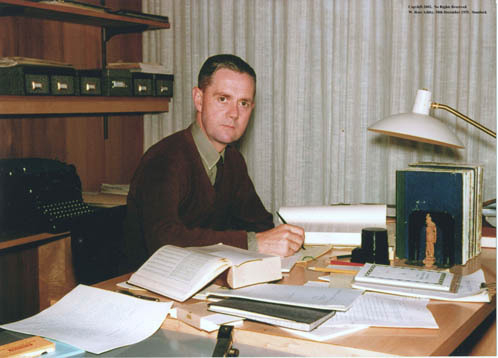
Even the index is just another note
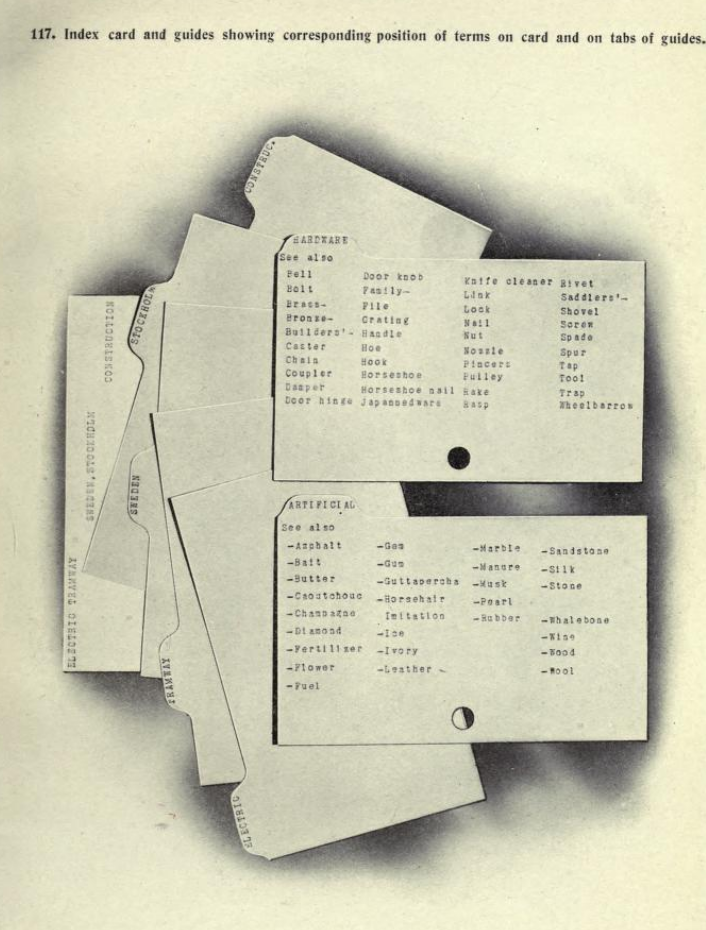
It’s tempting to place your notes in fixed categories
At some point in your note-making journey you’ll notice that quite a few people like to place their notes in fixed categories according to some scheme or other. The ancient method of commonplaces held that knowledge was naturally organised according to loci communis (common places). Ironically, no one from Aristotle onwards could ever agree on what the commonly-agreed categories were. Assigning your notes to categories is consistent with the ‘commonplace’ tradition, but that’s not what the prolific sociologist Niklas Luhmann did with his Zettelkasten, and furthermore it runs exactly counter to Luhmann’s claim in ‘Communicating with Slipboxes’, where he said:
“it is most important that we decide against the systematic ordering in accordance with topics and sub-topics and choose instead a firm fixed place (Stellordnung).”
But there’s no need to despair, there is a way through the impasse! After all, what exactly is a subject or category? The subject or category index itself, it turns out, is nothing other than just another note. Here’s a real-life example:
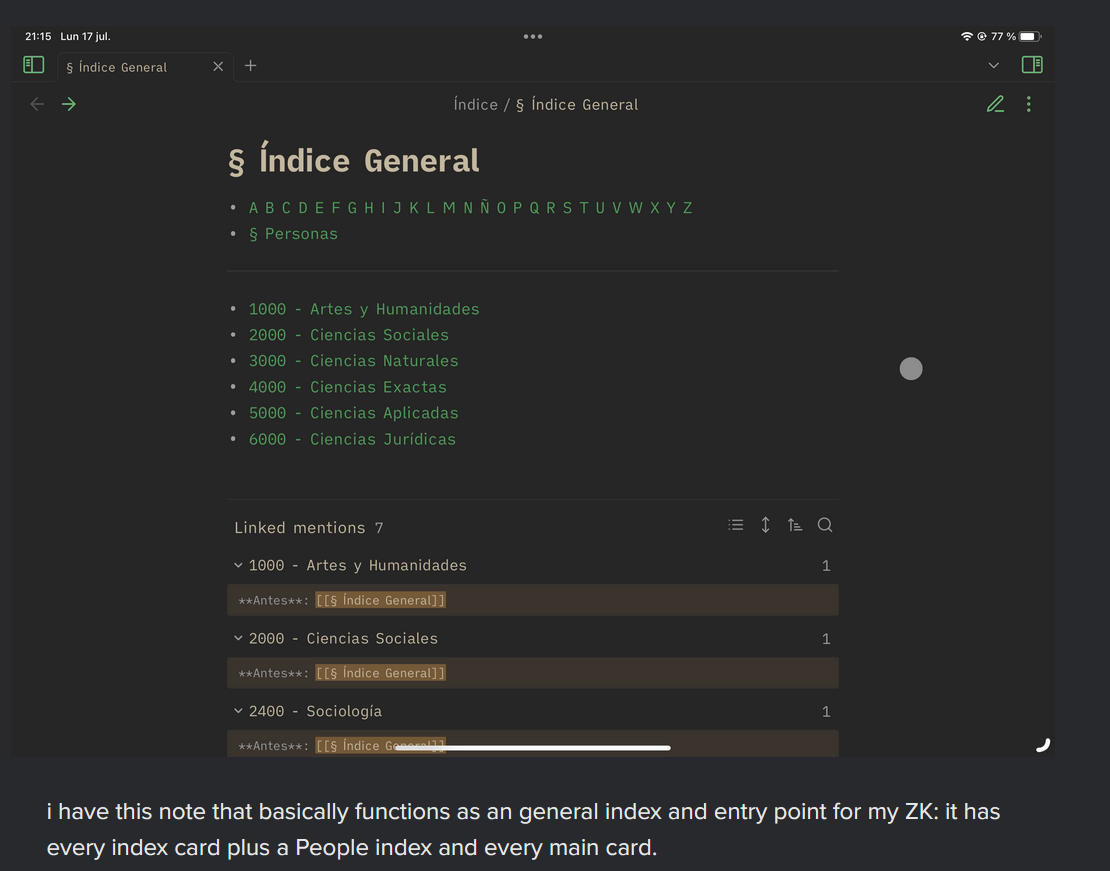
“i have this note that basically functions as an general index and entry point for my ZK: it has every index card plus a People index and every main card.” - u/Efficient_Earth_8773
When everything’s a note, even the categories are just notes
Why does this matter? If even the index is just a note, then you haven’t constrained yourself with pre-determined categories. Instead, you can have different and possibly contradictory index systems within a single Zettelkasten, and further, a note can belong not only to more than one category, but also to more than one categorization scheme. Luhmann says:
“If there are several possibilities, we can solve the problem as we wish and just record the connection by a link [or reference].”
When even the index is just a note, a reference to a ‘category’ takes no greater (or lesser) priority than any other kind of link. This is liberating. Where a piece of information ‘really’ belongs shouldn’t be determined in advance, but by means of the process itself.
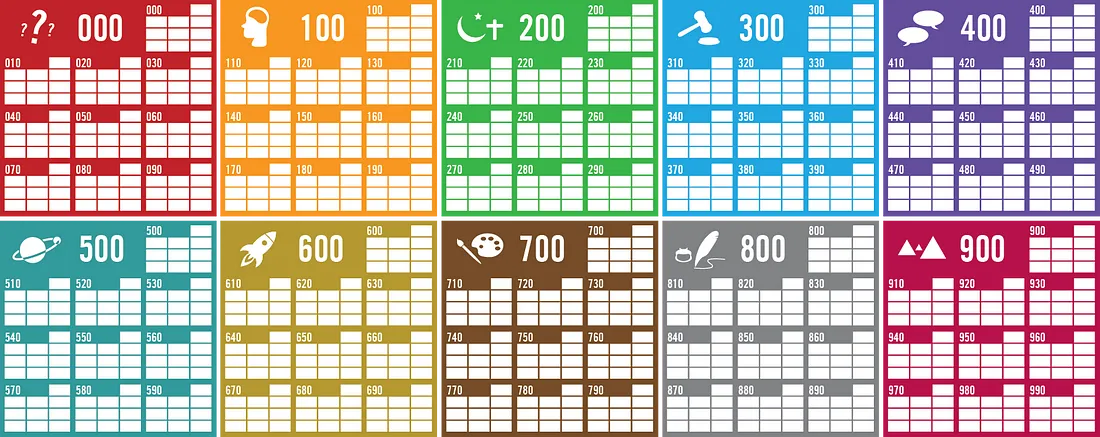
The Dewey Decimal System pigeonholes all knowledge, like cells in a prison.
Some people want an index, like folders in a filing cabinet, or subject shelves in the library. Well they can have it: just write a note with the subjects listed and make them linkable. Some people don’t want this, and they can ignore it. I personally don’t understand why you’d want to set up a subject index that mimics Wikipedia or the Dewey Decimal system, or even the ‘common places’ of old. I’m neither an encyclopedist, a librarian, nor an archivist. What I’m trying to do is to create new work. I want to demonstrate my own irreducible subjectivity by documenting my own unique journey through the great forest of thought. My journey is subjective, because it’s my journey. I’m pioneering a particular route, and laying down breadcrumbs for others to follow should they so choose. It’s unique, not because it’s original but because the small catalogue of items that attract me is wholly original. As film-maker Jim Jarmusch said:
“Select only things to steal from that speak directly to your soul. If you do this, your work (and theft) will be authentic.” (I stole that from Austin Kleon).
But that’s just me (and Luhmann).
Make just enough hierarchy to be useful
Having thought a bit about this I’m inspired now to sketch my own workflow, to see how it… flows. In general, I favour just enough data hierarchy to be viable - which really isn’t very much at all. I’m inspired by Ward Cunningham’s claim that the first wiki was ’the simplest online database that could possibly work’. Come to think of it, this may be one of the disadvantages of the way the Zettelkasten process is presented: perhaps it comes across as more complex than it really needs to be. As the computer scientist Edsger Dijkstra lamented,
“Simplicity is a great virtue but it requires hard work to achieve it and education to appreciate it. And to make matters worse: complexity sells better.” - On the nature of Computing Science (1984).
If you must have hierarchies like lists and trees, remember that they’re both just subsets of a network.
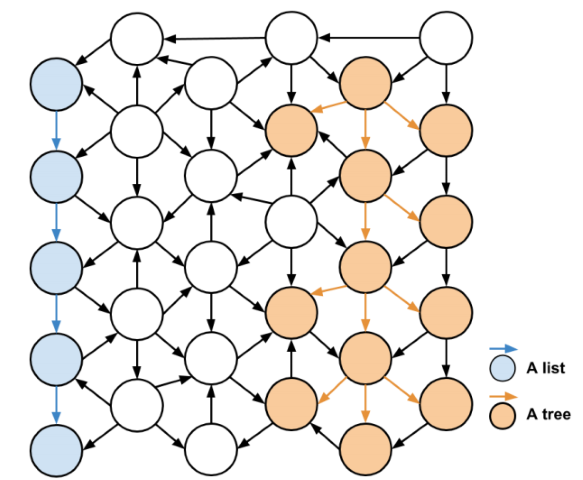
Source: I don’t know. If you do, please tell me ;)
See also: