
article
- A video interview with the author.
- A summary of the argument, adapted from the introduction: The Surprising New Significance of Shu Ha Ri in Postwar Karatedo.
- A 1983 BBC documentary about Okinawan karate: The Way of the Warrior: Karate, the Way of the Empty Hand. This is extraordinary and a real classic! (mentioned in a footnote on p.97).
-
Leonardo da Vinci, whose notes were “a collection without order”;
-
Leibniz, who created a haystack of notes (oh, and calculus);
-
Aby Warburg, who suffered from Verknüpfungszwang - the compulsion to find connections; and
-
Hermann Berger, a Swiss author who wrote a novel about a Zettelkssten (two actually) but didn’t publish it.
-
Then there’s cultural theorist Walter Benjamin, who invented a whole new methodology for his Arcades Project, which he didn’t finish. Wikipedia. He’s certainly a candidate for unqualified posthumous ADHD diagnosis.
Is there a Zettelkasten method?
Quite a few people write and speak about the Zettelkasten, a simple way of maintaining a note making system, but is there really any such thing? Some reflections on the seemingly obsolete practice of writing notes on small slips of paper and arranging them so they can be found again.
Mastering Any Skill, the Japanese Way
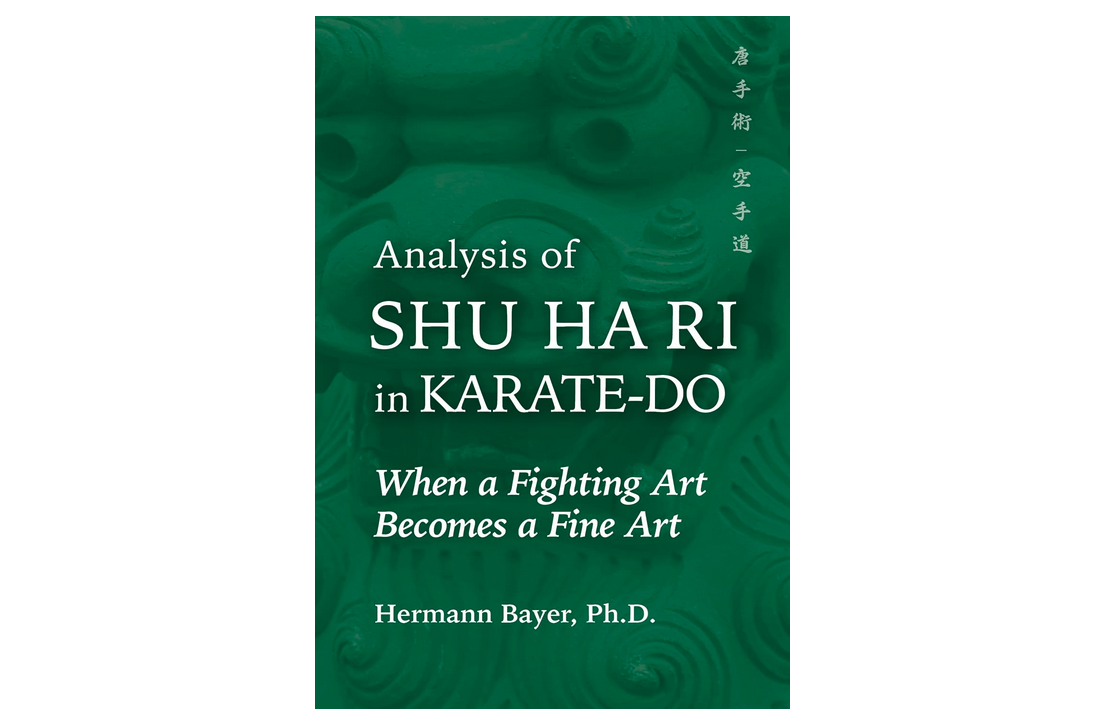
📚 A review of Analysis of Shu Ha Ri in Karate-Do: When a Martial Art Becomes a Fine Art by Hermann Bayer, Ph.D.
Most people believe that mastery of a skill comes from practicing harder and longer. ‘10,000 hours of deliberate practice’ has achieved a level of imperative unwarranted by the actual evidence (Epstein, 2021). Yet countless learners, whether in business, the arts, or sport, hit a plateau they can’t break through. The problem isn’t effort. It’s that they’re missing a hidden progression that separates the true experts from the merely experienced.
For centuries, Japanese masters have understood this journey. It has three distinct phases, Shu, Ha, Ri, and each demands a different mindset and approach. Skip one, and your growth stalls. Get them right, and you move beyond imitation into competence and ultimately mastery. Unlike many Western theories of learning, it’s not a linear set of stages to be climbed like the rungs of a ladder: instead it’s a cycle, a spiral of increasing competence where the earliest phase is never forgotten.
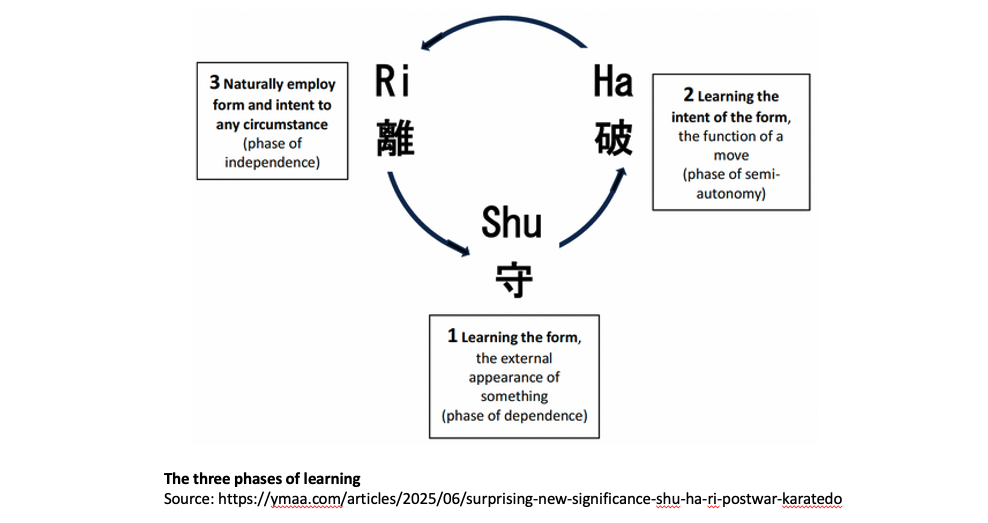
Hermann Bayer’s Analysis of Shu Ha Ri in Karate-Do is one of the clearest and most extensive explanations of this progression I’ve encountered. While his examples come from Okinawan karate, his real subject is the universal process of moving from novice to master, potentially in any discipline.
Bayer brings to his writing both deep scholarship and decades of martial arts expertise. This shows, but the book remains reasonably accessible for general readers. He unpacks philosophical ideas without jargon, showing exactly how they play out in practice. One of his most important clarifications is effectively a major theme of the book: Shu Ha Ri is not an Okinawan tradition. Despite its frequent modern association with karate, Bayer shows that the concept comes from Japanese fine arts, especially from the tea ceremony, and only entered karate after karate’s fairly recent introduction to mainland Japan, in 1922. This detail is more than just historical trivia; it changes how you see the concept. Shu Ha Ri is not tied to a single fighting style, and certainly not to karate. It’s potentially a transferable blueprint for mastering any complex skill.
Although Shu Ha Ri has wide applicability and has been adopted in many different disciplines, Bayer does focus heavily on karate, and on its Okinawan origins. This is the author’s specialist field. He is, after all the author of the two-volume Analysis of Genuine Karate, which explores Okinawa as the cradle of true karate. So readers curious about Shu Ha Ri, but with limited interest in karate and Okinawan history may wish for more examples from other disciplines. But the underlying framework is so universal that the author’s examples still work. You don’t need to know a kata from a kumite to apply what you learn.
If you are a practitioner of Karate, I suspect after reading this book you’ll never see it in quite the same way. But what makes the concept of Shu Ha Ri valuable beyond martial arts is its potential application to any field where performance and creativity matter. For instance, writers might see how to move from imitating their influences to developing a unique voice. Leaders might understand when to enforce process and when to encourage innovation. Artists, athletes, and entrepreneurs might recognise the moment to step beyond rules without losing their foundation.
If you care about personal growth and continuous improvement, or want a proven roadmap to mastery, this book will give you both the theory and the practical insight to get there. By the time you finish it, you won’t just understand Shu Ha Ri, you’ll be inspired to integrate this learning philosophy into your own life. And in case you were tempted, you will never again confuse Shu Ha Ri with the historical traditions of Okinawan karate.
Details
Analysis of Shu Ha Ri in Karate-Do: When a Martial Art Becomes a Fine Art by Hermann Bayer, Ph.D. (June 2025, ISBN: 9781594399954)
Purchase directly from the publisher, YMAA.
Resources
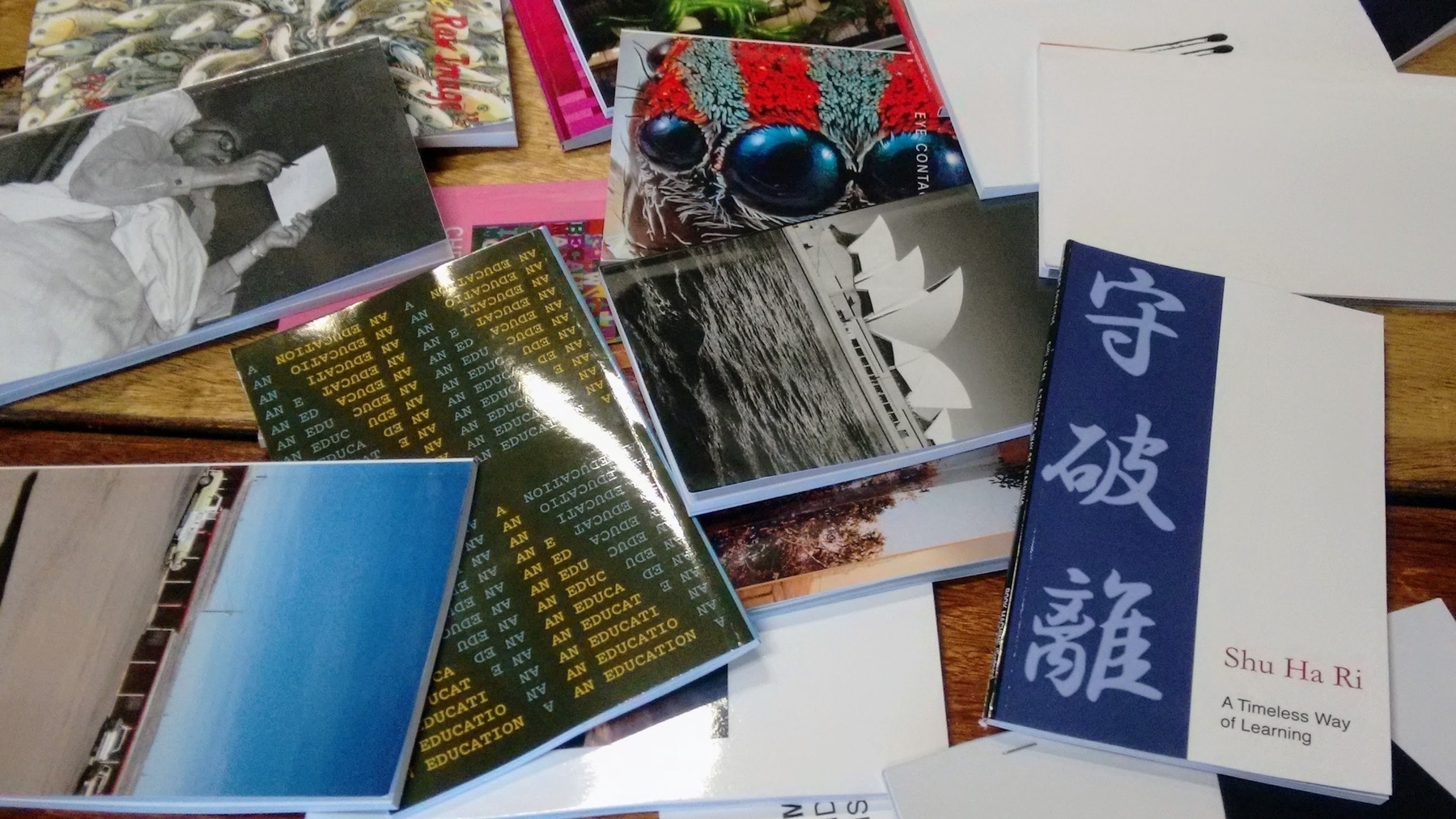
I’m the author of Shu Ha Ri: The Japanese Way of Learning, for Artists and Fighters. It’s a short and accessible introduction to the concept, available now.
And if you enjoyed this review, you may like to subscribe to the weekly Writing Slowly email digest.
Open, free and poetic
The Web is 34 years old! Following on from Plenty of ways to write online, here are some really practical resources to help you create your own presence online :
Keeping the Web free, open and poetic.
Old hands will probably find a few useful tips here too.
Oh, and here’s another great big list of useful personal website stuff. Actually, I’m making a note of this for my own ‘going down the rabbit-hole’ purposes:
Resources List for the Personal Web
It’s also easier than ever to publish a book. Check out mine: Shu Ha Ri: The Japanese Way of Learning, for Artists and Fighters. And to stay connected, subscribe to the weekly email digest.
*Image source: Public Domain, Wikimedia.

#indieweb #webwriting #worldwideweb #blogging
Plenty of ways to write online
Writing online is more accessible than ever. We can maintain control of our own work by publishing on personal websites while also syndicating content to social media. And as I’ve discovered, it’s also easier than ever to publish a book..
Watch in awe as a fleeting thought becomes a lasting note
I describe in detail how I wrote a blog post and then repurposed it as a permanent note in my Zettelkasten collection. This is the opposite of my usual workflow, where I create publishable writing from my existing notes.
Hot takes on our future with AI
Here are eight ‘hot takes’ on the latest problems, questions and opportunities large language models are giving us. It was going to be just three, but the hot takes are coming thick and fast right now. These links are shared alongside my personal reflections on the impact and future of AI that does your writing for you while cosplaying as a human.
I designed a book in three and a half hours
A while ago, well, quite a long while ago, I designed a book in three and a half hours. Fun, yes, but it wasn’t very publishable.
Now, years later, I’ve finally got round to updating and redesigning the whole thing.
Yes, I’m still writing slowly but I’m excited to say it will soon be available for sale - so watch this space for more information.
I’m unqualified to diagnose the following writers with ADHD but I’ll do it anyway
Yes indeed: confidently diagnosing deceased note-making writers with ADHD, while in possession of no medical qualifications myself, is a temptation I simply cannot resist.
For example I have wondered about:
As I said, it’s interesting, but for now I’ll stop there.
—-
This post started life as a comment on Reddit. If you’d like more from me, but in a weekly email, why not subscribe right now?
Don't let your note-making system infect you with Archive Fever
The Zettelkasten note-taking system offers a structured approach to organizing thoughts but might induce “archive fever,” which may lead to an obsession with preservation over actual writing. Here’s how to protect yourself.
Don’t throw away your old notes
Don’t throw out your old notes, even if you feel overwhelmed by them. Here are some helpful ideas on what to do instead.