article
- Harrison Owen, creator of Open Space Technology.
-
Don’t build a magnificent but useless encyclopaedia
-
Document your journey through the deep forest
-
Avoid inert ideas
-
Converse about what really matters to you
-
Imagine, then build, new knowledge products
-
Where (and how) you go is more important than where you start from
-
An example
- Maureen Murdock (1990) and later Gail Carriger (2020) have both presented feminised versions of the heroic quest narrative. I’m not convinced that these heroine’s journeys are really all that different, though, since they still assume that heroism, albeit that of women, is where it’s at. At least there’s an attempt to re-balance the faulty idea that only men are at the centre.
- The New Yorker published a moving non-fiction account by Laura Secor of an Iranian woman’s bravery. The true story of journalist Asieh Amini doesn’t rely on a standard heroic arc, yet is highly effective. This is only one example of very many alternatives.
- Novelist Becky Chambers points out in a talk on YouTube that real life has no protagonists. Surely this can help us to question stale narrative forms, especially those which claim to be true to reality.
- Meanwhile, Christina de la Rocha is on a noble quest to put an end to the hero’s journey in literature and beyond. OK, not a quest. Perhaps she’d approve of Ursula le Guin’s claim that “the novel is a fundamentally unheroic kind of story”. More on that in a moment.
- Screenwriter Anthony Mullins has written a whole book showing that there’s plenty more than only one kind of character arc.
-
See also Elizabeth Wayland Barber (1994) on women’s role in technology, textiles and the string revolution. ↩︎
-
If you’re not sure what website feeds are, see IndieWeb: feed reader and how to use RSS feeds. ↩︎
-
Does the index box distort the facts?
-
Can you create coherent writing just from a pile of notes?
-
Perhaps you should keep your notes private
-
Make it flow
-
To create coherent writing, make coherent notes
-
Begin with fragments
-
From smaller parts build a greater whole
-
Join your work together
-
Do it seamlessly well
Is the Web reconfiguring itself again?

Is the web falling apart?, Eric Gregorich wonders.
Meanwhile Manuel Moreale is confident that the web is not dying.
I agree with both of them. These views aren’t contradictory. Falling apart is what the Web does best. It’s been falling apart since it started, and reconfiguring itself too.
Google search used to control and shape the web. Because everyone just Googled their searches, websites all used Search Engine Optimization in a vicious circle of conformity. But that’s finally changing.
Search gets degraded by advertising greed on one side and AI tools are generating drivel on the other. Both are examples of what Ed Zitron calls the rot economy.
So how can good material rise to the surface?
In part it’s a return to the old ways. Blogrolls and webrings and RSS are having a mini-revival and it’s not entirely mere nostalgia. One-person search engines like Marginalia are having a moment, as are metasearch engines and other ‘folk’ search strategies. I like little experiments like A Website Is A Room.
Here’s my tip: to find interesting books, great quotes, and intriguing podcasts, more people should know about micro.blog Discover!
Photo by Valeria Hutter on Unsplash
How to set your own agenda
Harrison Owen, who died in March 2024, invented one of the most hopeful approaches to group facilitation I’ve ever come across. He called it ‘Open Space Technology’ (OST), but it was far from hi-tech. In fact, the main ’technology’ was simply in how people in a group setting can interact fruitfully with one another, even when they really don’t agree.
“Peace of the sort that brings wholeness, harmony, and health to our lives only happens when chaos, confusion, and conflict are included and transcended.”
I first came across Open Space as a means of organising workshops in highly contested political spaces.
In the UK during the 1980s and early 1990s progressive social activity was constantly undermined by Trotskyites (or whatever they were) striving to co-opt social movements for their own ends. There was always a risk that as soon as you set up a committee of any kind, they’d get themselves voted onto it and turn it into a front for the true workers revolutionary communist workers party, or some such combination of those terms.
But what were the alternatives? The Labour Party had been hammered with this problem, and had settled on a full-blown witch hunt against anyone affiliated with the Militant Tendency, which like a monstrous baby cuckoo had nearly pushed them out of their own nest. We’d witnessed how the so-called cure was nearly as bad as the disease.
I think it was about 1992 when we organised our own small Open Space event. Of course, the entryists turned up, but the Law of Two Feet really stumped them. When they realised anyone could set the agenda they were delighted. This must have seemed much easier than having to take over by stealth! But when the discussions began they were confounded by the fact that, equally, anyone could just walk away and find something more important to them. To everyone except the entryists, the experience was delightful.

Image by Chris Kinkel from Pixabay
Of course, OST didn’t change the whole world, and it’s not useful for every meeting. But it was formative for me personally, because I could see how people could come together to identify, commit to and begin to solve their own problems, without waiting for someone else to do it for them.
Open Space Technology has also left a strong mark on facilitation generally. Unconferences, World Café, Bar Camp, the Art of Hosting, design sprints, and many other approaches owe a great deal to Harrison Owen’s pioneering determination to trust people to pursue their own agendas.
Vale Harrison Owen.
More:
Working in Open Space: A Guided Tour
Don't make a Zitatsalat out of your writing
Zitatsalat? What does that even mean?
Yes, Zitatsalat. I found this lovely but rarely used German term in the title of a book by the journalist Stephan Maus. The book’s name is Zitatsalat von Hinz & Kunz.[^1]
I love the rhyming rhythm of this compound term, but what does Zitatsalat actually mean?
Well, Zitatsalat translates as Quote Salad. It’s not a compliment.

Zitatsalat, by Stephan Maus (2002).
But what’s wrong with quoting other writers?
How to make Mastodon even more fun!
Here are a couple of fun websites that will make Mastodon (and possibly the whole fediverse) even more fun. I know, it hardly seems possible. And if you know of others, please let me know about them too.
Just my toots
Do you sometimes wish you could see all your posts on Mastodon in a long list with no distractions? Of course you do! Every day! That’s why justmytoots.com is here to help. And yes, it shows you just your toots.
For the record, I hate the word ’toots'.
At least where I live no one thinks of flatulence when they hear it, but still, it somehow manages to sound even more stupid than ’tweets’, which takes some doing.
Now, above the cacophony of all the tooting I can almost hear you ask, “What’s the alternative?” ‘Posts’, that’s the alternative, and that’s what I’m sticking with. Why not join me, world?
Until then, you can see just my toots at https://justmytoots.com/@writingslowly@aus.social
RSS is dead LOL
Now this one really is cool.
You know how everyone at the Internet always says ‘RSS is dead’, right? It’s so annoying!
But anyway, just type in a fediverse username into rss-is-dead.lol and up pops a list of RSS feeds for that user and every account that account follows.
Its amazing! Nearly everyone I follow has an RSS feed! Wow!
Pretty much proves RSS still ain’t dead. Take that, haters!
Bonus fact: it turns out you can use RSS to ‘boost your productivity’. I don’t know what that phrase means, but it sounds great!
Meanwhile, check out my graph, or whatever you call it, at rss-is-dead.lol.
How to start a Zettelkasten from your existing deep experience
An organized collection of notes (a Zettelkasten) can help you make sense of your existing knowledge, and then make better use of it. Make your notes personal and make them relevant. Resist the urge to make them exhaustive.
Yes, we can be heroes, but does that mean we should be?
Yes really, we can be heroes. Thanks very much David Bowie! But if this sounds attractive, perhaps we should be careful what we wish for.
Do you want to be the hero of your own story? Perhaps you already are
According to reporting in Scientific American, imagining yourself as the hero of your own life gives you an increased sense of meaning.
“Our research reveals that the hero’s journey is not just for legends and superheroes. In a recent study published in the Journal of Personality and Social Psychology, we show that people who frame their own life as a hero’s journey find more meaning in it”.
But it’s not always great to be a hero
Meanwhile, from a quite different research perspective, comes a warning: Stanley and Kay (2023) caution that making people out to be heroic can inadvertently single them out for poor treatment from their peers.
“our studies show that heroization ultimately promotes worse treatment of the very groups that it is meant to venerate.”
Reading this I immediately thought of all those ‘heroic’ health workers who helped their communities through the COVID crisis at great personal cost and with very little long-term recognition (McAllister et al. 2020). In far too many cases, calling doctors, nurses and hospital workers heroes and even super-heroes ended up as quite tokenistic, little more than a way of justifying the exploitation of their labour. First they make you a hero, then they make you burn out.
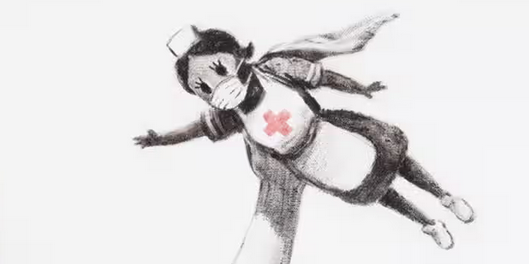
Banksy’s artwork of a child playing with a nurse ‘superhero’ doll raised more than 16m for charity… but nurses’ pay and conditions didn’t take off
Sometimes heroism isn’t what it seems
And here’s yet another, quite different warning: sometimes the person who sets themselves up as a classic hero is revealed to be anything but that. The case of Australian SAS fighter Ben Roberts-Smith is an extraordinary example of the moral jeopardy of a whole society desperate to believe in heroism. It seems this decorated and celebrated ‘war hero’ was really quite the opposite. The cover-up shows how much people want to believe in heroes, even when they don’t exist. This real-life tale has echoes of Beowulf to it. In Maria Dahvana Headley’s contemporary version (2021), the final words of that centuries-old tale ring painfully, bleakly, hollow with macho delusion:
”He rode hard! He stayed thirsty! He was the man! He was the man.”
So can we journey beyond the ‘hero’s journey’ already?
The hero’s journey trope has become so ubiquitous that it’s sometimes hard to remember that there’s any other kind of story. But there certainly is.
And author Jane Alison goes even further. In her book Meander, Spiral, Explode she notes that there are far more key patterns in literature than just the arc.
Not every story is a journey
Taking her cue from Joseph Frank’s book The idea of spatial form, and from Peter Stevens’s Patterns in Nature, Alison identifies some alternative or complimentary shapes.
I particularly like her concept of the story that meanders like a river, or ripples in waves and wavelets. These aquatic images remind me of something the former monk and psychotherapist Thomas Moore said about how life itself has a kind of liquidity to it:
“Your story is a kind of water, making fluid the brittle events of your life. A story liquefies you, prepares you for more subtle transformations. The tales that emerge from your dark night deconstruct your existence and put you again in the flowing, clear, and cool river of life.” (Moore, 2004, p. 61)
In his book on spatial form, Joseph Frank examines the structure of Djuna Barnes’s modernist novel, Nightwood. This novel doesn’t have a hero’s journey or a flowing river, but instead has a series of views or glimpses of life. He says:
“The eight chapters of Nightwood are like searchlights, probing the darkness each from a different direction, yet ultimately focusing on and illuminating the same entanglement of the human spirit . . . And these chapters are knit together, not by the progress of any action . . . but by the continual reference and cross-reference of images and symbols which must be referred to each other spatially throughout the time-act of reading.”
This searchlight metaphor is illuminating, but story structure can be yet looser, more diffuse than rivers and spotlights. I’m particularly taken with Ursula Le Guin’s carrier bag theory of fiction. Remember she said the novel is a fundamentally unheroic kind of story? If so then what is it?
“the natural, proper, fitting shape of the novel might be that of a sack, a bag. A book holds words. Words hold things. They bear meanings. A novel is a medicine bundle, holding things in a particular, powerful relation to one another and to us.”
Le Guin’s insight is itself based on the carrier bag theory of human evolution, as described in Elizabeth Fisher’s Women’s Creation (1979).
“The first cultural device was probably a recipient …. Many theorizers feel that the earliest cultural inventions must have been a container to hold gathered products and some kind of sling or net carrier.” 1
Not everyone needs to be a hero to be a valid person. Mostly it’s better when we’re not. And not every story needs to be a hero’s journey for it to be worth the telling. The idea of the hero can be useful in some circumstances, dangerous in others. But more often it just gets in the way. Sometimes it’s really about “complex skills and compassion”. Sometimes it’s less about hunting and more about gathering.
So now, do you still want to be a hero, you hero you?
Now read:
More than ever, embracing your humanity is the way forward
References
Alison, Jane. 2019. Meander, Spiral, Explode. Design and Pattern in Narrative. New York: Catapult.
Barber, Elizabeth Wayland. 1994. Women’s Work: The First 20,000 Years; Women, Cloth, and Society in Early Times. New York, NY: Norton.
Barnes, Djuna. 2006/1937. Nightwood, New York: New Directions.
Carriger, Gail. 2020. The Heroine’s Journey: For Writers, Readers, and Fans of Pop Culture. Gail Carriger LLC.
Fisher, Elizabeth. 1979. Woman’s Creation: Sexual Evolution and the Shaping of Society. 1st ed. Garden City, NY: Anchor Press.
Frank, Joseph. 1991 The Idea of Spatial Form, New Jersey: Rutgers University Press.
Headley, Maria Dahvana. 2021. Beowulf. A New Translation. Melbourne and London: Scribe.
Kaul, Aashish. 2014. Mapping space in fiction: Joseph Frank and the idea of spatial form. 3am Magazine
LeGuin, Kroeber, Ursula. 1989. “The Carrier Bag Theory of Fiction” in Dancing at the Edge of the World. New York: Grove Atlantic Press. Accessed at stillmoving.org/resources…
Margaret McAllister, Donna Lee Brien & Sue Dean (2020) The problem with the superhero narrative during COVID-19, Contemporary Nurse, 56:3, 199-203, DOI: 10.1080/10376178.2020.1827964
Moore, Thomas. 2004. Dark Nights of the Soul. London, UK: Piatkus Books.
Mullins, Anthony. 2021. Beyond the Hero’s Journey: A Screenwriting Guide for When You’ve Got a Different Story to Tell. Sydney, N.S.W: NewSouth Publishing.
Murdock, M. 1990. The Heroine’s Journey. Boston, MA: Shambhala Publications.
Rogers, B. A., Chicas, H., Kelly, J. M., Kubin, E., Christian, M. S., Kachanoff, F. J., Berger, J., Puryear, C., McAdams, D. P., & Gray, K. 2023. Seeing your life story as a Hero’s Journey increases meaning in life. Journal of Personality and Social Psychology, 125(4), 752–778. https://doi.org/10.1037/pspa0000341
Secor, Laura. 2015. War of Words. New Yorker
Stanley, M. L., & Kay, A. C. 2023. The consequences of heroization for exploitation. Journal of Personality and Social Psychology. Advance online publication. https://doi.org/10.1037/pspa0000365
Stevens, P. 1974. Patterns in Nature, New York: Little, Brown & Co.
Atomic notes - all in one place
From today there’s a new category in the navigation bar of Writing Slowly.
‘Atomic Notes’ now shows all posts about making notes.
How to make effective notes is a long-standing obsession of mine, but this new category was inspired by Bob Doto, who has his own fantastic resource page: All things Zettelkasten.

The Atomic Notes category is now highlighted on the site navigation bar.
And if you’d like to follow along with your favourite feed reader,there’s also a dedicated RSS feed (in addition to the more general whole-site feed).1
But if there’s a particular key-word you’re looking for here at Writing Slowly, you can use the built-in search.
And if you prefer completely random discovery, the site’s lucky dip feature has you covered.
Connect with me on micro.blog or on Mastodon. And on Reddit, I’m - you guessed it - @atomicnotes.
See also:
Assigning posts to a new category with micro.blog
A new post category in micro.blog, filtered to include existing posts
Micro.blog is a really useful and easy way to host a website. Even though it feels more like a cottage industry than a corporation there are way more features (and apps!) than I can probably use. It’s amazing how much Manton Reece, micro.blog’s creator, has achieved.
Under the hood the micro.blog platform is based on the Hugo static site generator, but there are a few differences. One such difference is post categories.

Here’s a new category being created.
It’s very easy to create a new category of posts, then you can use a filter to automatically add all new posts that include a selected key-word (or emoji, or even html element). By default only new posts are affected. But by running the filter you can also add all previous posts that meet the selected criteria. That’s what I wanted to do.

Once you have a new category, you can add a filter. This particular filter assigns to this new category only long posts with a particular word in the text.

When you run the filter, all existing posts that match will be added to the category. And future posts will be added automatically.
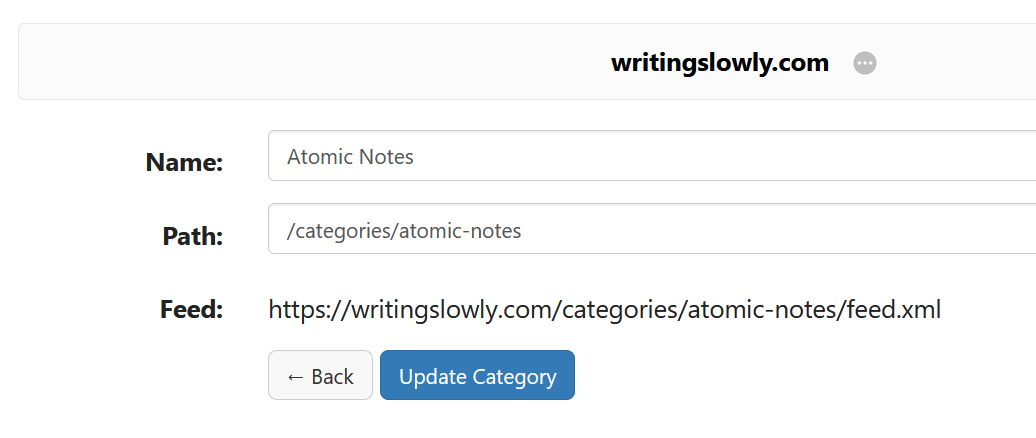
Also, each category gets its own RSS feed, which can be very useful.
This process was much easier than I expected!
More info from elsewhere:
How to overcome Fetzenwissen: the illusion of integrated thought
It’s too easy to produce fragmentary knowledge.
One potential problem associated with making notes according to the Zettelkasten approach is Verknüpfungszwang: the compulsion to find connections. It may be true philosophically that everything’s connected, but in the end what matters is useful or meaningful connections. With your notes, then, you need to make worthwhile, not indiscriminate links.
Another potential problem is Fetzenwissen: fragmentary knowledge, along with the illusion that disjointed fragments can produce integrated thought.
Almost by definition, notes are brief, and I’m an enthusiast of making short, modular, atomic notes. Yes, this results in knowledge presented in fragments. And in their raw form these fragmentary notes are quite different from the kind of coherent prose and well-developed arguments readers usually expect. You can’t just jam together a set of notes and expect them to make an instant essay. So is this fragmentary knowledge really a problem for note-making? If so, how can determined note-makers overcome it?
From fragments you can build a greater whole
Everything large and significant began as small and insignificant
This is my working philosophy of creativity and I’m trying to follow it through as best I can. Starting with simple parts is how you go about constructing complex systems.
“A complex system that works is invariably found to have evolved from a simple system that worked. A complex system designed from scratch never works and cannot be patched up to make it work. You have to start over, beginning with a working simple system”. — John Gall (1975) Systemantics: How Systems Really Work and How They Fail, p. 71.
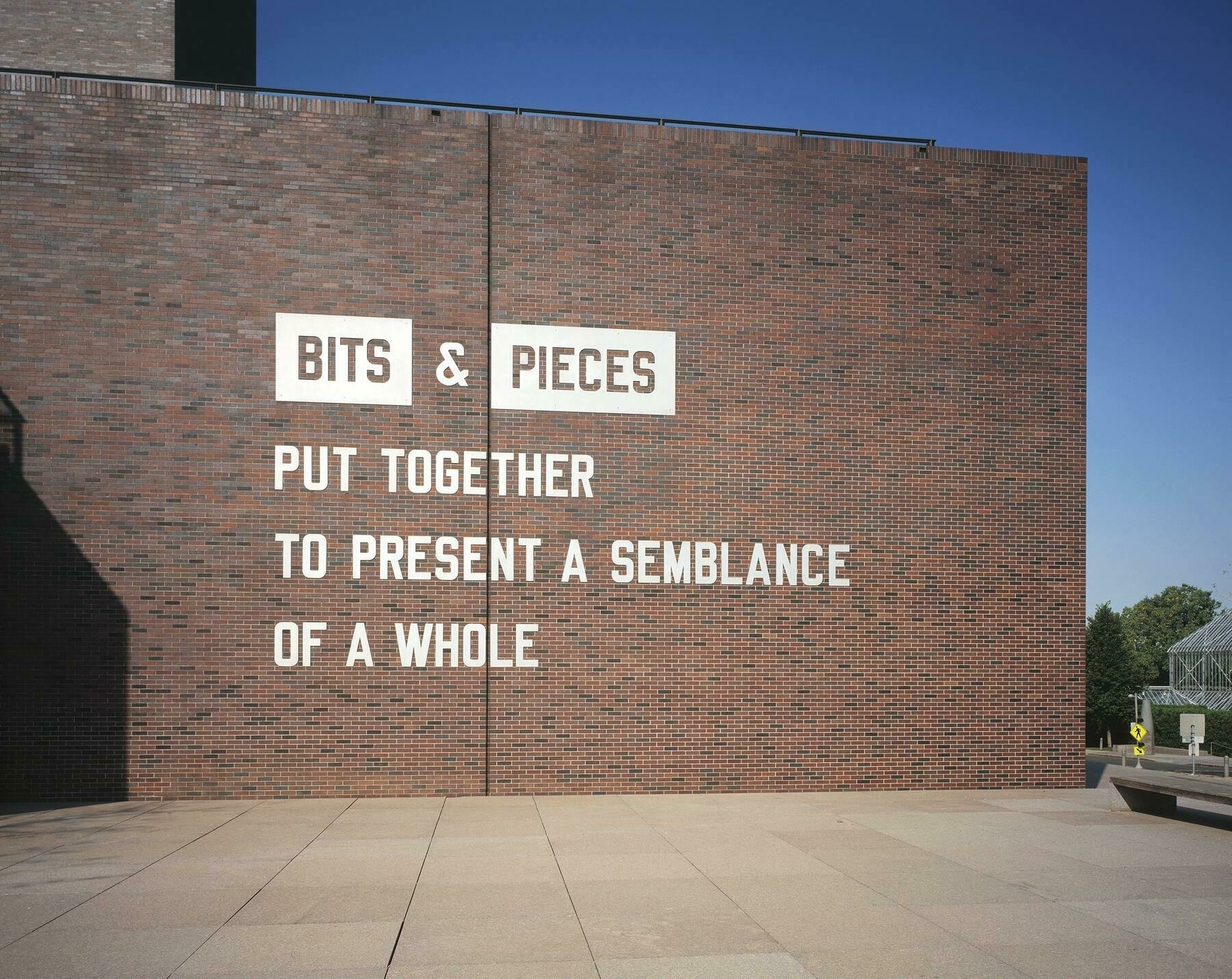
Bits and pieces put together to create a semblance of a whole, by Lawrence Weiner