Bookshops in Sydney. How's it going?
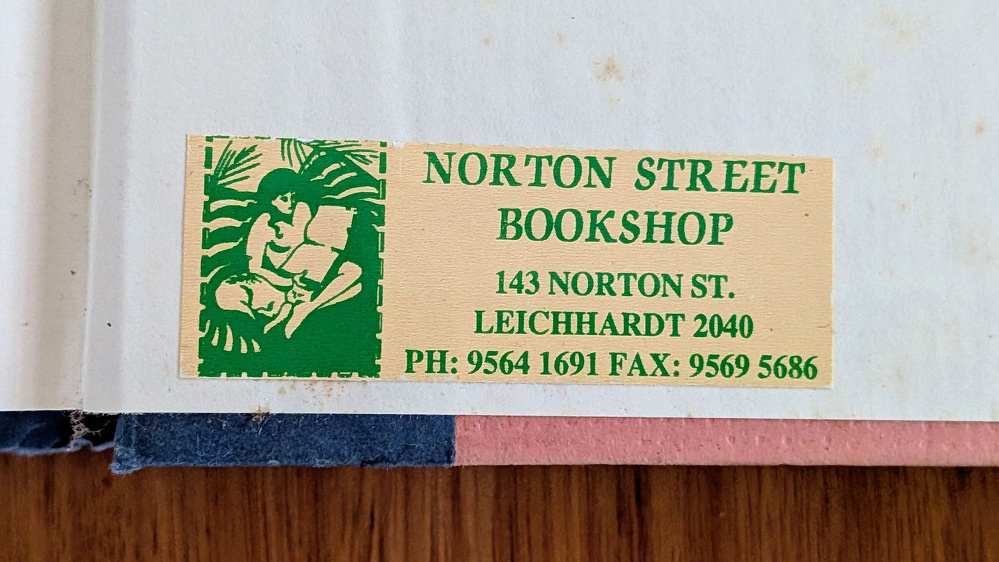
In the house by the ocean where we’re currently staying there’s a copy of Annie Dillard’s collection of essays, For the Time Being. In the inside back cover there’s a label from the store where it was purchased: Norton Street Books in Leichhardt, Sydney. That book shop has long since closed, so long ago that I’ve never personally heard anyone mention its existence. But then this year when Berkelouw Books, also on Norton Street in Leichhardt, announced they were shutting down I realised I’ve been living in Sydney for long enough now to have experienced the closure and opening of many bookstores over the years.
A good decade before COVID, around 2010 there was a period when it felt as though there was a real culling of Sydney bookshops. This was around the time Dymocks closed several of their CBD branch stores to focus on just their flagship store on George Street. Each closure felt like the end of an era. Cumulatively it was seriously worrying. And then the turmoil grew worse.
According to the ABC, “In the decade from 2013 to 2023, the number of Australian bookshops roughly halved: from 2,879 to 1,457.”
You can read more about this in Our love of cheap books is hurting independent bookstores and writers. But there may be a solution.
Though I knew nothing of Norton Street Books, I can remember Shearer’s books in Leichhardt, also closed down, as well as the legendary Gould’s Book Arcade in Newtown (YouTube doco), Adyar Books on Clarence Street, the whole chain of ABC bookstores (there was one in the Queen Victoria Building, as I recall), and the University Co-Op bookstore in Ultimo. Oh, and I remember Basement Books, the cavernous remaindered books emporium in the Devonshire Street tunnel right next to Central Station. Given how heavily it relied on commuter foot traffic, it was surely the COVID pandemic of 2020 that contributed to its sudden demise.
I want to believe book shops will exist for ever, but it’s a dynamic scene, and even though the closure of a single store feels painful, I know from experience that others are likely to pop up, perhaps in unexpected places.
So yes, quite a few stores have changed hands or closed, but since then other book shops have arrived, while established outlets have experienced new vigour and, presumably, new customers. Brays Books in Balmain became Roaring Stories. The late Bob Gould’s daughter set up a new Gould’s Books further down the same street in Newtown as the old one. GleeBooks in Glebe received a fantastic makeover and is still one of my favourites, not least because it’s right next door to Sappho, which has a wonderful selection of second-hand titles. And every time I visit Kinokuniya, the giant Japanese book store in the CBD I’m a little taken aback to find I’m more or less the oldest person in there. The aisles seem to be full of young adults seeking out the latest fantasy novels and manga and everything else displayed on the shelves.
Yes, there are still plenty of interesting stores dotted around Sydney: Ariel, Title, Gertrude & Alice, Constant Reader, Bookoccino, Better Read than Dead, Elizabeth’s second-hand store, Hill of Content, Urchin Books (another second-hand store, plus it has cats!), Abbeys (my absolute favourite for history titles), the Potts Point bookshop, Desire Books & Records over in Manly. And I haven’t even mentioned the dozen or so outlets of the QBD chain and the nine or ten of Harry Hartog, and the numerous suburban Dymocks stores that didn’t close.
Sydney has a long and dynamic tradition of bookselling. I was wondering about the way Dymocks in George Street has gradually been reducing its floorspace for books and devoting it to stationery and gifts. But then from an online history of Sydney Bookshops I learned that the upper floor of the flagship Dymocks store used to sell not books, but pets. I guess it was always like this: changing.
So even though one bookstore in Leichhardt has announced closure, I thought, perhaps another bookstore will open there on the ever up-and-coming-but-never-actually-arrived Norton Street. And there are still Berkelouw’s outlets in Paddington and Balgowlah, and the Berkelouw’s Book Barn in Berrima, with its popular cafe and wonderful collection of top-quality second-hand titles.
There’s a map of some of the bookstores I’ve mentioned, made for the Global Book Crawl.
And actually, the future of bookstores around Sydney is quite bright! A new book shop opened in Summer Hill. On opening night at the Rose Read Bookshop (I guess that’s a clever pun), there was a long queue just to get in. Were the residents of Summer Hill previously starved of reading material? Do the owners just have a lot of friends? Either way, the founders, Stephanie Beck and Mischa Parkee recognise people want a personal connection: the store opened with at least six book clubs and a full calendar of book launches (and even yoga). And when I last looked they were advertising no fewer than eight book clubs.
When sisters Amanda Isler and Deborah Thompson announced in May 2026 that they had sold Collins Books Thirroul, the store they’d opened in Thirroul just south of Sydney after eight years of successful operation, there was local consternation. But within a couple of months, as detailed in Chapter 2: A new owner at Collins, there was a new and enthusiastic owner and manager, James Tierney, who has previously managed both Bookoccino in Avalon and GleeBooks in Glebe.
And what about Berkelouw Books in Leichhardt? As announced in Berkelouw Leichhardt Moving Next Door, the next we knew, they announced that instead of shutting down, they’re just moving next door. As I said, the future of bookstores is bright.
One key factor is that in this febrile moment that idolizes automation, and not least automatic writing, there’s a counterpoint: people increasingly turn to real human presence. More and more, bookshops are becoming venues for live events, and thereby contributing to the knitting together of communities of literacy and ideas. As James Tierney said in an interview: “I’ll definitely be continuing the events program. If anything I’ll be looking to strengthen it in any way we can… It’s just good for my soul, it’s good for the community to have access to people of that quality in the community and just to ask questions and get a conversation going.” In some ways, the need to compete with remote and online alternatives is forcing book shops to be more like how I always imagined they should be: places that bring people together, even as they place books in their hands.
Perhaps your home town or city has a book store you like, or even, if you’re exceptionally lucky, more than one.
In the introduction to her collection of essays Annie Dillard described her main themes. One of them was “Given things as they are, how shall one individual live?”
Thinking about the ebb and flow of book stores, I’m pretty sure they’re a really important part of my life. So what about you? How do you feel about the state of the bookshops near you? Do you see a resurgence in interest in the physical book and the people who make them, or a retreat? And are you optimistic or pessimistic about the future of books and reading?
For more perspectives, you can listen to a podcast episode from the ABC that addresses some fears for the future of the book: Can books survive the age of algorithms? | Download this Show Podcast.
I know what you’re thinking. You’re thinking: “But I don’t live in Sydney.” Fear not! There are even bookshops outside Sydney. For example, there’s a trail of thirteen bookshops in the Blue Mountains, which by my unreliable calculation gives the area one of the highest densities of bookshops to residents in the world. Even if you don’t live in Sydney or the Blue Mountains, in fact, wherever you live, why not find yours and cherish them while they last?
I’m the author of Shu Ha Ri. The Japanese Way of Learning, for Artists and Fighters, available now.