
Why I wrote the book on Shuhari and what’s in it for you
Well, a book doesn’t just write itself, but why should I be the one to write it? What made me decide to write an introduction to the Japanese concept of Shuhari? There were several reasons and here are five of them.
-
The well is poisoned now with AI slop, but even years ago when I was looking online for information on Shu Ha Ri, there were plenty of mentions but it was all extremely shallow. There were hot takes from martial arts sites and almost clueless discussions about agile software development. True, they mentioned the concept but not where it had come from, or really any context. They were skimming the surface of a very deep pond. I wanted something more substantial and so I started researching.
-
To this day there is no accessible introduction to Shu Ha Ri, and nothing in print with credible references that you can follow up yourself if you want to. So I saw a gap that was begging to be filled.
-
No one else had done it. I mean I’m not the world’s greatest expert on Japanese culture, but no one else wrote the book on Shuhari. My first draft was written in 2015 and I gave the world another 10 years to write the book on Shuhari. No one did, so in July 2025 I published my own book myself. Ironically, another introduction to Shuhari was finally published, in Spanish, two months later.
-
I had a bee in my bonnet, put there by the literature on learning. It’s heavily learner-focused, which is fine, but very often it misses out entirely any mention of the role of teaching, which is not fine. This seems plainly weird, and in my own small way I wanted to make a contribution to correcting this. Learners need teachers, and what’s more, the teachers need to be humans, not bots. I saw the Japanese concept of Shuhari as a way of emphasising this point, that learning and teaching are two sides of the same coin.
-
Following on from this last point, I wanted to present a different approach to learning theory, one with is about social interaction, not just neuroscience. Understanding the brain is great, obviously, but learning and teaching takes place in an environment that extends well beyond the individual brain.
So anyway, I did the research, I read scores of books and articles, I took endless photographs (of which readers only get to see the best ones), I chased up obscure references, many in Japanese, with which I needed to gain at least a basic familiarity, and I visited Japan. Oh, and I wrote the book, designed the cover, and published it.
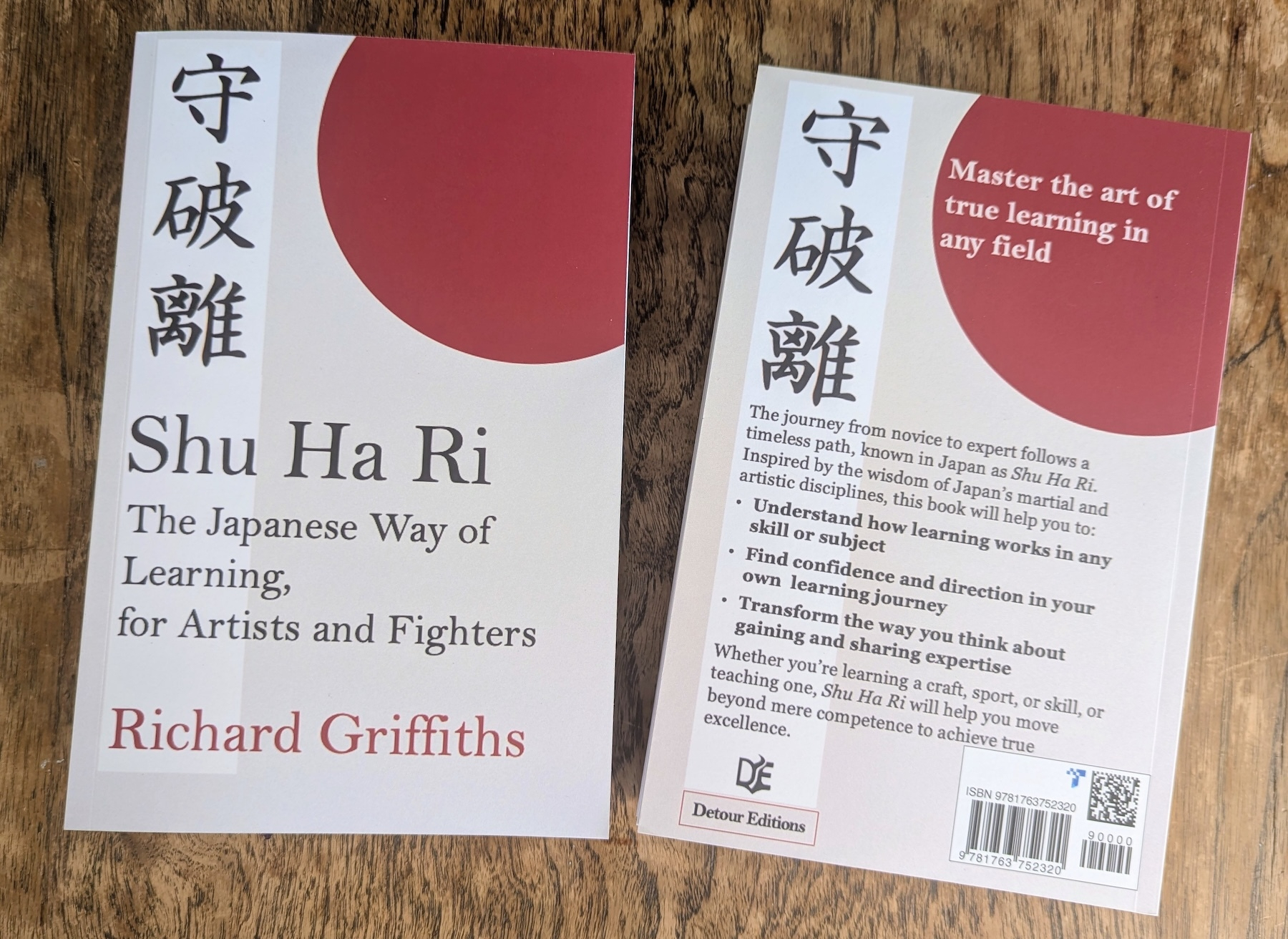
The result is Shu Ha Ri: The Japanese Way of Learning, For Artists and Fighters. I hope you enjoy it and find it useful.
One reviewer said:
”Simple in its structure, yet profound in the information it conveys, SHU HA RI is a must read for anyone wanting clarity on a tried and true approach to teaching and apprenticeship. A great resource for teachers, but also anyone interested in learning how to honor the teachings of precious masters while respectfully forging ahead.”
—-
Now read:
Japanese Shu Ha Ri: Is it better than Western learning methods?
There’s a fundamental flaw in how we learn about expertise.
Mastering any skill the Japanese way.
And of course, my book, Shu Ha Ri: The Japanese Way of Learning, for Artists and FIghters.