quote
Shu Ha Ri and the philosophy of interior design
The late interior designer Professor Shigeru Uchida discusses the importance of Shu Ha Ri for design:
💬 “The current education system lacks “Shu.” There’s a total absence of the attitude to observe, study, and learn from others. The term “breaking the mold” is common, but without having learned anything from others, one cannot depart from or break away from anything.”
I’m the author of Shu Ha Ri. The Japanese Way of Learning, for Artists and Fighters, available now in paperback and ebook.
💬 “The way we organise our online lives bleeds into the way we organise the rest of our social interactions. If it’s just assumed without question that the online space is a fiefdom, then democracy everywhere is undermined.”
Why niche blogs and small rooms still win
#DigitalLife #Blogging #OnlineCommunity #SmallWeb #Fediverse #Decentralization
💬 “By jumping off your roof into a paddling pool with a goat in it you’ve probably enjoyed millions of views. You’ve probably gone totally viral. But the thing is… I don’t want to be a serf on someone else’s plantation.”
💬 Everyone has principles, don’t they, until the moment they see the phrase, “MySQL wasn’t configured properly”?
AI is not helping the learning process
💬 “When teachers rely on commonly used artificial intelligence chatbots to devise lesson plans, it does not result in more engaging, immersive or effective learning experiences compared with existing techniques”
See also:
Civic Education in the Age of AI: Should We Trust AI-Generated Lesson Plans? | CITE Journal
I’m the author of Shu Ha Ri: The Japanese Way of Learning, for Artists and Fighters, available now.

Provocative words about learning, teaching, AI, and the timely value of history
Do you like links? Here’s what I’ve come across on the Web lately: provocative words about learning, teaching, AI, and the timely value of history.
💬 “What A.I. can’t do is feel the shape of silence after someone says something so honest we forget we’re here to learn. What it can’t do is pause mid-sentence because it remembered the smell of its father’s old chair. What it can’t do is sit in a room full of people who are trying—and failing—to make sense of something that maybe can’t be made sense of. That’s the job of teaching.” — Sean Cho A. on teaching college during the rise of AI The Rumpus.
💬 “When human inquiry and creativity are offloaded to anthropomorphic AI bots, there is a risk of devaluing critical thinking while promoting cognitive offloading. If we turn the intellectual development of the next generation over to opaque, probabilistic engines trained on a slurry of scraped content, with little transparency and even less accountability, we are not enhancing education; we are commodifying it, corporatizing it, and replacing pedagogy with productivity.” — Courtney C. Radsch, We should all be Luddites • Brookings.
💬 “While the school says its students test in the top 1% on standardized assessments, AI models have been met with skepticism by educators who say they’re unproven.” — The $40,000 a year school where AI shapes every lesson, without teachers. CBS News. Wikipedia: Alpha School. I’ll revisit this in a few years to see just how hard it crashed (or not).
💬 “As our lives become more enmeshed with technological devices, services, and processes, I think that awareness is something which we the technology-wielding should strive for if we want to build a properly humane and empathic world.” — Matthew Lyon, The Fourth Quadrant of Knowledge • lyonheart.
💬 “Knowledge of history and awareness of history can allow us to see patterns, make connections, and identify incipient problems. It can give us a language and a set of references which allows us to step back, broaden our view, and see things and sometimes warn ourselves and others when necessary.” — Timothy Snyder on Stalin and Stephen Miller.
I’m the author of Shu Ha Ri. The Japanese Way of Learning, for Artists and Fighters, available now.. And for all the crunchy, fresh Writing Slowly goodness you can sign up to the weekly digest. It’s exactly like a bunch of radishes, but made out of email.

Publishing means no more hiding
Revelation must be terrible, knowing you can never hide your voice again. – David Whyte
Publishing my book, I had the strange feeling of having crossed an invisible but very powerful threshold.
It was while signing copies at a small and very supportive gathering, that it dawned on me that the thoughts that used to be just in my head are now public and exposed to the world – and since I’ve lodged this work in every State Library in Australia, they’ll never again be totally private.
I had thought I just wanted to publish my words, to release my book into the wild, as it were, to allow it to find its readers.
So it never occurred that I might have been benefiting in some way from the obscurity of the drafting process.
Not that I want to hide my voice – far from it.
Nor that I’m expecting a million readers. Again, far from it.
But the knowledge that I now have one unique reader – you – with whom my words will perhaps connect whether I bid them or not, well that changes things somehow.
And it’s certainly a revelation to realise there’s no going back.
My book, Shu Ha Ri: The Japanese Way of Learning, for Artists and Fighters, is out now. Please check it out.

Curious about Hypercuriosity
One reason I make notes and write is that I’m curious about everything.
I’ve written previously about how to be interested in everything. And I’ve also written about busybodies, hunters and dancers - three different styles of curiosity.
It was the ‘dancer’ style of curiosity that resonated most with me:
“This type of curiosity is described as a dance in which disparate concepts, typically conceived of as unrelated, are briefly linked in unique ways as the curious individual leaps and bounds across traditionally siloed areas of knowledge. Such brief linking fosters the generation or creation of new experiences, ideas, and thoughts.”
So I was interested to see that Anne-Laure Le Cunff, author of Tiny Experiments and founder of Ness Labs, Has been exploring what she calls ‘hypercuriosity’, which may be associated with ADHD.
Well, I guess I’m the living proof. I set out this evening to write about my book, Shu Ha Ri: The Japanese Way of Learning for Artists and Fighters but I ended up writing about something completely different instead: hypercuriosity.
Come to think of it, that’s how the book got written in the first place, by pursuing my curiosity. And come to think of it, that’s how I do practically everything.
In writing the book I was particularly attracted by the value placed on the Japanese concept of shoshin (初心), ‘beginner’s mind’ - a quality often downplayed in Western contexts, where experts are supposed to already know everything.
I’m more interested in not knowing - and then going to great lengths to find out.
Links:
Brar, G. (2024, November 14). The hypercuriosity theory of ADHD: An interview with Anne-Laure Le Cunff. Evolution and Psychiatry (Substack).
Gupta, S. (2025, September 16). People with ADHD may have an underappreciated advantage: Hypercuriosity. Science News.
Le Cunff, A. (2024). Distractability and impulsivity in ADHD as an evolutionary mismatch of high trait curiosity. Evolutionary Psychological Science, 10, 282.
Le Cunff, A. (2025, July 15). When curiosity doesn’t fit the world we’ve built: How do we design a world that supports hypercurious minds? Ness Labs.
If you’re curious to catch the latest Writing Slowly action, please subscribe to the weekly email digest. All the posts, delivered straight to your in-box.

Keeping a diary is a way of living
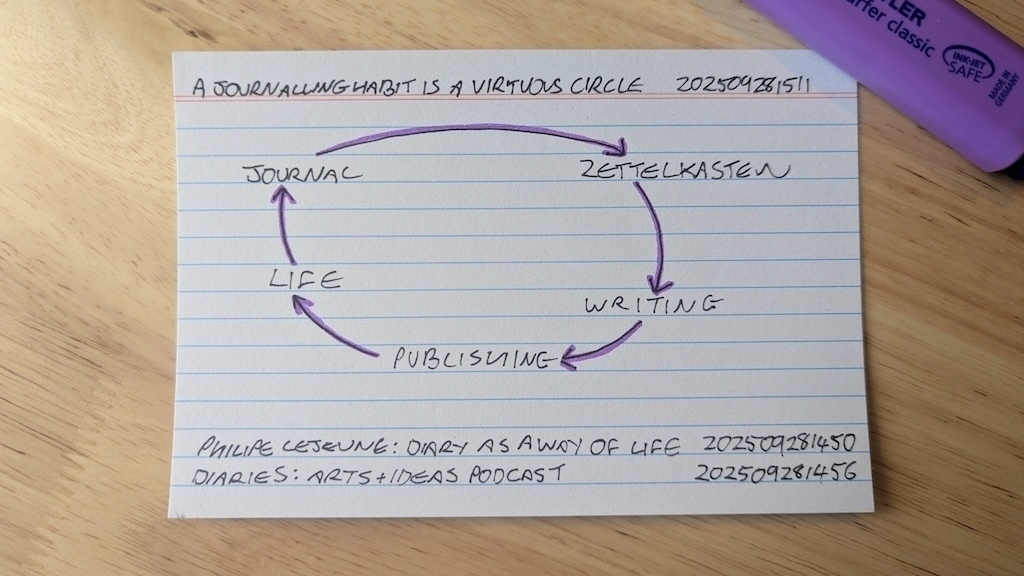
“A diary is not only a text: it is a behaviour, a way of life, of which the text is a by-product" - French theorist Philipe Lejeune. Source: Arts & Ideas Podcast.
Exactly so. I have a journalling habit, which fuels my Zettelkasten, (my collection of linked notes), which in turn fuels my writing. This in turn affects my life, which I journal about. It’s a virtuous circle.
I’m the author of Shu Ha Ri: The Japanese Way of Learning, for Artists and Fighters.
And did you know you can sign up to the Writing Slowly weekly email digest?
Zettelkasten podcast episodes
Here are a couple of podcast interviews where the Zettelkasten approach to making notes is discussed in detail. Enjoy!
William Wadsworth (Exam Study Expert) interviews Sonke Ahrens, author of How to Take Smart Notes. Apple Podcasts.
Sönke Ahrens on Niklas Luhmann’s writing process:
“The main part of the writing process happened in this in-between space most people, I believe, neglect. They write notes, they read, they polish their manuscripts, but I think few people understand the importance of taking proper notes and organising them in a way that a manuscript, an argument, a chapter can evolve out of that.”
Jackson Dahl (Dialectic) interviews Billy Oppenheimer, Ryan Holiday’s research assistant, on staying attuned for clues. Apple Podcasts.
“I adopted/adapted Ryan Holiday’s notecard system, which he learned from Robert Greene. And it’s just literally boxes of 4x6 notecards. I’ve never seen Robert’s actual cards, but I have seen Ryan’s. His are filled with shorthands: a maybe a phrase, a word, or a single sentence that conveys a story from some book. They are little reminders capturing the broad strokes of something. You notate it with the book and page number so you can go back and find the specific details.”
“Niklas Luhmann also has another great idea about making notes for an ignorant stranger… Because that’s what you are when you come back to it. We think, “There’s no way I’m going to forget this story.” You come back to it, and it’s highlighted and underlined. You’re like, “What was I loving about this?” I try to make the note cards for an ignorant stranger. You should be able to pick one up and have enough context to make out what this thing is. And so in a similar way, in the margins of books, I try to do that for myself.”