note

Andy Bell found 14 ways to supercharge your workflow with AI, but I’ve found the single best one.
A new post category in micro.blog, filtered to include existing posts
Micro.blog is a really useful and easy way to host a website. Even though it feels more like a cottage industry than a corporation there are way more features (and apps!) than I can probably use. It’s amazing how much Manton Reece, micro.blog’s creator, has achieved.
Under the hood the micro.blog platform is based on the Hugo static site generator, but there are a few differences. One such difference is post categories.

Here’s a new category being created.
It’s very easy to create a new category of posts, then you can use a filter to automatically add all new posts that include a selected key-word (or emoji, or even html element). By default only new posts are affected. But by running the filter you can also add all previous posts that meet the selected criteria. That’s what I wanted to do.
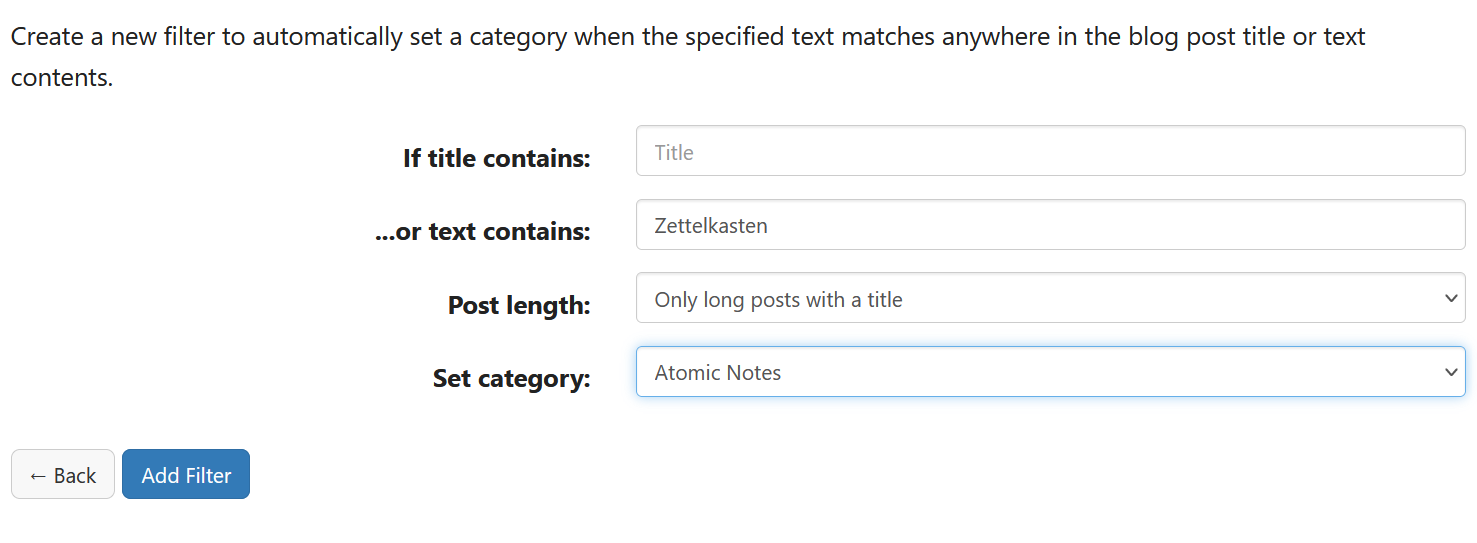
Once you have a new category, you can add a filter. This particular filter assigns to this new category only long posts with a particular word in the text.
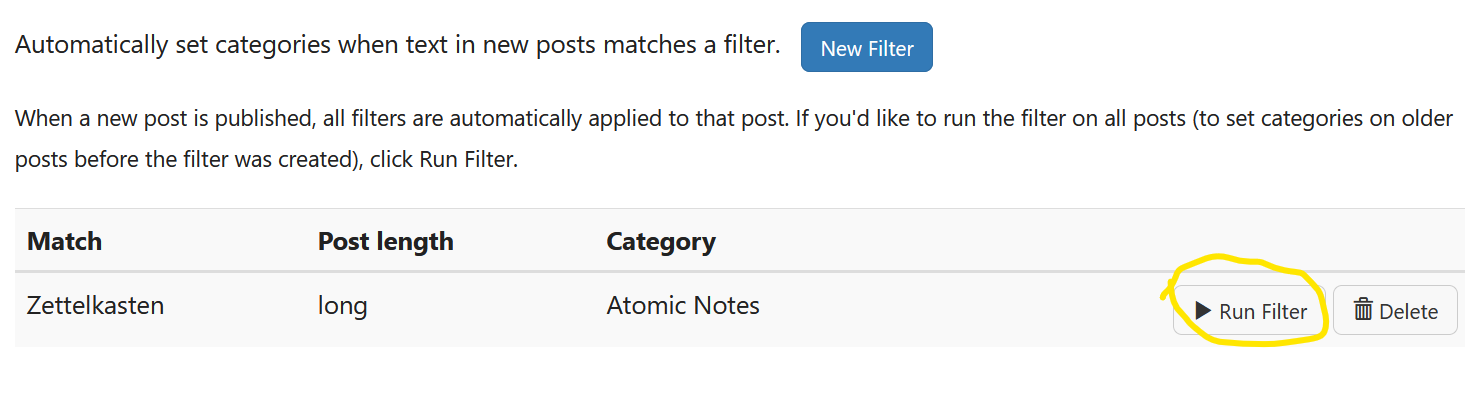
When you run the filter, all existing posts that match will be added to the category. And future posts will be added automatically.
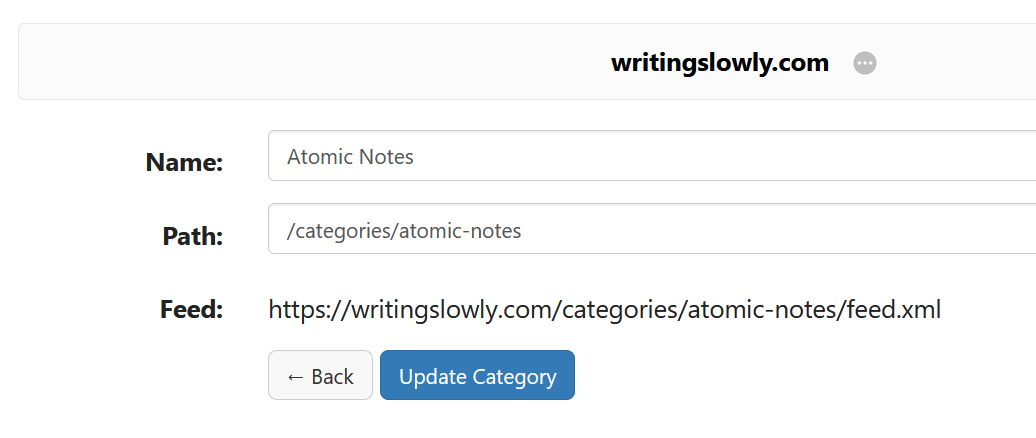
Also, each category gets its own RSS feed, which can be very useful.
This process was much easier than I expected!
More info from elsewhere:
Manton Reece has updated his excellent and inspiring book on Indie Microblogging.
This 1660 description of the Royal Society well describes micro.blog methinks:
💬 “Their first purpose was no more, then onely the satisfaction of breathing a freer air, and of conversing in quiet one with another, without being ingag’d in the passions, and madness of that dismal Age”. The fediverse is an opportunity learned societies can’t ignore
A note on the craft of note-writing
An fairly new article from Brazil caught my eye, on note-writing as an intellectual craft. It highlights the German sociologist Niklas Luhmann’s note-making process (he put his many linked notes in a Zettelkasten - an index box).
Cruz, Robson Nascimento da Cruz, and Junio Rezende. “Note-writing as an intellectual craft: Niklas Luhmann and academic writing as a process.” Pro-Posições 34 (2023).
<doi.org/10.1590/1…>
https://www.scielo.br/j/pp/a/L7gmq6W7bvzgn984hSJ94
Abstract: "Despite numerous indications that academic writing is a means toward intellectual discovery and not just a representation of thought, in Brazil, it is seen more as a product of studies and subjects than an integral part of university education. This article presents note-taking, an apparently simple and supposedly archaic activity, as a way through which academic writing is eminently oriented towards constructing an authorial thought. To this end, we discuss recent findings in the historiography of writing that show note-taking as an essential practice in the development of modern intellectuality. We also present an emblematic case, in the 20th century, of the fruitful use of a note-taking system created by German sociologist Niklas Luhmann. Finally, we point out that the value of note-taking goes beyond mere historical curiosity, constituting an additional tool for a daily life in which satisfaction and a sense of intellectual development are at the center of academic life."
The early morning cloud was lifting over Spectacle Island 📷

Footnotes
Best albums of 2018
Thanks to NPR’s list of great albums of the year, I found Jeremy Dutcher, Wolastoqiyik Lintuwakonawa. Spent a marvellous evening listening to this mesmerising album twice in a row. Since he’s won the Polaris Music Prize probably everyone in Canada already knows about it. If you haven’t heard it you should fix that at the earliest opportunity. 🎵
I had forgotten that posts to my wordpress site only show up on micro.blog if there’s no title.
Let’s see whether this post, written on my new iPad, makes an appearance…
Finally the iPad
Having finally got hold of an iPad, I’m expecting more posts here soon - and by extension on micro.blog