Living questions
Living questions
Instead of chasing after easy answers, the poet Rilke urged a young artist to “live the questions”. Sound advice maybe, but which questions really matter, and how can we go about living them?
“I beg you … to have patience with everything unresolved in your heart and try to love the questions themselves as if they were locked rooms or books written in a very foreign language. Don’t search for the answers, which could not be given to you now, because you would not know how to live them. And the point is, to live everything. Live the questions now, perhaps then, someday far in the future, you will gradually, without even noticing it, live your way into the answer …” – Rainer Maria Rilke
Yes, it’s all very well ‘living the questions’ but which questions are we talking about here? All of them? Some of them? Which ones?
Maybe it’s true you can do anything, but you can’t do everything. And despite what Thomas Edison thought, you can’t be interested in everything either. So what should you focus on?
Developer Allen Pike says you should have a research question. Ok, great, but what should it be?
One possibility is to respond to questions that open up creative possibilities.
- Who do you want to be, and does it resemble who you are?
- When was the last time you were your own best friend?
- What do you unequivocally believe in?
- Who do you wake up for?
- Have you found “it” yet? That something you’re looking for? Do you even know what it is?
- What makes you feel like a child?
- Do you welcome things you don’t understand and give clarity room to grow?
- When are you your “best-self?”
- Can you forgive others–truly? Can you forgive you?
- Whose voice brings you peace?
- Do you like who you’ve become?
- Have you decided what to be when you “grow up?”
- What are you holding onto? Is it time to let it go?
- Whose memory do you hold the tightest?
- Can you give the impossible a try?
- When is enough truly enough?
- Why do you fear what you fear?
- Who makes you feel important?
- What are you sorry for?
- Why do you believe what you believe?
- When is the last time you had a real conversation with God?
- What is your most secret wish?
- Do you wish you had a do-over?
- What do you love about yourself?
- How can you make today less ordinary?
- What is the dictionary definition of you?
- If you were stuck on an island and could bring three books, what would they be?
- Are you living out of desire or circumstance?
- What do you want to change about yourself? What are you waiting for?
- If you could have a conversation with anyone who would you like to talk to?
- Did you wake up thankful?
- When is the last time you took yourself out for a date?
- Who do you love? Do they know?
- (Source: thisquotablelife.wordpress.com)
But such questions, interesting as they are, come from outside. They’re ready-made, not bespoke. Your answers to such questions may be useful but since they are not your own questions, many of the answers may not be all that important to you.
“We cannot live in a world that is not our own, in a world that is interpreted for us by others. An interpreted world is not home. Part of the terror is to take back our own listening, to use our own voice, to see our own light.” –- Elaine Bellezza, on Hildegard of Bingen
So which are your questions? Which are the questions you seek to live, the questions that have the power to shape your life? Which are the questions that only you can ask, that your unique life might be the answer to?
It may feel hard to address these questions head on, because we may feel the lack of answers most keenly. Perhaps an appropriate question is: what are the questions you most need answers to? What questions do you avoid even articulating, for lack of an answer?
It may feel too heavy to consider the questions that really matter. But you already know what interests you, at least to an extent. Living questions may spring from your areas of interest. What activities and ideas and values most engage you?
Here are some prompts from the University of California Berkeley to explore your areas of interest.
- If you could teach courses on any subject, at any level, what subjects would you teach?
- If you had $600,000 to invest in 3 business ventures, what kinds of businesses would you invest in?
- If you were an excellent writer or journalist, what topics would you want to investigate and write about?
- If you could switch jobs with 3 people, what jobs would you select and why?
- What local, societal, or world problems interest you?
- There is a conference focusing on the topics you have always wanted to learn about: they are:
- What classes or subject areas fascinate and absorb you?
- What subjects do you most enjoy reading about?
- What are your favorite hobbies or pastimes?
- What subjects do you enjoy discussing with your friends?
- What did you dream you would be when you were young?
- If you could make money doing whatever you wanted, what would you do?
- If you could intern at any business or organization right now, what would it be?
Source: Planning Your Future: Exploring Your Interests (berkeley.edu) | Know Yourself - Areas of Interest | Career Center (berkeley.edu)
Articulating your own living questions may be a way to ‘find the others’ — other people, that is, who are intrigued by or puzzle over the same questions as you. Asking your questions out loud, in public or semi-public, may be a means to find your people. Conversely, the inability to articulate your own questions amounts to a kind of isolation.
“Loneliness does not come from having no people about one, but from being unable to communicate the things that seem important to oneself, or from holding certain views which others find inadmissible.” — C.G. Jung
Doing things often means doing things with others. Here are some questions to ask yourself.
- Who do you most admire?
- Who do you aspire to be like?
- Who do you like spending time with?
- Who do you like working with?
- Who would your favourite housemate be?
- If you were to make a long journey, who would you choose to travel with you?
For questions to live, they need to be articulated, therefore you need to write them down.
Uncertainty and diffidence are on your side, because like many living things, questions grow gradually from seed to maturity. The tiny germ of an idea written down is worth far more than a complete thought that remains locked in your head. The former can grow and flourish, while the latter is root bound and in danger of withering before anyone can admire it.
The American physicist Richard Feynman pointed out that writing and thinking are not separate. In his experience, writing is thinking.
Similarly, German sociologist Niklas Luhmann claimed you cannot think without writing - at least not systematically.
“Behind the Zettelkasten technique stands the experience: You can’t think without writing - at least not in a sophisticated way, selective access to memory in demanding contexts. This also means: without marking differences, one cannot think.” — ZK II: Zettel 9/8g - Niklas Luhmann-Archiv.
Living questions amount to a personal research programme, an agenda for thought and action.
“Richard Feynman1 was fond of giving the following advice on how to be a genius. You have to keep a dozen of your favorite problems constantly present in your mind, although by and large they will lay in a dormant state. Every time you hear or read a new trick or a new result, test it against each of your twelve problems to see whether it helps. Every once in a while there will be a hit, and people will say, ‘How did he do it? He must be a genius!’”― Gian-Carlo Rota, Indiscrete Thoughts.
Living questions can arise organically - there is no need to force them. Living questions are not what you think you should focus on, but what you actually do focus on. They are the questions and themes you find yourself returning to.
Living questions can arise organically from a process of writing notes without hierarchy. The Zettelkasten approach to notetaking can aid this organic discovery of key questions. A Zettelkasten helps you write ‘from the bottom up’ instead of ‘from the top down’. Without any predetermined categories you take short notes and link them. At first everything seems random and scattered, but over time themes emerge by themselves, and because the notes are linked you can identify clusters of interest. This way, from fragments you can build a greater whole.
Of his own Zettelkasten, Luhmann said:
“Much peters out, many notes one will never ever see again. On the other hand there are preferred centres, where lumps grow and areas with which one works more often than others. There are large projected idea-complexes that were never executed and there are asides that keep enriching and inflating themselves; that, while located at subordinate text passages, more and more tend to dominate the system.” — Johannes Schmidt: The Zettelkasten as the second brain of Niklas Luhmann. YouTube Lecture (28:36) | Translation Transcript
He also said: “The order adapts to the development of the thinking.”
Although I’ve assumed that living questions need to be articulated in words, the starting point might be non-verbal. It might instead be visual. For example, instead of writing down your questions and desires, you could instead map your desire lines. Visakan Veerasamy says “The paths you take when you’re following your desires will reveal things to you”. And the historian Franco Moretti writes:
“A good map is worth a thousand words, cartographers say, and they are right: because it produces a thousand words: it raises doubts, ideas. It poses new questions, and forces you to look for new answers.” — Atlas of the European Novel (Source).
Living questions are not set in stone. The mathematician Richard Hamming recommended changing research areas every seven years so as to avoid becoming stuck in a self-created rut.
In fact it may make sense to think of your wider life — not just your research — in chunks of roughly seven years.
Think Of Your Life In Chunks | Dr. Ian O’Byrne.
It has often been said that while we tend to overestimate what we can achieve in one year, we underestimate what’s possible in ten.
Our path through a period of seven years to a decade may take one of several shapes. There isn’t just a single possible path.
The educationalist Bryan Mathers thinks about ‘pathways’ through learning processes. He uses the metaphors of stepping stones, collections and constellations.
- Stepping stones are sequential and prescriptive.
- A collection is prescriptive but non-linear.
- A constellation is non-linear and descriptive.
These are different but equally valid ways of making a meaningful path through a series of locations or mileposts.
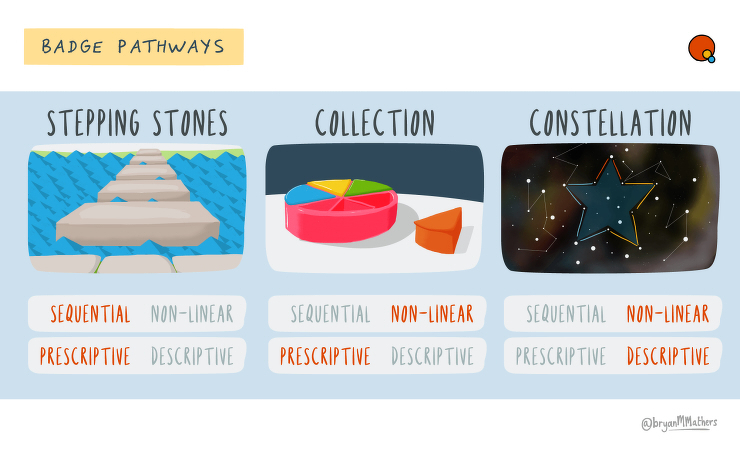
Image Credit: Pathways by Visual Thinkery is licensed under CC-BY-ND.
Some examples of living questions mapped
Each of Emmanuel’s questions has its own web page (Title, Question I return to, I’m curious about, I want to, Establishing quotation, Overview, Stories, Request to send leads and resources). I really like this little framework.
Psychologist Ayelet Fishbach lists her research interests in six areas: Self-control, intrinsic motivation, social connection, feedback, patience, healthy lifestyle.
Her overall approach is introduced with a quote from a profile article: “What unites Fishbach’s research is a kind of hopefulness. Her work shows how we can live up to our highest aspirations.”
Each area is described in a sentence or two and then a statement starting with “My research explores…” followed by three featured articles.
Tom Critchlow’s map of inquiry
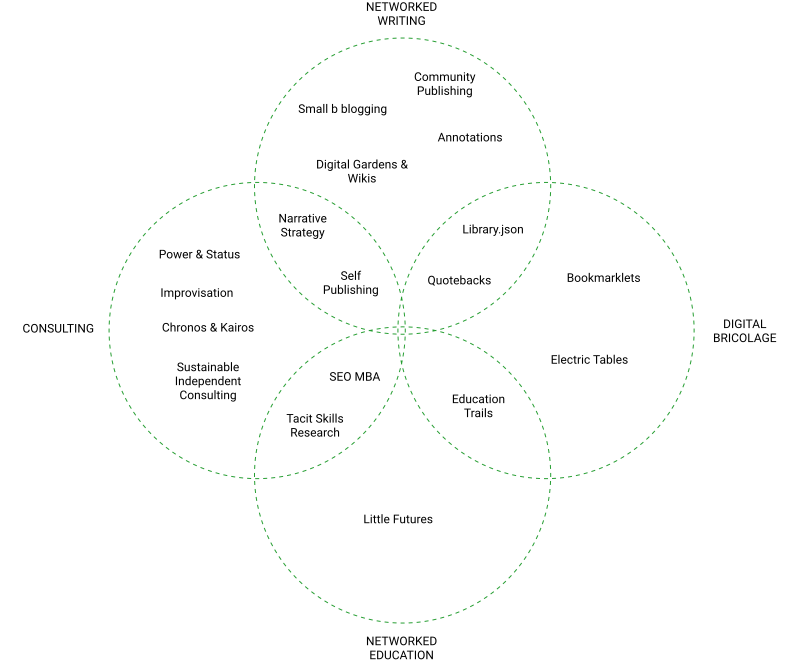
A clickable map of four overlapping subject areas, linking to web pages for each of 18 projects. Anyway, it used to be clickable, which was cool.
The co-founder of Stripe lists 23 interesting questions, similar to lists by bloggers Alexey Guzey and Gwern.
Summary
All this talk about ’living the questions’ can be simplified and summarised. It really adds up to what another poet, Mary Oliver called ‘Instructions for living a life’:
“Pay attention.
Be astonished.
Tell about it.”
Well, I’ve been accumulating notes on ‘living questions’ for quite a while now, and I realised it was about time to pull them together and indeed to tell about it. I hope you find at least some of this useful. And if you have your own set of living questions you’d like to share, I’d love to hear about it.
I’m the author of Shu Ha Ri: The Japanese Way of Learning, for Artists and Fighters.
To receive a weekly email digest of all the posts here and nothing else, you can easily subscribe.
-
I’ve argued elsewhere that whether or not it was Richard Feynman, for which I’ve found no evidence, it was certainly Richard Hamming. Two Richards, both involved with mathematics, both of whom worked on the Manhattan project. But only Richard Hamming presented ‘You and your Research’: “Most great people also have 10 to 20 problems they regard as basic and of great importance, and which they currently do not know how to solve. They keep them in their mind, hoping to get a clue as to how to solve them. When a clue does appear they generally drop other things and get to work immediately on the important problem. Therefore they tend to come in first, and the others who come in later are soon forgotten. I must warn you, however, that the importance of the result is not the measure of the importance of the problem. The three problems in physics—anti-gravity, teleportation, and time travel—are seldom worked on because we have so few clues as to how to start. A problem is important partly because there is a possible attack on it and not just because of its inherent importance.” ↩︎