Atomic notes have a long history
Did previous generations ever think much about atomicity of ideas in their notes? After all, if most people were using notebooks, surely they didn’t need to consider how long their notes should be – they could just keep writing till they were done.
It seems thinking about atomicity was a major element (pun intended) of mathematics and philosophy at the start of the 20th century. Bertrand Russell’s ’logical atomism’ was very influential. Russell said:
“you can get down in theory, if not in practice, to ultimate simples, out of which the world is built, and that those simples have a kind of reality not belonging to anything else” (‘The Philosophy of Logical Atomism’ 1918: 270).
A similar positivism (where the universe is made of discrete entities rather than one great holism) was a major feature of the efforts to catalogue the world’s knowledge centered on Paul Otlet’s ‘Mundaneum’ into the 1930s.
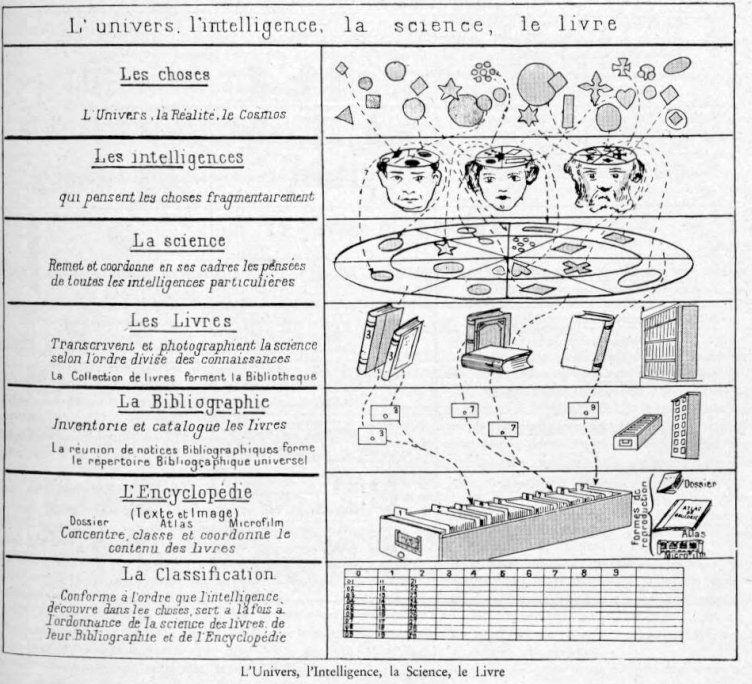
Otlet inspired the ‘documentalists’ to reformulate information science in the post-war period, including Vannevar Bush, the originator of the ‘Memex’, which was a precursor to the desktop computer.
Douglas Engelbart further pioneered the way we now use computers. In his paper on augmenting human intellect (1962) he referred to his notes on edge-notched cards as ’thought kernels’, ‘concept packets’ and ‘kernel statements (cards)’ but the established concept behind this was the ‘unit record system’. This had originated in 1888 when H.E. Davidson of Melvil Dewey’s Library Bureau realised he could sell catalogue cards and shelving to commercial businesses to improve their record keeping, previously constrained in ledger books. Engelbart said:
“Mainly what is new is the use of the smaller units of information in restricted-subject sets (notedecks) so that I gain considerable flexibility in the manipulations of my thought products at the level at which I actually work in my minute-by-minute struggle with analytical and formulative thought. Not only do my own thoughts produce results in this fashion but when I digest the writings of another person I find generally anyway that I have extracted from his structure and integrated into my own a specific selection of facts, considerations, ideas etc. Often these different extracted items fit into different places in my structure or become encased in special substructures as I modify or expand his concepts. Extracting such items or kernels and putting each on its own notecard helps this process considerably–the role or position of each such item in the growth of the note structure is independent, and yet if desired all can quickly be isolated and extracted…” (Engelbart, 1962: 57)
The features Engelbart found he couldn’t get from his use of cards – that was precisely what he set out to obtain by means of the digital computer.
Anyway, this is a long-winded way of saying earlier generations thought a lot about atomicity – more even than I had realised!
Now read: The shortest writing session that could possibly be useful
Note: This post started life on Reddit
I’m the author of Shu Ha Ri: The Japanese Way of Learning, for Artists and Fighters, available now.
And if you found this article interesting you might like to sign up to the Writing Slowly weekly email digest. You’ll receive all the week’s posts in a handy email format which masks how they were all created one by one like little atoms.