
📷 Micro.blog March photo challenge, day 13: “connection”
At work I’m into connecting people and places. A project I’m proud of is the Greater Sydney Green Grid.

📷 Micro.blog March photo challenge, day 12: “shiny”
It’s often very bright at my local surf beach. Sometimes makes me think I’m not wearing sunglasses.

📷 Micro.blog March photo challenge, day 11: “gimcrack”
The very opposite of gimcrack: a Genroku (1688-1704) period plate from Kyushu Japan, displayed in the National Gallery of Victoria, in Melbourne. I spotted six birds hiding in this design. Are there any more?

📷 Micro.blog March photo challenge, day 10: “ritual”
My daughter goes surfing almost every day. She’s gradually accumulating more boards.

📷 Micro.blog March photo challenge, day 9: “together”
Spotted during my regular bike ride: birds of a feather.

Micro.blog March Photo Challenge Week 2 Preview
Just thought I’d provide a preview1 of week 2 of the photoblog challenge.
Week 2 prompts: 🗓
- March 8: walk ([@lwdupont](https://micro.blog/lwdupont))
- March 9: together ([@sherif](https://micro.blog/sherif))
- March 10: ritual ([@drewbelf](https://micro.blog/drewbelf))
- March 11: gimcrack ([@jafish](https://micro.blog/jafish))
- March 12: shiny ([@odd](https://micro.blog/odd))
- March 13: connection ([@agilelisa](https://micro.blog/agilelisa))
- March 14: horizon ([@crossingthethreshold](https://micro.blog/crossingthethreshold))
We can use a few more suggestions! 💡 Email 1-3 to jean@micro.blog.
-
OK, day 8 has already been posted. ↩︎

📷 Micro.blog March photo challenge, day 7: ‘Whole’
The leaves of my Swiss cheese plant, Monstera deliciosa, are whole, holes and all. Makes me wonder if this is factored in when we talk about becoming a whole person.

📷 Micro.blog March Photo Challenge, day 6 “Engineering”.
This time last year we were enjoying the Adelaide Fringe Festival, the Writers Festival and the wonderful Botanic Gardens. Maybe next year we’ll get there again 🤞

You don't build art, you grow it
Finished reading: Dancing with the Gods by Kent Nerburn 📚
This book is advice on the artistic life from an experienced sculptor and writer. I found one section particularly striking. It contrasted two approaches to making art: that of the architect and that of the gardener.
“The architect designs and builds; he [sic] knows the desired outcome before he begins. The gardener plants and cultivates, trusting the sun and weather and the vagaries of change to bring forth a bloom. As artists we must learn to be gardeners, not architects. We must seek to cultivate our art, not construct it, giving up our preconceptions and presuppositions to embrace accident and mystery. Let moments of darkness become the seedbed of growth, not occasions of fear.”
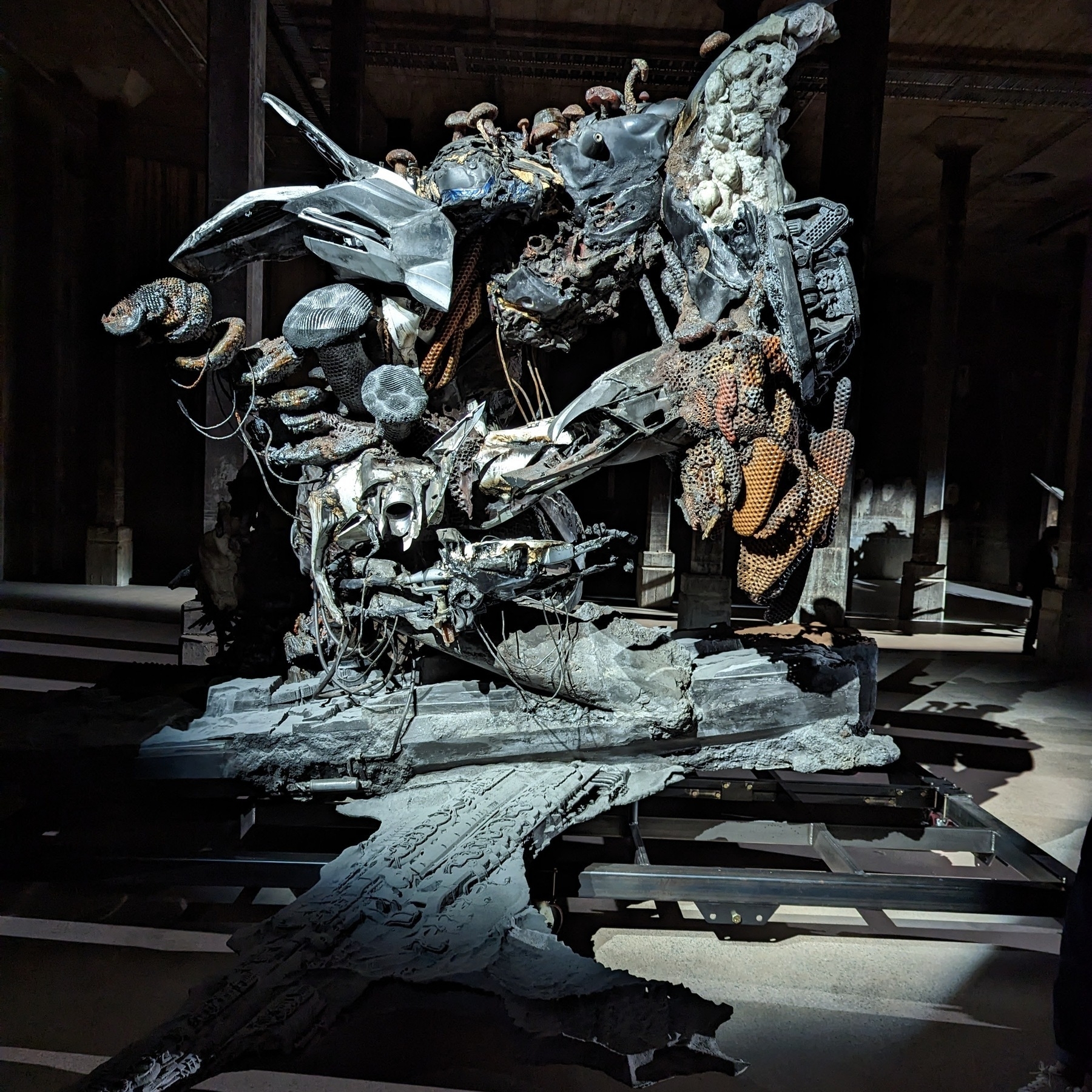
I remembered these words while visiting the new exhibition spaces at the Art Gallery of New South Wales in Sydney. It’s hard to imagine an artwork that could have more clearly illustrated the cultivation approach to art that Nerburn wrote of.
In a huge, mysterious, and very dark underground space called The Tank, Argentinian sculptor Adrián Villar Rojas was exhibiting a series of extraordinary sculptures entitled The End of Imagination. These pieces, apparently four years in the making, seemed really ancient, but of the deep future, organic, not constructed, more biological than artificial, and they appeared to be growing there in the darkness.
Rojas undertook an exhaustive computer simulation of deep-time environmental processes in imagined extraterrestrial contexts, to shape and weather each piece, prior to creating their physical representation. So the outcome was not so much sculpted as weathered and sedimented into existence - yet not by any kind of earthly processes.
Earlier thoughts on Dancing with the Gods.